
Yuri Dzivielevski recently posted a video on YouTube.
This is a man who has risen to the top of the Brazil All Time Money List. He has $15,000,000 in live earnings, has founded the RegLife training school, and made over $5,000,000 from WSOP and PGT events this year.
Even someone at this level, the highest level, apparently thinks that Triton tours are not a good idea.
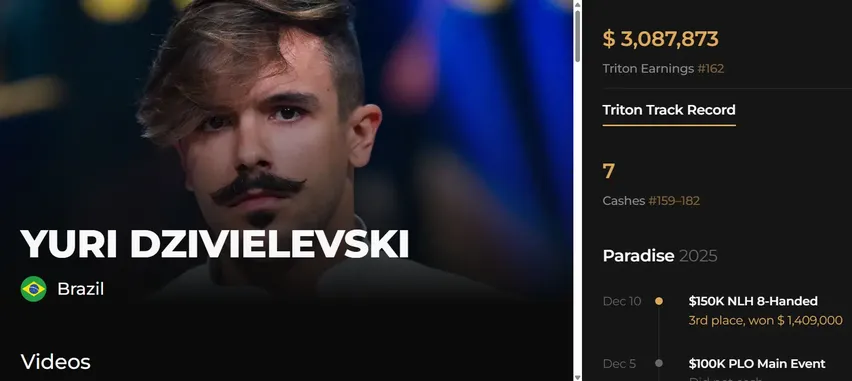
We've translated his words into English, trying to be as faithful to the original as possible.
Man, I'm exhausted today. I went to bed super late, at 2 AM, but that's a good sign. When you go to bed that late on a Sunday, it's because the session went well.
I ended up winning a pretty big tournament on a website that isn't tracked by SharkScope or anything, a website that only operates here in the United States called Club WPT Gold. I ended up winning a big tournament there, and it was the last tournament of the session. I like it when it works out like that, because it always reminds me of something I've been saying forever.
In a tournament session, you only need one tournament to go well for the whole session to be good. So the focus has to be on staying concentrated from beginning to end, because that last tournament you registered for could be the deciding factor. And yesterday was exactly like that.
Why Yuri Won't Play Triton Again
The most straightforward reason I can give you as to why I'm not going to the Tritons is because I don't have the money. That's the truth. I don't have enough money to play in those tournaments comfortably.
And if I'm only going to be able to play a small fraction of the action, it's not worth it. There are all the travel costs to consider, and we also have to understand the opportunity cost. If I stay home playing the games I play today, besides the comfort, I'll be able to make more money.

I want to help you understand this concept by doing the math together, because I believe many players make big mistakes in terms of bankroll management in poker. As I always say, poker isn't just a sport or a competition. It is, much more than anything else, the allocation of capital under uncertainty.
When we talk about capital allocation, it's pure mathematics. So there's no room for guesswork. What I'm going to say here isn't my opinion, it's mathematics. It's the same as me saying 2 + 2 = 4 and someone replying, "Yuri, I don't agree, sometimes it's five." That doesn't work.
I used some information from Triton to do these calculations. I don't know if you saw it, but a website published how much each player is winning and how many entries they've made.
Based on that, I'm going to calculate how much a player can expect to earn inside one of the Tritons, and I made three different player profiles.
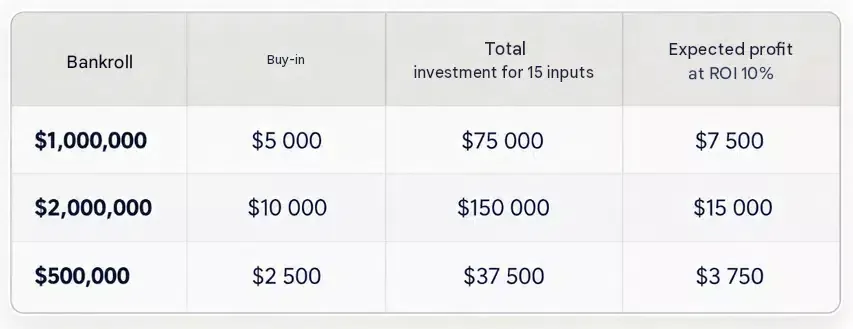
Example 1: The first has a $1 million bankroll and wants to play the Tritons. That means $1 million saved purely for poker, not mixed with personal money.
Example 2: Example two is a guy with a $2 million bankroll.
Example 3: The third one, let's call him the delusional one, is the guy with a $500K bankroll.
Okay, so the first thing we need to understand is, for someone with a $1 million bankroll, what fraction of that million should they ideally invest in any single tournament?
Remember that when we think about bankroll management, we're looking at the maximum single bet we can make relative to our total bankroll, not the average bet. So, when you have $1 million in your poker bankroll, you have to think about your average buy-in, or more importantly, the most expensive tournaments you're going to play.
The formula used is the Kelly Criterion. It's generally adapted for poker, and it's a mathematical formula originally created for sports betting. This formula calculates the maximum amount you can bet on a single wager relative to your total bankroll.
What About a $1,000,000 Bankroll?
A guy with a $1 million bankroll, if the tournaments have 128 players and he has a 10% ROI, which is the return on investment at Triton, could play at a certain level. Using the Kelly Criterion on the more aggressive end, and pulling back to a more conservative range that I would actually advise, here's what that looks like.
Playing in $2.5K tournaments with 128 players gives a 10% ROI. The bigger the field, the less you should invest. So, with 256 players you could play in a $1.8K tournament. I think the $10K and $20K Triton events get around 200 players in the most popular venues, if I'm not mistaken. And with 128 players, he could play in a $500 tournament.
If you're being super aggressive, you could double those numbers, so around $5K for 128 players and $3,600 for 256 players. Now, going back to those formulas, which you can find anywhere online, think about it. You're playing in a tournament against the best players in the world, in a structure that isn't very favorable, and you're expecting to have a 10% ROI.
That means you'd have to be better than, I don't know, Stephen Chidwick, for example, and I don't even think he has a 10% ROI there. And you'd need around 200 buy-ins in your bankroll, which is already being very aggressive. I would never recommend playing with that kind of bankroll management.
Let's Crunch the Numbers
I used 15 entries to do this calculation. So if you stop to think about the investment, let's put an average of $3K per tournament. You're going to invest $3K and play 15 tournaments with a 10% ROI. That means you're going to earn from a Triton trip around $4,500.
Now let's look at a more aggressive strategy, with 200 buy-ins:
And how much does a ticket cost to go to a Triton? Let's say around $2,000 for a regular economy ticket. Then there's food. I'm not even going to count the hotel, because if you spend more than $100K they give you the hotel for free, or at least they used to. So here's the EV of that scenario.
Let's suppose that same guy has a million in his bankroll and he plays online about four times a week. Don't you think he can invest around $40K per week? If he manages to invest around $40K with a 10% ROI in a week, he'll make $4,000. In two weeks he'll be making $8,000, which is already more than he would earn at the Triton, and that's not counting the cost of the flight. Of course there's food too, but he has to pay for food every day anyway.
So you see, the guy with a million in his bankroll staying home and playing tournaments at $300 to $400 buy-ins, if he's really good at that, will earn much more than by going to the Triton.
What Bankroll Do You Need for $25,000 and $50,000 Tournaments?
But Yuri, does that mean it's never worth going to the Triton? It's worth it when you actually have the money to buy your full stake, even for $50K tournaments. But for that, using the conservative formula of 200 buy-ins, you would need $10 million in your bankroll just to play up to $50K tournaments. And I would never recommend using just 200 buy-ins for tournaments this difficult.
Let's say we're going to use more conservative bankroll management of 400 buy-ins, which is what I would actually recommend, especially for high-variance tournaments like these.
To play up to $50K events with 400 buy-ins, you would need $20 million in your bankroll. And at the same time, you would have to be very, very good at poker.
Read ReadWhat Else to Do with a Large Bankroll?
Wouldn't you earn more by doing something else? Like setting aside a smaller portion for poker, say $5 million of those $20 million, and putting the other $15 million into financial markets or other investments? At a certain point, you need so much capital to play Tritons that it stops being worth it. You have $20 million sitting essentially idle as a poker bankroll for maybe three or four Tritons a year.
So the math works out like this: keep $1 million as your poker bankroll, invest the other $19 million, and you're generating income from $19 million plus whatever your $1 million poker bankroll produces. That's if you even want to continue as a professional player. Of course, sometimes it's about passion for the game, and life isn't only about money. But that's the reality.
And if you want to play Tritons and travel constantly, it's very exhausting. You mess up your time zone, your routine, and everything else, and you're far from your family.

If you're single and don't care about any of that, then go for it. But it's extremely hard to build a $20 million poker bankroll in the first place.
Honestly, I barely know any players who have made a profit their entire careers. I know very few. And those guys who have made $10 million in lifetime winnings don't actually have $10 million in the bank, because they didn't save everything. They gambled a good portion away, bought a house, and various other things, and they might have a few million sitting around, but nowhere close to $10 million.
How Variance Hits Players – Even the Best of the Best
If I had that $20 million bankroll, would I play the Tritons? Eventually, yes. I really enjoy that kind of challenge and those trips are genuinely cool.
But let's look at what the numbers actually show. Take Ike Haxton, who for me is one of the best players in the world, and not just for me. He has 434 entries in Triton over not even 10 years, starting in 2017, so about 9 years, and he has lost $7.7 million over that time.
He is without question one of the best players in the field. His average buy-in is around $70,000, and $70,000 over 434 entries means he has run at minus 100 buy-ins. Everyone has had a bad 100 buy-in stretch playing much easier tournaments than this. He may well be the unluckiest of all of them, because he's definitely one of the best, and he's in a massive downswing. But 400 tournaments is a literally ridiculous sample size in this context.

He's one of the few people who actually can sustain this, and for him it makes more sense to participate in Triton. And here's something you might not know. He buys shares in many Triton players. He has significant capital, I don't know if it all came from poker or crypto, but he's one of the biggest investors in poker. That's already public knowledge.
So he definitely hasn't actually lost those $7 million net, because he has pieces of other players, including some of the biggest winners there.
But the main thing I want you to see is how real the variance is. Another well-known player who has won multiple Triton events and was even Triton Player of the Year has lost $6 million in Triton results.
- Artur Martirosyan, 325 entries, minus $6 million.
- Chris Brewer, another excellent player, minus $5.4 million in 223 entries.
- Juan Pardo, another guy who is genuinely one of the best in the world, 111 entries, losing $4.5 million.
And all of this is completely normal. It doesn't mean any of these guys are bad players.
Think about it honestly. Take Juan Pardo as an example. Incredible player. But is it really worth it for him to be there, in purely financial terms? If the guy has other reasons for being there, like the challenge or the competitive experience, that's a completely different story. But financially, I'm pretty sure it isn't worth it.
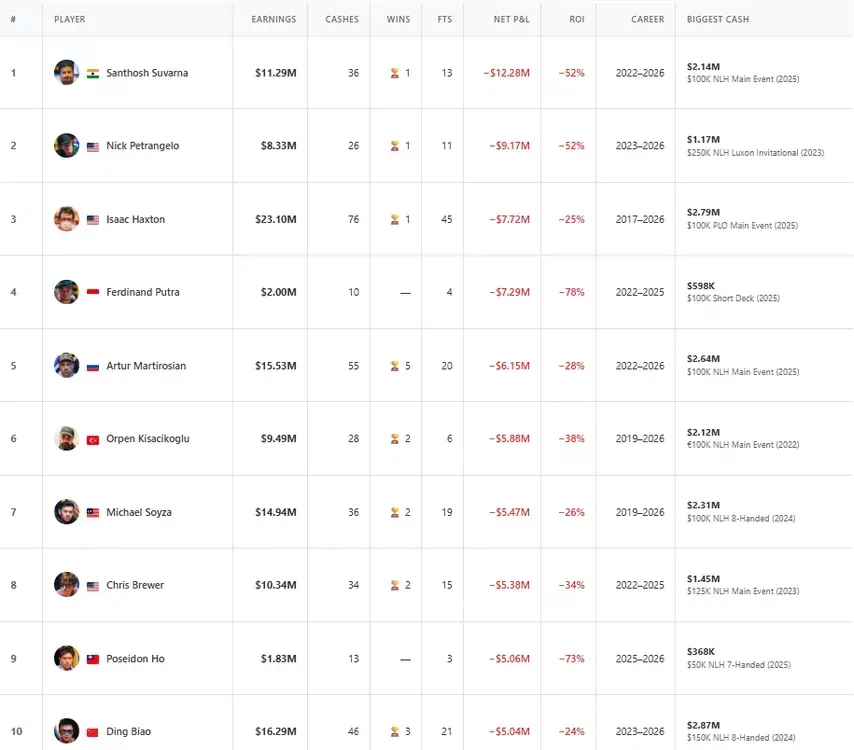 These figures don't include the final stage of Triton. Petrangelo improved his situation somewhat.
This is what I'm trying to open your eyes to when it comes to bankroll management, because it's very easy to get carried away in poker. Imagine you're playing low micro stakes, grinding with your team, and there's a BSOP Millions or some similar event coming up and you really want to play it. You're playing $30 buy-ins online, grinding hard to beat that level, dealing with big downswings, running at 10 to 15% ROI at that buy-in. And then a BSOP Millions comes around and you want to go play the $500 main event, something that's 15 times your average buy-in, with high rake on top of that.
Some live fields, like the WSOP, can be fantastic in terms of field quality. But everything has its time. If you want to go to the BSOP to see your friends, have fun, and network, that's perfectly fine. That's a different kind of trip with a different purpose. But don't fool yourself into thinking these live tours are going to be what build your career or give you financial stability.
Read Read