
Original 2+2 Forum Link: https://forumserver.twoplustwo.com/28/discussion-poker-sites/qqpk-rigged-rng-amp-bots-game-integrity-investigation-1864932/
After analyzing 26 million hands played in 27,936 tournaments with buy-ins ranging from $0 to $525 between July 2 and October 2, the authors of the investigation found nearly 6,000 suspicious accounts, of which 2,587 were deemed bots with a near-100% probability.
33,958 exact flop/turn calculations: approximately 19,006 bb above expectation.
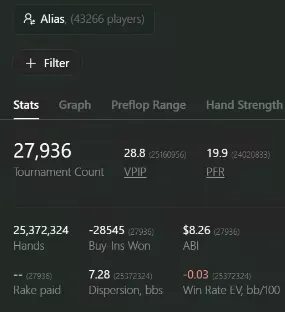
All of the "suspects" had similar stats and playing patterns:
- Always even 3-bet sizings
- 100% limp-3-bet frequency with a certain range
- Many other coincidences and matching styles
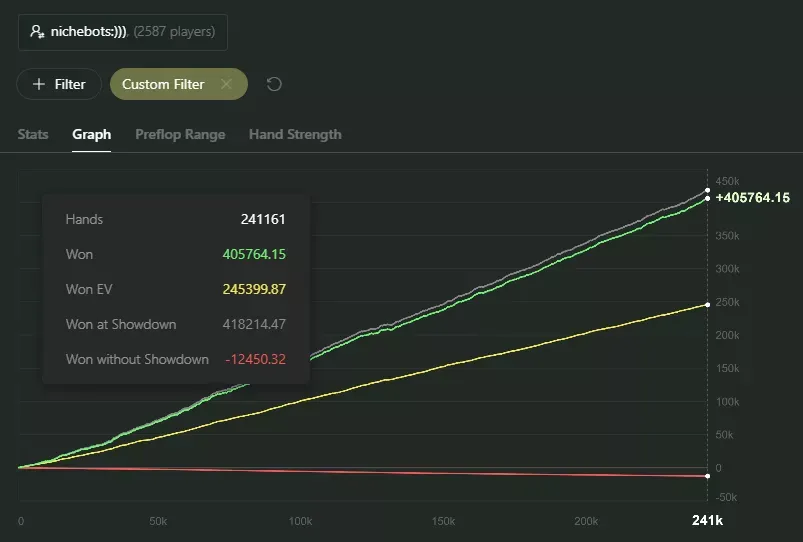
But the biggest suspicions and concerns were raised by the incredible all-in counts of these accounts—138,705bb in 193,757 hands. Only the alleged bots' all-ins against regular players were counted.
Bots vs. Humans Graph:
Human vs. Bot Graph:
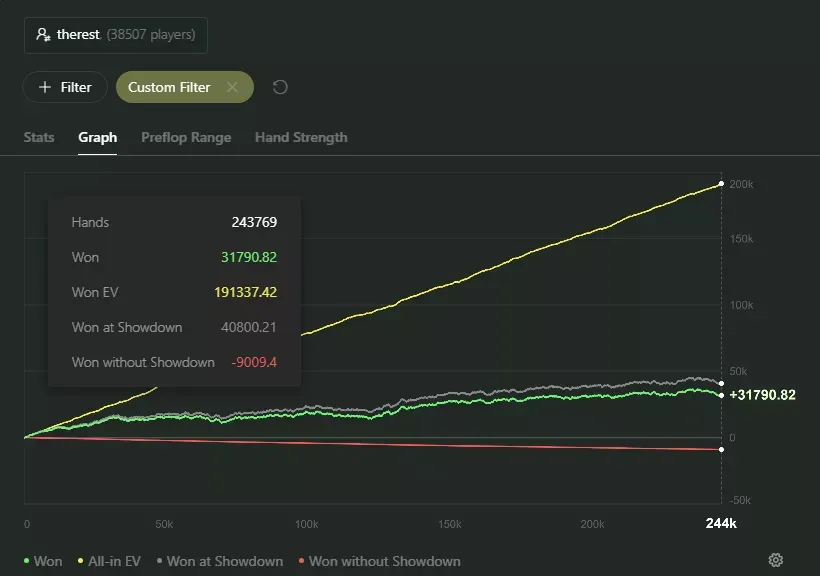
Almost all of their EV was earned when the "bots" were underdogs

Some characteristics of suspicious accounts:
- Underdogs won 67,024bb when they called their opponent's bet.
- Underdogs won 34,332bb when their opponent called their bet.
- The most profitable combinations are AK/AQ (28,677 bb), the rest are Ax (38,905), and broadways without aces (30,755 bb).
- Almost all of the busts were earned in pots from 20 to 200 bb.
- In pots <20 bb (46,395 hands), the bots lost 936 bb.
- In pots 20-50 bb (94,323) they won 35,765 bb.
- In pots 50-100 bb (43,574) they won 68,240 bb.
- In pots 100-200 bb (8,987) they won 35,739 bb.
9,726 tournaments were analyzed. The 10 most profitable tournaments for suspicious accounts accounted for only 4% of the overall difference between expected and actual wins.
The EV was observed when placing bets on all streets, not just preflop.

Bot Detection Methods
All 2,587 accounts almost always limped the top 2% of hands if there was no action before them. If an opponent raised, they always limp 3-bet and were willing to go for stacks regardless of the action or position (except in hands from the blinds).
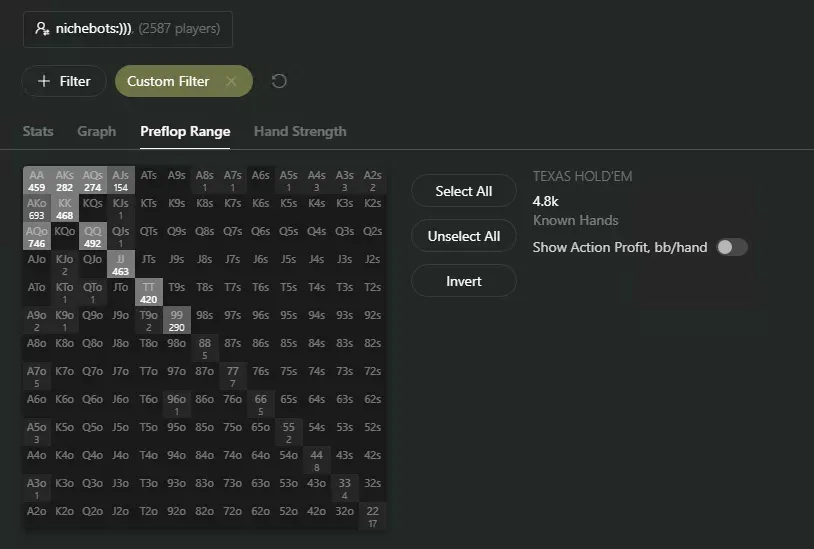
Statistical features of bots:
- VPIP: 30-34, PRF 20-23, 3bet 11-15,
- 3-bet sizing: 6bb, 8bb, 11bb – always an even value.
- High 4-bet percentage.
- High level of delayed aggression.
- Passive strategy against the second barrel.
- High percentage of check-raise on the flop.
- Even flop continuation bet sizings (2bb or 3bb bets were used at any SPR, even if this resulted in an unusual sizing relative to the pot, such as 57%).
Almost all accounts appeared at the same time (spring 2026) and played a similar load within their ABI (all accounts can be divided into three groups by buy-ins – $20, $9 and $2).
Link to a detailed investigation:
https://docs.google.com/document/d/1Oird7SRyyT-gKGl3U388YSLecNwMQrQSCkmUGhKgBNE/edit?tab=t.0
A QQPK representative promised that the room would conduct its own investigation and publish the results in a couple of days.
"The main question here is not bot ring exposed but a question of games are fair," wrote Yegor on 2+2. "I don't want to make any accusations in this post, I just want to highlight separate issues, not addressed by this room. the ev graph clearly shows that games may not be random. one possible explanation is teamplay by bots, which is particularly common in plo4-5 games where more cards can be shared and hence the account that goes all in knows dead cards that are still included in EV calculation. The other explanation is 2 particular mechanics QQPK implements.
But first i want to clarify how rng certification works, because there may be some confusion. I run my own poker app that has certified RNG, so let me explain how certification process goes. you need to give exact code and algorithms for the rng and deck shuffling to the certifier (there are 3 main companies that issue rng certificates, process is similar). They examine it, mainly its source of entropy and statistical properties of millions and millions of shuffled decks. Then you need to show that this exact code is actually deployed on your servers – they ask you to share screen and show this exact code on the server and how it compiles deploys. so the rng certification only means that the app does have fair rng and deck shuffling code somewhere on the server, it does not guarantee it's the only mechanism or even if that mechanism is used at all.
QQpoker advertises its verification mechanism, which works as follows: there are 2 endpoints on their backend, first returns encrypted shuffled deck and cut cards positions at the beginning of each hand, 2nd endpoint returns keys to decrypt this data. for normal users 2nd endpoint returns empty keys during the hand and returns some of the keys (ie if a hand ended on the flop one can decode only flop cards). this was meant to prove that deck wasn't altered during the hand. in theory, it's possible to decrypt to a different card, ie client received a string at the beginning of a hand which can be decrypted as "2 of diamonds" with key A or "Ace of spades" with key B. but the string contains some state data so in practice server can't find key B to send to clients in any reasonable time, so mechanism does look legit. but most poker apps simply don't have the object "shuffled deck" at the beginning of a hand in the first place – they only store seed and generate object "flop" or "turn" or "river" at the time when it's dealt.
but in current implementation privileged users may receive secret keys before the hand ends, decrypt entire deck and essentially see the outcome and make a decision to go all in only if they win at showdown. that doesn't mean RNG is unfair – it just means some users may potentially see the future outcome ahead of timeanother mechanism is a secret menu in client code that exposes "manual deal", it can be enabled in standard client under certain conditions(that are never triggered in normal game flow). here's how it looks:"
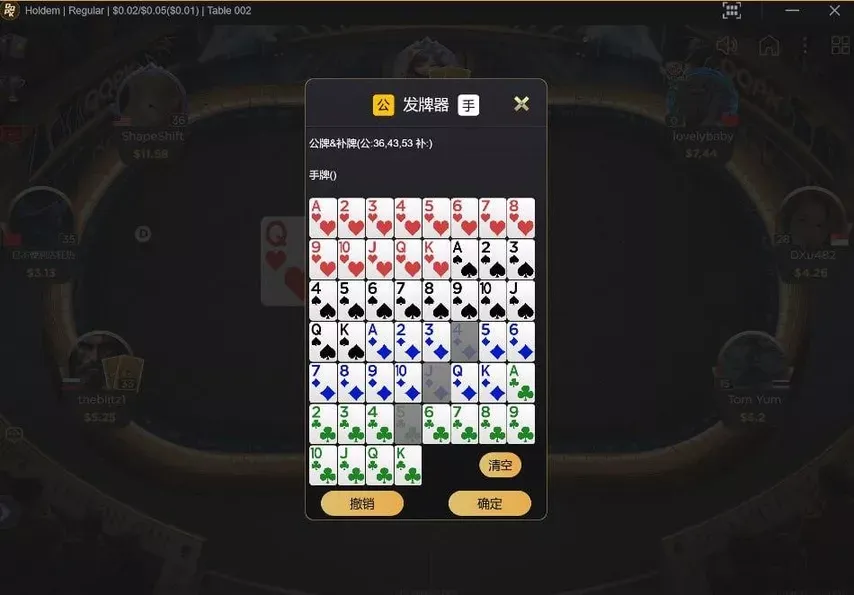
"发牌器 means "manual deal". the source code contains comments in chinese explaining the mechanism: in 公 mode first 5 cards become board cards, next cards are dealCountCards; in 手 mode cards are grouped by players: 2 for holdem and 4 for plo.
This may have been a dev feature for some tests, though it doesn't make much sense. we simply didn't have anything like that in our app and i don't see how it can "test" something. but their production (not test) endpoint that is connected to this interface was live when i tested it and returned "unauthorized". that means some privileged users may have access to this feature. So if manual deal is enabled in some cases, then RNG is no longer random, and technically that does void the RNG certificate."
On October 13th, QQPK tweeted about the incident, confirmed that 724 accounts were involved in "unauthorized automated play and serious violations of the Terms of Service." All of them were banned.
Questions about RNGs, anomalous all-in results, and two thousand other suspicious accounts went unanswered.
After a barrage of criticism in the comments, QQPK posted a new message, saying a "detailed report will be released soon."
The QQPK Risk Control Team replied in 2+2 on the 15th of October. They guaranteed $300,000 would be returned to the player pool, said they would establish an Integrity Bounty Program,
They also announced that the main cause of cheating was actually card sharing.
Cheating Mechanism: Real-Time Card Sharing
The platform had never encountered a card-sharing (collusion) cheating pattern on such a massive scale, resulting in a delayed response from our existing risk control mechanisms. Combining deep reviews of network logs, hardware characteristics, and millions of decision trees, the QQPK Risk Control Team officially categorizes the abuse:
1. Collusion & Card Sharing: The investigation confirmed this syndicate operated via coordinated collective control. They shared real-time hole-card information across mutual tables, utilizing multiple dead card (blockers) advantages to make highly precise, abnormal preflop folding and betting decisions.
2. Mathematical Cause of the High EV: The extreme All-in EV deviation is the direct result of this collusive playstyle:
- Blocker Filtering Effect: Through card sharing, the syndicate accounts knew the distribution of a large volume of dead cards. Before committing all-in, they artificially filtered out dominated equity spots, acquiring an additional decision advantage through unfair intelligence; conversely, when their equity dropped due to blockers held by accomplices, they executed abnormal early folds.
- Over a long period, this unnatural "precision screening of high-win-rate all-in scenarios" directly caused the abnormally high EV metrics observed in the statistics.
The QQPK room has been in existence since 2024, actively promotes itself in live series, and is an official partner of the Triton series. The first tournament of the upcoming Triton One series, which begins on November 5 in Northern Cyprus, will be held under the auspices of QQPK.
The room's ambassadors are leading Asian players: Punnat Punsri (Thailand), Danny Tang (Hong Kong) and Webster Lim (Malaysia).