Now, on July 1st, it’s changed to “Over $7M in CoinRewards each month.”
We’ve done the complex math already. That’s over a million dollars more a month, or $250,000 a week.
The main thing that changes with CoinPoker’s rewards after July 1st is the removal of 15% rakeback. The site says that they’ve funneled those rewards into other areas (which we confirmed in our test).
The reinvestment of 100% of micro-stakes rake back into the micro-stakes player pool also continues.
Let’s look at each of the four reward mechanisms on CoinPoker and do some analysis.
We've also updated this as of July 30th, a month after the CoinReward changes.
Before We Get Into the Numbers, Know This
Everything below is what CoinPoker pays every player, no matter how they signed up.
Registering through GipsyTeam adds a second layer on top of it: our own monthly rake race with its own prize pool, an increased rakeback rate for our players beyond the room's standard terms, and access to some future promotions we negotiate directly with the room and run only for our players.
The CoinRaces, Missions and Splash Pots you're about to read about work exactly the same — the difference is what lands in your balance on top of them. You'll also get help with deposits, withdrawals and any account issues, in your language, from people who play here themselves.
CoinRaces: Cash Game Leaderboards
CoinPoker’s cash game leaderboards are called CoinRaces. They pay $1,200,000 a week now, up from $1,000,000 before July 1st.
Here's a little breakdown for anyone unfamiliar:
Formats: Texas Hold’em and Pot Limit Omaha (PLO, PLO5, PLO6) on separate leaderboards.
Leaderboard Time Before Reset: One hour at micro-stakes, two hours up to $25/$50.
Prize Payout Time: Almost instantly to each player’s balance as the leaderboard resets.
Prize Calculation: Based proportionally on rake. For example, if you rake 5% of the total rake at a certain leaderboard level, you collect 5% of the prize pool.
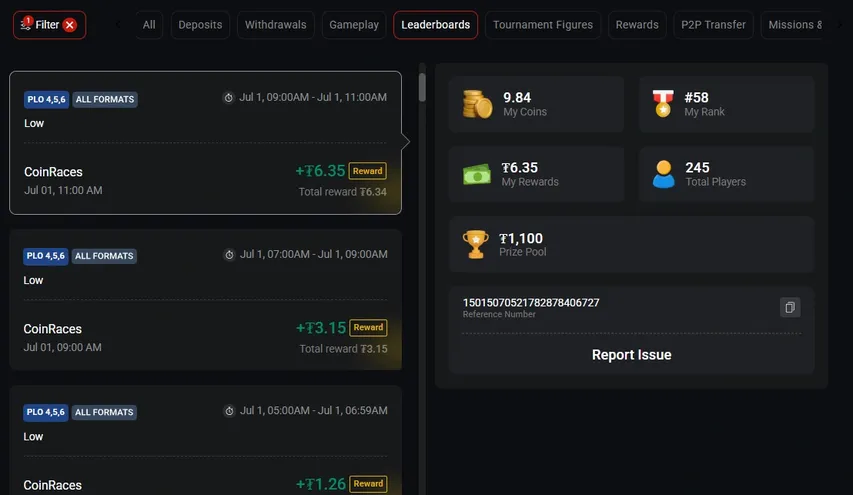
The good part about CoinRaces is that the competition is quite light. For example, at the $0.05/$0.10 to $0.25/$0.50 Hold’em leaderboard, up to 600 players get paid each reset. Slightly less coverage on the PLO leaderboards, thousands are able to collect prizes each reset.
🖳 Our Test: Even playing a single table at $0.25/$0.50 for short portions of the two-hour leaderboard, we were able to get a very healthy return from the new CoinRaces.
Rake Paid
Prize from CoinRaces (July 1st)
Rounded Rakeback %
$9.84
$6.35
65%
$5.39
$3.15
58%
$2.40
$1.12
47%
Average: ~56.6%
🆕 July 30th Update
Checking again on July 30th, we get a slightly different picture:
Rake Paid
Prize from CoinRaces (July 25-30)
Rounded Rakeback %
$37.63
$12.22
32%
$24.52
$8.05
33%
$14.53
$4.51
31%
$30.58
$14.27
47%
$36.05
$13.66
38%
$24.92
$10.76
43%
Average: ~37.3%
These figures are from playing PLO5 at $0.25/$0.50 before July 1st:
Rake Paid
Prize from CoinRaces (Before July 1st)
Rounded Rakeback %
$8.11
$3.02
37%
$13.03
$4.46
34%
$14.67
$5.13
34%
$25.87
$11.72
45%
$20.87
$7.72
37%
Average: ~37.4%
So, after July 1st, with the new CoinRaces, we initially saw an average rakeback increase of 19.2% across a small sample of leaderboards.
Then, checking again at the end of July, we see that the returns are almost exactly the same, for our game type and for stakes.
Early Morning Cash Game Rakeback at CoinPoker – Do Not Miss This
But here's some truly insane returns that we saw, specifically during the morning hours when most poker players are tucked in bed.
Less players = prize pool split fewer ways = absolutely wild levels of rakeback.
The numbers were so unreal we initially thought it was a glitch.
At the Low stakes of PLO on CoinPoker, players were getting about 251% rakeback.
At the Low stakes of Hold'em on CoinPoker, players were getting about 270% rakeback.
If that's not a reason to get up early, we don't know what is.
Let’s move on to Splash Pots.
Splash Pots: Cash Drops
Random cash drops sound great, and everyone loves scoring the big ones, but they are unreliable in nature. Nobody on earth can tell you how many you’re guaranteed to hit or how much you’ll win.
CoinPoker has two different versions of Splash Pots:
Infused Splash Pots: Funds added from CoinPoker juice the prize pool at stakes up to $0.25/$0.50 (previously this figure was $125,000 a week added by CoinPoker). This allows Mega Splashes to be activated, which can drop up to 1,000BB onto a table. Before July 1st, CoinPoker listed these as $125,000, which we assume has not changed.
Non-Infused Splash Pots: There are the regular ones, funded by players through a “0.1BB fee per hand on tables where Splash Pot is an active feature.” That fee is per pot, not per player. 100% of the fees get put back into the pool and randomly distributed through RNG-based Splash Pots.
When a Splash Pot arrives, everyone instantly gets a portion of the drop, and the rest goes into the pot. The ratio of instant prizes to pot prizes fluctuates, but it’s usually around 60:40.
🖳 Our Test: Unfortunately, Splash Pots aren't something you can easily quantify. In the last couple of days, we had one Mega Splash and about a dozen Regular Splashes.
In some sessions, you’ll get lucky enough to see Splash Pots frequently, perhaps even a Mega Splash. In other sessions, you’ll see one or two, and not really feel the impact.
But to be honest, this class of reward is not something players should rely on. Nobody should join a cash game and factor in Splash Pots to their winnings. See them as lottery tickets that get scratched on every hand.
Poker Missions: Tasks That Unlock Rewards
CoinPoker’s Missions were actually rolled out in June, but needed some optimization. At first, they required far too much rake for the prizes they unlocked. Now, they’ve become a meaningful part of the rakeback system.
Missions work like this:
You get awarded a Mission for cash games or tournaments.
Requirements vary, and could be rake generated from cash games, rake from tournament entries, or other objectives.
An expiry date is set, usually a week or more.
Complete your Mission requirements, and claim the reward.
Rewards unlock instantly after you claim them, and some Missions can be done multiple times.
These might feel like hoops CoinPoker is asking players to hop through, but the hoop is one you’re already hopping through, and there’s a small pot of gold on the other side.
Also, Missions exist separately from CoinRaces, so anything you collect here is extra.
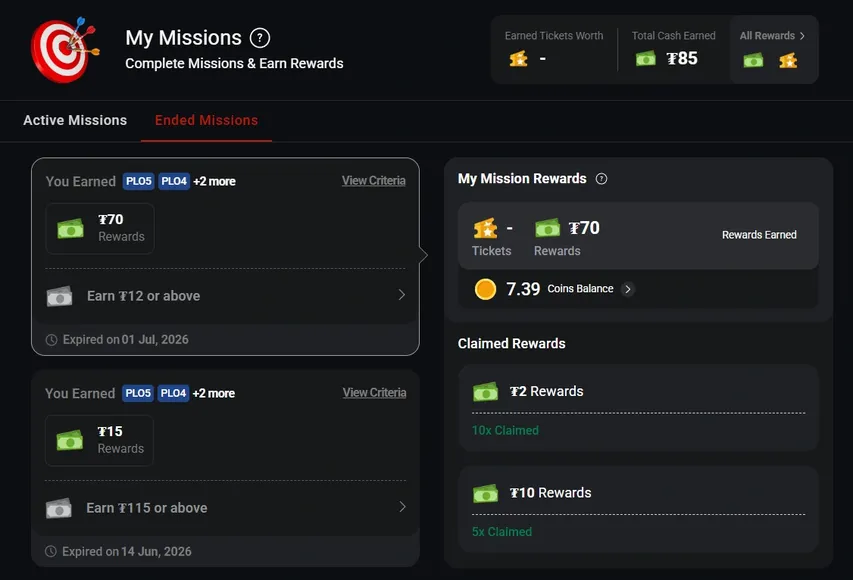
🖳 Our Test: We received a Mission for cash games. The stakes and formats were the same we already played, so there was no need to move up to higher limits or swap formats.
There were two options presented to us on July 1st:
Mission
Reward
Expiry Time
Rakeback
Rake $10
$2
12 Days
20%
Rake $30
$10
12 Days
33%
🆕 July 30th Update
CoinPoker has clearly stated that everyone gets different Missions. You might get different ones than another player, and winners might get slightly less returns than a losing player.
As of July 30th, Missions have definitely changed. Milestones are further away, and provide slightly less cashback.
Here are the new Missions we got:
Mission
Reward
Expiry Time
Rakeback
Rake $500
$80
25 Days
~16%
Rake $1,700
$310
25 Days
~18%
Rake $3,950
$800
25 Days
~20
Unfortunately, it looks like with some adjustments, Mission payouts were lowered, perhaps because the July 1st version was too profitable for players.
The idea here is clear. Play more, collect a higher prize.
Of course, this will encourage some players to spend more time at the table. For grinders who are there already for longer sessions, absolutely nothing changes, except there's a bit more rakeback added on top of the cash game leaderboards.
You able to claim the prizes from Missions multiple times within the expiry period.
The latest Missions are definitely asking players to go a little further, but its still something to stack with CoinRaces and Splash. It's just not something you can claim every session, but find to include into the bigger picture.
As of July 30th:
~37.3%rakeback from leaderboards
~16%rakeback from the lowest Mission option
= About 53.3% rakeback overall, while the Mission is active (not factoring in any other rewards)
Bankroll Boosts: Support Payments
Of the four reward mechanisms, Bankroll Boosts are the most elusive. There’s very little information about them, and personally, we haven’t received one yet.
What we know about Bankroll Boosts:
Available for cash game players at $0.50/$1 and above.
They offer support “during downswings or stretches of negative variance.”
Bankroll Boosts can be MTT tickets, Missions, or other rewards.
That’s all so far.
This reward is not for micro or low-stakes players, and it’s only for those who are running bad. Like Splash Pots, this reward shouldn’t be something you count on in each session.
If you play at $0.50/$1, then it might swoop in to help you a little during a rough stretch. But at this point, we aren’t sure how much it will offer or how badly one must run to collect it.
CoinPoker's July 1st Rakeback Changes in a Nutshell
There was plenty of uproar about the 15% daily rakeback removal on Twitter. The thing that players liked about it was the reliability. It was always there, no matter what. The morning after a day of poker, it was waiting for us in our wallets like a good friend.
🟩 Positive Changes: But from what we’ve already seen, the CoinRaces adjustment has already had a positive effect, and Missions take things even further in the right direction. In our test case, the rakeback on July 1st was higher by about 24%, even without the 15% daily rakeback.
CoinRaces are for everyone, but it’s less clear who will get Missions. So the question is, without Missions to add a little extra rakeback, is the new CoinPoker rakeback better or worse?
So far, it is. CoinRaces gave us around 20% more rakeback than it did before July 1st. We’ll keep tracking the numbers, but if it continues to deliver ~56.6% average rakeback (as we saw in our small test), that’s a huge improvement.
🟥 Negative Changes: Tournament players are the ones who’ll be most unhappy after July 1st. Their only rakeback from the new CoinRewards system is from Missions, but we aren’t sure if these are rolled out across the player base.
🆕 July 30th Update
When we reexamined our CoinPoker rakeback at the end of July, things were not quite as bad as we initially though.
Yes, our CoinRaces payments were lower.
Yes, our Missions were harder to cash in.
But our overall rakeback was only down 3% from about 56.6% on July 1st to around 53.3% on July 30th.
Factor in Splash Pots, and that 3% is likely down to 1% or 2%.
All in all, the changes were minimal, and if you like the field and software, the July 30th update is unlikely to be noticeable (at least for the stakes this tester was playing).