

Many poker theorems from the early online era were designed as simple shortcuts for decisions that would now be analyzed through ranges, frequencies, and GTO strategy. Zeebo’s theorem is one of the clearest examples: its literal wording is too absolute, but the exploitative tendency behind it can still be useful.
The original 2023 article used Adam’s review to test several classic 2+2 ideas against modern poker strategy. This updated version keeps that historical analysis, but starts with Zeebo because it shows particularly well how an old poker theorem can remain useful as an exploit without becoming a universal rule.
What Is Zeebo Theorem in Poker?
Zeebo theorem is one of the best-known poker theorems from the early online era. It is attributed to Greg Lavery, better known by the screen name Captain Zeebo, who formulated the idea in 2006. The original version was deliberately absolute:
No player is capable of folding a full house on any betting round, regardless of the size of the bet.
Taken literally, that statement is false. Strong players can fold full houses, and modern GTO strategy can require doing exactly that when a hand sits near the bottom of a range facing a sufficiently strong betting range. The value of the theorem is not that it describes every possible decision. It identifies a common population tendency: players often become too attached to the absolute strength of a rare made hand.
That distinction matters. A full house sounds extremely strong in isolation, but its relative strength depends on the board, the action, and which better hands are available. On some boards, almost every full house is close to the nuts. On others, especially double-paired boards, a small full house can be far from the top of the range.
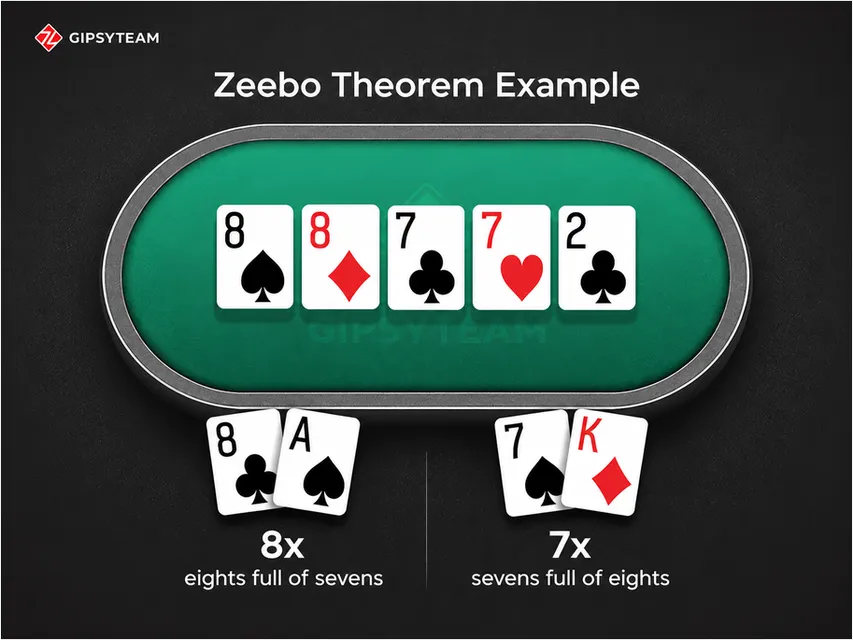
So what is Zeebo theorem useful for today? It works best as an exploitative shortcut. If an opponent’s range is likely to contain a full house and that player is unlikely to make a disciplined fold, bluffing becomes less attractive. Conversely, when you hold a stronger full house or quads, larger value bets may earn more than a cautious sizing. That is the part of Zeebo’s idea that remains strategically useful.
Zeebo Theorem Explained: Why It Works in Practice
The hand above is a perfect example of why Zeebo theorem became so memorable.
- On a J♥-8♠-9♣-J♣-8♦ board, J♠7♠ makes jacks full of eights — an extremely strong hand in absolute terms.
- But 8♥8♣ makes four of a kind, so the full house is already drawing dead.
This is the key idea behind the poker theorem: players often focus on the name of their hand rather than its relative strength. Folding a pair is easy to imagine; folding a full house feels very different, even when the board and action suggest that better hands are possible.
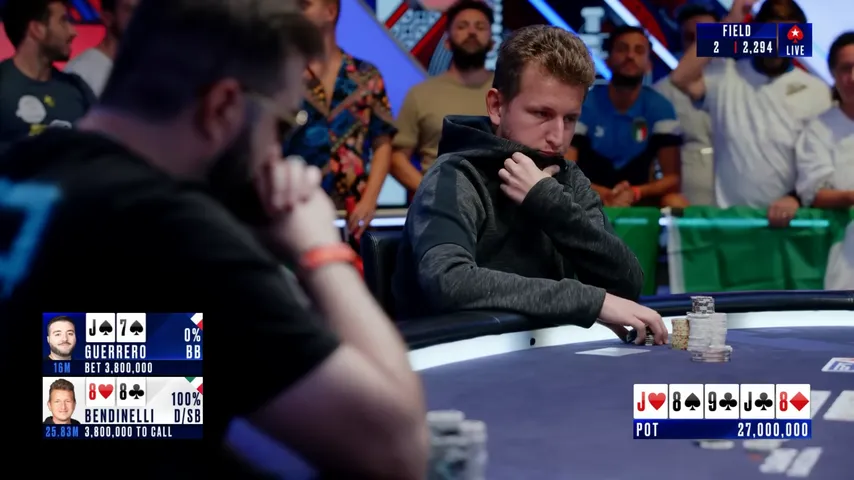
That tendency creates a simple exploit. When an opponent can have a weaker full house, stronger boats and quads can often be value-bet aggressively. On the other hand, bluffing into a range containing many full houses is usually less attractive, especially against recreational players who dislike folding very strong made hands.
So, what is Zeebo theorem in modern poker? It is not a rule that full houses can never be folded. GTO strategy can certainly find those folds. Zeebo theorem explained in practical terms is simpler: if an opponent overvalues a full house, bluff less against it and extract more value when you hold the stronger hand.
Zeebo Theorem vs GTO: When the Rule Breaks
Zeebo theorem is useful as an exploit, but it should not be treated as a universal poker rule. Modern GTO strategy evaluates a hand relative to ranges, bet sizes, blockers, and the number of stronger hands available. A full house can therefore be strong in absolute terms and still be weak enough to fold.
Double-paired boards are a good example. On 8-8-7-7-x, a player holding 7x has a full house, but every 8x makes a better one. Against a large bet from a range with very few bluffs, a disciplined player can fold the weaker boat.
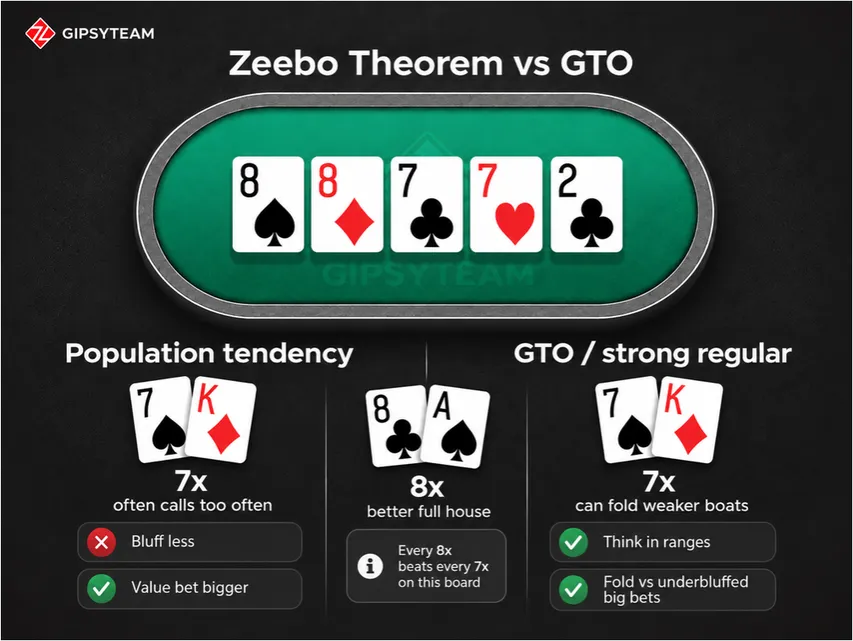
This is where Zeebo theorem vs GTO becomes useful. GTO provides the baseline; Zeebo describes a common population deviation. If an opponent calls too many full houses, the adjustment is simple: bluff less and value bet stronger hands more aggressively. Against strong regulars who can correctly evaluate relative hand strength, the theorem becomes much less reliable.
If you want to test these ideas in real games, GipsyTeam works with several rooms for different types of players:
- CoinPoker. A strong all-round option with solid traffic, crypto payments, and extra GipsyTeam promotions.
- BCPoker. Worth considering for softer low-stakes games, regular promotions, and exclusive GipsyTeam freerolls.
- RedStar Poker. An established iPoker room with strong traffic, tracker and HUD support, plus additional conditions for GipsyTeam players.


- GipsyTeam's unique promotions
- Help with deposits and cashouts
- Access to private freerolls
- Round-the-clock support
- Уникальные акции от GipsyTeam
- Помощь с депозитами и кешаутами
- Доступ в закрытые фрироллы
- Круглосуточная поддержка
Other Classic Poker Theorems and Whether They Still Work
The Zeebo theorem was only one of several memorable shortcuts that became popular during the early online poker era. Baluga, Clarkmeister, Yeti, and AEJones addressed different situations, but all tried to turn complicated strategic decisions into simple rules that were easy to remember at the table.
Modern poker theory gives us a better way to judge them. Some still describe useful population tendencies, while others break down once ranges and solver logic are considered. The original analysis below tested these classic poker theorems against population data and modern strategy.
Balug's theorem
This theorem is not about the big fish of the sturgeon family, but about raising on the turn. It was formulated by Andrew BalugaWhale in 2006 on 2+2. It sounds like this:
The strength of one pair should be significantly reassessed after a raise on the turn
Original example from 2006:
We're UTG with Ako, raising to 4bb (you can feel the old-school vibe right away). BTN call, flop comes A93o. We make a pot-sized bet (now the solver advises to bet much less), the opponent calls. The turn is a 7 for a flush draw. We bet the pot again and get raised.
Balug's theorem is that after these raises our top pair with top kicker doesn't look very good. The theorem does not say that you must fold, just that you need to be very critical of the strength of your hand. Well, and sometimes still say “pass”, as quite often this will turn out to be the right decision.
If we analyze this situation in the solver, then it almost always advises calling both a raise on the turn and a bet on the river. However, it should be understood that after betting on the river, our top pair top kicker is just a bluff catcher. The EV of calling on the turn isn't very high, technically it's a call we play to protect our range, otherwise, we end up folding too much on the turn. If in this situation our hand is weaker than TPTK, then the solver will tend to fold.
In general, this theorem is quite far from GTO and is geared more toward an exploit. The idea is that the average opponent doesn't often bluff raise on the turn. In the NL200 PokerStars population sample used in the original 2023 Range Research analysis, turn raises looked like this:
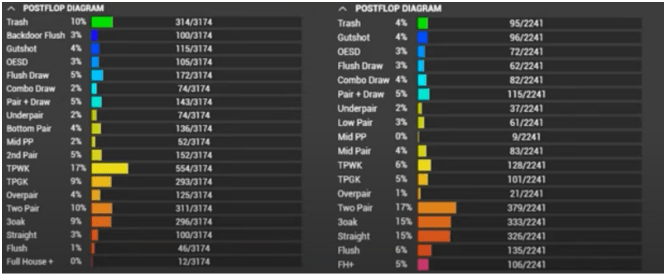 On the left are players in position, on the right they are out of position
In that sample, players out of position held two pair or better after a check-raise 58% of the time and top pair or better 70% of the time. When the raiser was in position, those figures fell to 25% for two pair or better and 30% for top pair or better.
The 2023 population data therefore supported Baluga Theorem as an exploitative warning rather than a GTO rule, particularly against turn check-raises. Raises made in position contained substantially more bluffs and semi-bluffs, so the heuristic was less reliable there.
Clarkmeister Theorem: Betting a Four-Flush River
This theorem was also born on 2+2. It sounds like this:
If a fourth suited card comes heads-up on the river and we have the first action, we should bet.
Sounds pretty logical. True, it is quite difficult to prove the benefit or harm of this theorem, since everything here depends on the specific situation.
For example, we are out of position, our opponent c-bets the flop and the turn, and the river comes a fourth flush card. In this situation, our bluff donk bet on the river generates 57% fold equity, and applying the Clarkmeister theorem will be very profitable – if we bet 75% of the pot, then we need to get only 40% of folds to turn this action into profit.
Another scenario that fits the theorem is when we are probing. This is the name of a bet that we place against an opponent who did not place a continuation bet on one or more of the previous streets. Here our bet on the river will already give 62% fold equity. However, this situation is much less revealing, since we almost always have a lot of fold equity here, regardless of the card that hit the river. But in the first case, the fourth card to the flush is just important, since in another situation the donk bet will not be so profitable.
This does not mean, of course, that the theorem works perfectly. If we bet three times out of position, c-betting the flop, turn, and river, in most cases our fold equity on the river will drop to 40%. Moreover, the option in which the fourth card to the flush comes on the river is even worse than the others – in other cases, our fold equity is 45-50%.
Conclusion: Clarkmeister's theorem can be considered working, but not in all situations. GTO is not so optimistic about this theorem and rarely advises betting on the fourth card to a flush.
Yeti Theorem in Poker: Are Dry-Flop 3-Bets Really Bluffs?
This theorem also arose on 2+2, and received the name in honor of the author.
3-betting on a dry flop, especially a paired flop, is almost certainly a bluff
Let's say we hit a dry flop such as A-7-2 rainbow or K-K-2 rainbow. The original Yeti theorem assumed that if an opponent raises again after facing a flop raise, the range should contain many bluffs because very strong hands would often prefer to slowplay.
The NL200 population sample used in the original 2023 analysis showed the opposite tendency. Bluff 3-bets and merged 3-bets were extremely rare on dry and paired flops, while players taking this line were heavily concentrated around strong made hands.
Now the average flop 3-bet bluff range player is almost non-existent, and they will only play this way with the stone-cold nuts, regardless of the texture. In a sample with NL200 on a dry or paired board, the percentage of bluff 3-bets and merges is extremely low.
Conclusion: the Yeti theorem in poker is a poor default rule for modern population play. It can still describe a specific opponent who overbluffs dry boards, but without that read it should not be treated as a reliable shortcut.
AEJones Theorem: “Nobody Ever Has Anything”
It was published by high roller Aaron "aejones" Jones on the 2+2 forum in 2007.
Nobody ever has anything.
Of course, this wisdom of past centuries should not be taken literally, but this theorem can be rephrased as follows:
Players won't always have as strong a hand as you think.
This problem can be called the "monster under the bed" syndrome. It usually escalates during downswings, when you constantly think your opponent has the nuts. “Of course, we caught a low set, but the enemy must have top set!” It is not difficult to believe this, especially if these situations have happened to you quite often over the past few tens of thousands of hands.
If we try to abstract away the effect of streaks and look at the big picture, it turns out that the opponent's hand is quite often weaker than we thought. It's not that easy to make a strong hand in hold'em, and if we don't always succeed, then our opponents must have the same problem. It is useful to remember this, especially during a downswing.
From this statement, one more can be deduced, which does not lose its relevance at all times:
Aggressive play is much more profitable than passive play.
Don't worry too much about the fact that your opponent has a strong hand in some particular cases because this can prevent you from deciding on a profitable bluff at the next table. And sometimes you might even be surprised how easily opponents are willing to part with their cards.
Classic poker theorems are most useful when treated as observations about player behavior rather than fixed rules. Zeebo theorem is a good example: players can fold full houses, but many still call them too often, creating clear opportunities to bluff less and extract more value with stronger hands.
Modern GTO analysis gives these old ideas better boundaries. Instead of asking whether a poker theorem is simply true or false, the more useful question is when the underlying tendency applies — and against which opponents.