
On October 15, QQPK acknowledged collusion among players on its platform, announced the ban of 893 accounts, and announced $300,000 in compensation. That same day, under the handle MTT Database Review, he published the results of his own investigation. He estimated that the room may contain approximately 12,000 bots, which accounted for over 70% of all hands in his database.
The initial accusations against QQPK can be found in a separate article:
Read ReadThe MTT Database Review nickname belongs to Vojtech Cervinka, an MTT coach who constantly analyzes mid- and high-stakes regulars' databases and uses his own HUD with thousands of statistical metrics.
GipsyTeam readers may recall his 2024 investigation into bots on ACR. In 2026, he conducted similar investigations on WPT Global.
An anonymous user started a thread about bots on QQPK on 2+2, but it didn't attract much attention. He then contacted Cervinka, asking for an independent verification of the results.
Searching Thousands of Bots with Hand2Note
Vojtech published his investigation on YouTube.
In a 21-minute video, Cervinka first compared QQPK's overall statistics with his own large PokerStars database, and then began identifying suspicious accounts.
For his initial selection, he used a fairly simple filter: regular 3-bets to exactly 11bb with effective stacks of 25-60bb and at least 1,000 hands per player. The resulting group of accounts played approximately 9.8 million hands. Vojtech then examined other metrics, including limp ranges, postflop sizings, and actions in various game situations. The strategies turned out to be similar not only preflop.
On October 15, Cervinka published another study covering the period from July 16 to October 11, using a database of 24 million hands. He estimated that suspected bots played 17.5 million hands, or more than 70% of the total. In total, he counted approximately 12,000 such accounts and published a list of 11,469 nicknames that almost certainly are owned by bots.
— What did you verify or add to the investigation after he contacted you? How did you use your database tools to check his findings?
— I was able to confirm most of his findings using my database tools. I also shared some additional stats in my YouTube video, mainly to show players how to exploit these bots in case QQPK failed to take action.
As for identifying the bots, it was surprisingly straightforward. They almost always 3-bet to exactly 6bb, 8bb, or 11bb, use fixed c-bet sizes of 2bb, 3bb, or 4bb, and limp-reraise a very specific range of 99+, AJs+, and AQo+. It's almost as if they weren't even trying to hide it.
— According to the data from your video, suspicious accounts played about 9.8 million hands, but in the new study, that number increased to 17.5 million. Did you use additional filters or simply expand the original sample?
— Yeah, the first was very conservative, using very basic filters.
— What key metrics did you use to compile the final list of 11,469 nicknames?
— Frequency of specific 3bet sizings, postflop sizings, limping frequency, and limping range.
Cervinka applied his filters to a comparable PokerStars tournament database and found no matches. It took two rounds of loosening the criteria to find even three suspicious players.
Strange Nicknames and a Master Account
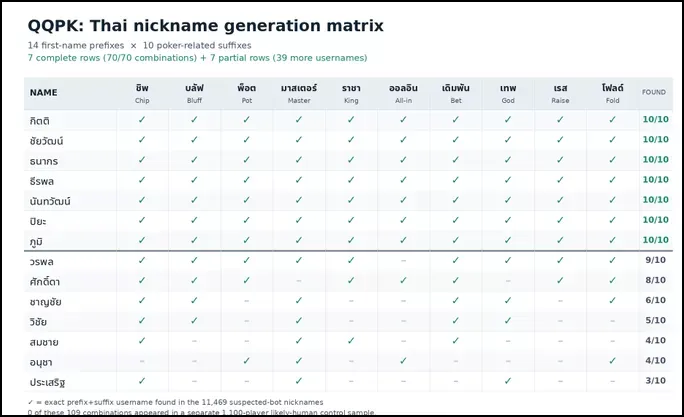
A distinctive feature of the QQPK list is the large number of similar nicknames. Vojtech discovered groups of accounts whose nicknames follow similar patterns, including a table of combinations of Thai names and poker terms. However, this is partly explained by the room itself assigning generic nicknames to users who don't choose a unique name upon registration.
— When compiling the list, did you check all the accounts for game patterns, or did you add some because of similar nicknames?
"It's all based on game statistics. What I published about nicknames is just an additional observation, not of particular significance."
Several people told me that names starting with "Happy" are a standard QQPK pattern. But there are other similar patterns, too. For example, my report contains a table of 70 combinations of Thai names and poker terms. All the accounts in it are bots.
A record-breaking player was discovered among the suspicious players. The account 郑鱼F, which Cervinka nicknamed Big Daddy Bot, played approximately 153,000 hands. The second-largest suspected bot turned out to have only played about 5,000.
According to SharkScope, Big Daddy played 8,329 tournaments over 33 days. Cervinka calculated that, on average, it participated in 8.3 tournaments at a time. Its strategy, however, is similar to other discovered bot accounts.
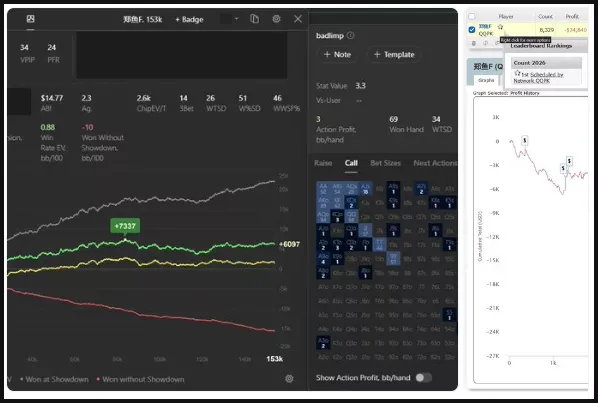 The account, which Cervinka nicknamed Big Daddy Bot
Cervinka wonders if this was a test account for a bot farm, but he has no confirmation. It's unclear why this bot is so prominent in terms of game volume.
Abnormal All-In Busts and Survivorship Bias
One of the key findings of the first QQPK investigation was an all-in EV overshoot of 138,705 big blinds in 193,757 pots played by suspected bots against other players. According to the authors' calculations, this corresponds to 14.6 standard deviations—a discrepancy so large that it's virtually impossible to explain it with normal variance. Most of the overshoot occurred when the suspected accounts were underdogs. These figures sparked speculation about collusion and possible RNG manipulation, but Cervinka pointed to another possible explanation.
"I can't confirm or rule out collusion based on that evidence alone. However, there's an important statistical issue that I think has been overlooked: selection bias.
If you construct an alias using only accounts that have played a certain minimum number of hands (which makes sense when trying to identify bots reliably), you're potentially introducing survivorship bias. Players who run above EV tend to survive longer in tournaments, play more hands, and are therefore more likely to meet that minimum hand-count requirement.
As a result, the selected group can end up running above EV even without any collusion or rigging. So I wouldn't consider the EV deviation alone sufficient evidence of either.”
Cervinka confirmed that the author of the first investigation also used a filter based on the number of hands. However, the extent to which this filtering may have influenced the final EV deviation remains unknown.
— What if we identify bots based on hands from one period and then check their EV results on a later sample that wasn't included in the selection? Have you conducted such a test?
— “No, I didn't do that.”
QQPK Acknowledges Bots, but the Problem Remains
In its official report on October 15, QQPK announced the permanent ban of 893 accounts. Of these, 567 were on the initial list of investigators, and another 326 were discovered by the room's security team.
The remaining 2,020 accounts from the initial list are undergoing further review.
QQPK also pointed to collusion. According to the room, members of the group used multiple accounts at a single table and exchanged information about hole cards in real time. Knowing the blockers allowed them to avoid unfavorable all-ins. This explains the room's abnormally high all-in EV.
However, QQPK's internal audit found no evidence of RNG manipulation or unauthorized access to server data.
Another controversial issue is Hand2Note's scoring methodology. QQPK claims that after checking 4.87 million hands against server data, only 1.76 million unique hands remained. The company claims that combining multiple accounts into a single alias led to the same hands being counted multiple times.
Cervinka questioned this interpretation.
— You mentioned doubts about their duplicate-hands explanation. They reduce 4.87M player-hands to 1.76M unique hands. But if multiple accounts from the alias played the same hand, are those really duplicates?
— "I don't think it should affect EV at all. Whichever all-in happened will be counted only once.
There are more player hands so that every player has his stats counted and then all averaged together for population or alias stats.
Sure, other players "see" certain all-ins happening, but it only counts in-graph for the player involved.
Other player in the same alias records that hand too, but just asi -0,12bb because he folded ante preflop, or maybe he was the one losing and another player wins the hand.
So it’s even after everything is counted. That’s why the whole population ends up at 0.”
As an example, Cervinka sent two graph slices from his PokerStars database. On the left, after 10.6 million hands, the players' total result is slightly different from zero. On the right, after 15.7 million hands, the total result and all-in EV are practically zero: the wins of some players are offset by the losses of others.
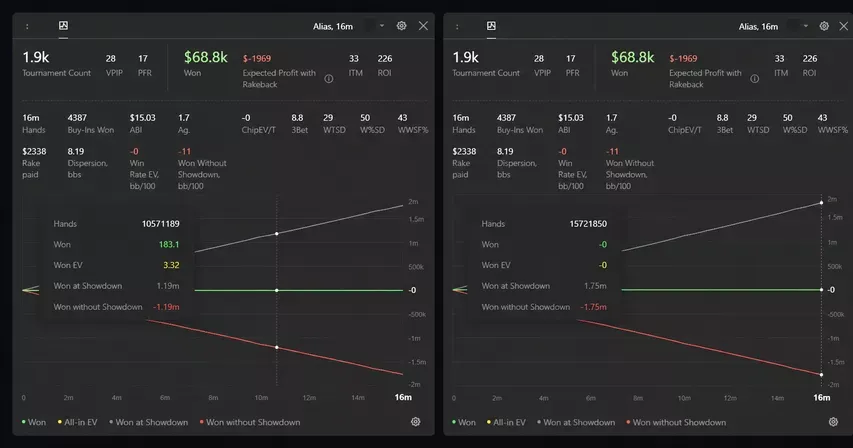
Cervinka explains the slight difference in the intermediate sample by the fact that some players' hands have already been included in the sample, while others haven't. A single hand may appear in the statistics of multiple players, but this doesn't mean that winning an all-in hand is counted multiple times.
It's unclear from the published data how removing duplicates affected the EV and statistical significance of the results.
Remarkably, even after its own recalculation, QQPK found an EV excess of 69,700 bb for 893 blocked accounts. According to the company's calculation model, this corresponded to 14.17 standard deviations.
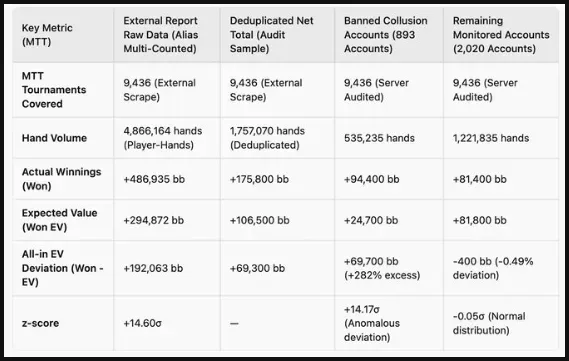 QQPK calculations: original sample, data after duplicate removal, 893 blocked accounts, and 2,020 accounts under observation
In a report dated October 15, QQPK also announced its intention to reward independent researchers involved in exposing the scammers and invite them to further collaboration.
— QQPK explains this anomaly by the exchange of map information between group members. How convincing do you find this explanation?
— "I don't know. QQPK mentions collusion, but I haven't really investigated that in depth."
— Have QQPK representatives contacted you since the report was published?
— “I have not been contacted by anyone from QQPK.”
— How do you rate the room's response overall? They blocked 893 accounts, but your new research suggests there could be almost 12,000 bots. Is QQPK doing enough to address the problem?
— "Not great, not terrible. I guess that we will have to wait a few more days for another statement."
QQPK Earmarks $300,000 in Compensation
On October 16, QQPK published detailed terms for payments to affected players. According to the company's estimates, 13,928 players should receive compensation, with $300,000 to be distributed among them.
Of the total fund, $64,627 consists of confiscated funds from blocked accounts, and the room promises to supplement the remaining $235,373 from its own funds. Payments were scheduled to begin on October 20. QQPK reports that the funds will be automatically credited to gaming accounts, after which they can be withdrawn. No separate application is required.
However, the compensation conditions turned out to be quite specific.
To receive a payout, a player must meet three criteria:
- Participate in an MTT in the last three months
- Be at the same table with at least two accounts that violated the rules in the same hand
- Lose in tournaments, not cash games
Banned and deactivated accounts are excluded from the compensation program.
This approach leaves out players who only encountered one cheater. Players who finished in the black in the relevant tournaments will also not receive compensation, even though the cheaters' actions could have reduced their winnings or EV.
In the published plan, QQPK did not disclose the detailed formula for individual calculations. Players can contact the room's support team with questions about compensation until November 30.
— As an MTT coach, do you think these criteria make sense? Couldn't they exclude players who were also harmed, for example, those who faced just one bot or finished in profit but still lost EV because of the cheating?
— "No, it makes no sense. It is crazy giving out compensation while they only banned a fraction of the bots. How much will go to other bot accounts?"
— You've investigated bots on ACR, WPT Global, and now QQPK. Based on your experience, what should poker rooms be doing differently to detect and stop these bot networks earlier?
— “I think poker rooms should work much more closely with experienced players and independent analysts who specialize in this kind of research.
The rooms have access to far more data than we do, including complete hand histories, device information, deposit/withdrawal behaviour, IPs, etc. But sometimes it takes someone who has spent thousands of hours analyzing poker strategies to recognize patterns that automated security systems are missing.
Ideally, this should be a proactive, ongoing collaboration rather than waiting for someone to expose hundreds or thousands of bots publicly.
And obviously, if independent researchers are saving poker rooms potentially millions of dollars and protecting their reputation, they should be compensated accordingly. Meaningful bounties and properly paid consulting arrangements would give more people a reason to invest serious time into this kind of work. Because the people who create the bots definitely get paid very well for their job.”
Banning HUDs Only Helps Scammers
On October 17, Cervinka published a lengthy post on X about the ban on third-party software on GGPoker. The researcher explained why he considers such restrictions practically unenforceable and proposed several alternatives.
“Banning HUDs is dumb and basically impossible to enforce.
This isn't about whether you like HUDs or not. I totally accept that some players prefer a more analytical approach to poker, with lots of stats, while others prefer playing without HUDs because they see it as a cleaner, fairer, purer way of playing poker.
I'm just here to tell you that HUDs cannot really be banned. Or, to be more precise, only the ones used by people who follow the rules can be banned.
Whether you like it or not, having stats on your opponents in online poker is a thing. It has been a thing for way too long for players to just give it up. Legal HUDs can be banned, but there is pretty much no way to reliably enforce a ban on underground HUDs.
Poker sites can monitor running processes, but there are ways to capture your screen without running any screen recording software on your PC.
Nowadays your friendly ChatGPT, Grok, Claude, Gemini... will happily help you build an app that reads nicknames and actions from the captured video/screenshots, converts them into .txt hand histories, sends them to another PC running Hand2Note, PokerTracker, Holdem Manager, DriveHUD... and generates a HUD there.
Instead of using a remote desktop app that can be detected in running processes, you could just view it through your browser. I don't think any poker site is planning on banning you from using Chrome, Safari or Firefox during a session. And detecting that is virtually impossible. (Maybe some behavioral patterns, if you exploit someone too hard? I seriously doubt it.)
Or, if that's still too complicated, there are already websites that are basically cloud HUDs available for a subscription. And they already have huge databases of datamined hands ready.
AFAIK, these are mostly for cash games, but if regular HUDs get banned, I'm sure cloud MTT HUD alternatives will appear. Especially nowadays, with how easy these things are becoming to vibe-code.
It won't be as comfortable as a regular HUD, but it will be virtually impossible to detect.
And instead of accepting that some players have an advantage from using HUDs, which are allowed on certain sites and available to anyone, you're now giving an even bigger advantage to people willing to break the rules and bypass the restrictions.
Good luck enforcing that rule unless someone is dumb enough to expose themselves using prohibited software on social media. (Shoutout to the former ACR pros. 😂)”
Read Read“And GG is now taking this even further by banning trackers that aren't even interacting with GG. So someone playing GG alongside PokerStars or ACR can't have a legal HUD running on those sites either. Meanwhile, someone willing to break the rules might still get HUD stats on GG itself.
So that's it? Just let evil, predatory regs quickly strip recreational players of their money using HUDs with their own hand histories, or possibly even quicker with datamined hands?
No. There are other things you can do to lessen the gap between professional and recreational players.
Let's start with giving everyone a useful built-in HUD.
Yes, I know, several sites already have basic HUDs in their clients. But WTF is that? Most recreational players have no idea what half of those stats even mean, let alone what the values should be.
Why can't anyone make it more user-friendly?
For example, why is there no poker site (AFAIK) that lets you save an actual hand to an opponent's profile?
Open the hand history, click "Save to player's notes". Done.
Next time you play against that opponent, you hover over their nickname and see the last five hands you've saved on them, displayed as little hand previews like in Hand2Note4. Click on one to open the full hand replay.
Maybe give players an option to mark their opponents with some simple badges like "loves hunting bounties", etc. Features that every recreational player will immediately understand.
Instead, you have things like GG showing a mini graph of a player's results from their last five tournaments. That is the most useless waste of space imaginable. Whether someone cashed or made a final table in their last five tournaments has basically zero predictive value. Absolutely useless for judging how someone plays.
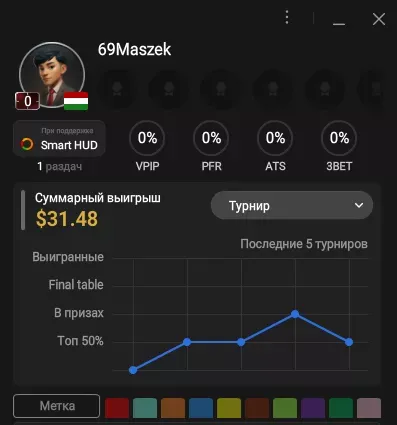
Changing nicknames is definitely something worth debating. Let losing recreational players change theirs more often? That's a reasonable thing to consider.
Try inventing new formats. Something that makes every decision a bit more unique and harder to put into stats. Knockouts are a perfect example of that. Situations with big bounties can definitely skew a player's stats.
I'm not saying everything should become some Monster Mystery Bounty gamble fest. Just experiment with small changes to formats, structures, etc.
Also, while we're on the topic of preventing predatory regs from quickly bleeding the fish dry...
WHY IS IT STILL SO REWARDING TO LATE-REG AT THE LAST POSSIBLE MOMENT AND STALL EVERY SINGLE HAND?
This is the dumbest way a player can get an edge.
Not by studying opening ranges, cbets, probe bets, ICM, exploiting opponents, maintaining their A-game throughout a long session...
No. Just play as few hands as possible to maximize your chances of min-cashing because late registration ends way too close to the money.
Yes, I know, poker sites are greedy and want to maximize the number of entries in every single tournament. But fighting HUDs while this remains a viable strategy to make money is truly bizarre.
BTW, while I'm on a rant (just a general one, not targeted at GG, AFAIK they don't have these), another incredibly dumb format is rebuy/add-on tournaments where the add-on gives you significantly more chips per dollar than the original buy-in.
Recreational players often don't realize how important taking the add-on is. Sometimes they don't even have enough money in their cashier for it.
So just knowing that you should late-reg at the last possible moment, stall until the add-on and make sure you have better price on your chips can give you a massive ROI boost without having to learn any actual poker strategy.
Oh, and if you really want you can actually solve the whole HUD problem by just making everyone anonymous in-game. But good luck expecting poker sites to police those games properly. Some of the anonymous sites out there aren't exactly famous for their game integrity. Quite the opposite. Also pretty boring when every opponent is just a random string of characters.
End of rant.
TL;DR:
You can't ban HUDs. You can only ban legal HUDs.
Same as with online poker itself. You can ban legitimate operators, but you can't ban all the shady, made-up-license, nonexistent-game-integrity, your-agent-will-probably-scam-you poker sites.
That's something we all know well.”
In the comments to the post, Patrick Howard, coach and creator of the MobiusGTO simulator, argued with Cervinka. He agreed that data mining helps uncover cheating, but drew a distinction between studying statistics outside the table and using a HUD during play:
“I usually agree with your takes, but I have a different opinion on this one.
Everything you said about enforcement applies just as much to RTA. RTA is hard to detect too, and nobody thinks that makes it OK. Something being hard to enforce doesn't make it fair. It just means sites need to put more work into enforcing it.
Poker is a mental sport. At the table, your decisions should come from your own head. A HUD gives you information in real time that you couldn't hold in your head. That's outside help at the table, same category as RTA (though not as severe). Chess works the same way. You can prepare as much as you want before a game, but you can't look at notes during it.
Off the table is different. Studying, running solvers, reviewing your database, even going through mined hands IMO, is all fair game as long as you're not actively playing. Mined data improves transparency on sites and is how players have been catching cheaters, as you said, so I'd hate to see that go away.
Quality of life things like table tiling, hotkeys and an RNG are fine to me. They help you act, they don't give you information, and you could get the same randomness from a clock, or spinning an object, as an RNG.
HUDs only became accepted because trackers showed up early in online poker, sites made a lot of rake from multi-tablers, and by the time anyone thought about whether it was fair, it was already normal. I'm completely okay with getting rid of them.
Where I do agree with you is that all sites should build a decent HUD into the client. They should also add hotkey and basic tiling support, because it's trivial. This would level the playing field and make it less appealing to use illegal tools.”
Why Do Poker Players Need Datamining?
On October 18, Cervinka returned with a post specifically on the topic of data mining. In a new publication, he listed investigations in which analysis of collected databases helped uncover bots and other violations, and asked readers to consider the consequences of abandoning these tools.
“Also, on the topic of datamining itself:
- Huge bot ring on ACR – found thanks to datamining.
- Huge bot ring on WPT Global – found thanks to datamining.
- Absolutely enormous bot network on QQPK – found thanks to datamining.
- Bots on GG (with patterns matching the ACR bot farm, although not nearly as widespread) – found thanks to datamining.
- Superuser on GG – found thanks to datamining.
- High-stakes player allegedly spying on his opponents' hole cards (multiple poker sites) – suspicious winrates uncovered through datamining helped raise the alarm.
- Massive PLO bot ring on PokerStars in 2015 – exposed by players analyzing millions of datamined hands.
- Ultimate Bet superuser scandal in 2008 – suspicious winrates and hand histories analyzed by players, including data from external tracking sites.
(And this is by no means an exhaustive list.)
So, what would you prefer?
A) Playing on a site where another human player might know how you played hands they weren't even involved in, giving them an extra edge. Something you can at least partially counter by studying and fixing your leaks (I can help you with that BTW), potentially even counter-exploit them by being over-aggressive in spots you learned you were previously too passive in.
OR
B) Blindly trusting poker sites to put enough effort into game integrity, because players no longer have the tools to investigate the games themselves?
And hoping those sites will catch potentially hundreds or thousands of bots in the best-case scenario, and collusion rings, hackers and superusers in the worst?”
What Has Changed Since QQPK’s Announcement?
On October 21, Vojtech wrote another Twitter post:
Today, I created a small database with fresh hands played since October 16.
6.6k of those accounts were still active.
But you know what's absolutely hilarious?
Remember their famous limping strategy?
They now limp...
Wait for it...
Wait for it...
Waaaaaaaaaaaaaaaait for it....................
ZERO.
0%.
I bullied them so much for their ridiculously obvious limp-raise strategy with 99+, AQo+, AJs+ that these 6.6k accounts, which previously were ALL using a limp strategy, are now at 0.0% limp.
Yeah now I definitely cannot tell you're all bots.
HAHAHAHAHAHAHAHAHAHA.