Jungleman's Basic Guide to Flop Textures & Board Categories
GipsyTeam
10 January, 11:252477
Daniel Cates warns poker enthusiasts starting to learn GTO Wizard theory against common mistakes, offers advice on how to classify flops, and shares a method for independent study.
A different kind of seminar today. I decided to go over a bit more of what you guys should look at when studying, and also just to give you guys a bit of understanding of the different textures. I thought it’d be a bit easier to grasp, and, instead of something super advanced, a bit more practical. A different approach that people aren't doing too much, with some quizzes.
The first thing is: look at the frequency of situations that come up, and how big the pots are. And this is apparently sorted already through GTO Wizard.
You can see that not all these spots are equal, and that makes sense. A bunch of spots are quite rare, and it doesn’t work exactly that you need to focus on things totally in this order. But if you were to just start out, this would be the way that you’d go.
Or if you saw some of these that were high on the list that you're kind of rough in, or you're not really sure about a lot of things, you would look at things like this.
So it also matters how big the pot is, right? Because although these three-bet pots are big, they’re infrequent. But if they’re really big and the same frequency as one of the three-bet pots, if they’re a bit bigger, then it would make more sense to study them.
Or if you happen to play a game that was a bit bigger, or you just had some situation that was a bit bigger but as frequent as some of these three-bet pots, you do that. But anyway, some three-bet pots are a little bit more frequent than others, of course.
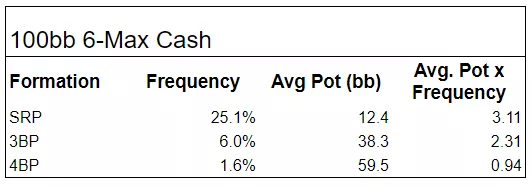
GTO Wizard expert Tombos21 calculated the proportion of pots with a single raised pot, 3-bet and 4-bet:
SRPs win thanks to frequency, but Tom advises against neglecting 3-bet pots: their larger size means small mistakes are heavily punished, and being the aggressor out of position (a common story in 3-bet pots) is intuitively more difficult.
But spots from the small blind are quite frequent. The ranges are wide, so that one’s going to be pretty important. That’s going to be more important than under the gun versus hijack, which is pretty rare. It’s pretty rare you call a three-bet or just get three-bet hijack versus under the gun. It’s just not a common spot.
Yeah, the single-raised pots are quite common, and the loosest ones are the ones that are most important to focus on, like small blind versus big blind, button versus big blind. We’re going to look at those today.
So you can see all that pretty easily. And button versus big blind is one of the most important ones. Those ones are not that easy, I would say. And you get punished a bit more if you're too far away from what you’re supposed to be doing on those.
Those are the most common ones. This is the frequency that they happen, and the size of the pot.
As you can see, the big blind posts the money, and also the big blind defends really wide against all the positions because it’s got to do that in order to not lose as much as folding.
One thing that’s not taken into account in this is where all the biggest mistakes are. It is a bit because there are bigger mistakes button versus big blind and all that for sure, but it doesn’t necessarily take into account that people play four-bet pots very well.
And so if people just happen to play those worse, or you happen to play them not so well, and you know that you happen to play them not so well, then you should focus your effort on those.
Efficient GTO study and practice for most disciplines in your browser
Different Types of Boards
The next thing is I want to talk about the different kinds of boards, because there are loads of different boards out there, right? But it helps to kind of bucket them into certain categories. If you’re really trying to be thorough, you study certain ones instead of just loading up GTO Wizard or whatever and picking random boards.
You could even mark them for having picked one. We can create something like that too. You can create a little sheet for you guys to mark what you studied.
Like if you were to study one of each of the nine boards, button versus big blind, you know, three-bet pot, small blind versus button, and put in, like, thirty minutes, an hour, or whatever, for all these, for various different combinations of things, that would get you pretty good pretty fast if you really took it seriously.
That would not be a load of fun, but at some point you have to put in the work in some kind of way. But this is going to be fairly easy, a pretty quick intro to these different possibilities.
And it helps to figure out some kind of way to think of each board differently. It doesn’t exactly work like this, but now at least you’d have an outline strategy of how to get really good pretty fast and bolster your knowledge, and it would be not so bad. There’d be lots of interesting things.
And if you had that outline of how to get good, you could just be like, “Okay, well, if I invest twenty hours into this, you get way better.” I think not a whole lot of people do this at all. Actually, I think people are not studying at all.
Editor – Don't be one of the players "not studying at all." Pick up the latest poker software for the best prices, upgrade your skills, and watch your graph improve month over month.
Efficient GTO study and practice for most disciplines in your browser
And I want to go into some frequencies of things and a bit of why things are as they are for some simple details of these boards.
So one way to analyze the different kinds of boards is how connected they are and what their texture looks like.
I divide textures into three main categories: consecutive, non-consecutive, and paired. I think the classification is clear. Call these straight-possible boards, like , and so on.
The other kind is where the cards are quite connected and there is a straight possible. So there are also one-card straight draws, that sort of thing. That’s the main defining new feature of this one. , , .
Consecutive ones can also include and But they're a little separated. The paired ones are , , etc.
We then subdivide each category into three subcategories, based on the highest card.
High Boards
The most common flops are, of course, high flops. A-high and K-high flops account for 40% of all flops.
To get a as the high card, you not only need to "open" with a jack, but also miss three times with an , , or . The probability of getting a flop with a as the high card is... . It's even lower. Therefore, first and foremost, I recommend mastering the game on boards with or .
Both flop textures are favorable for the preflop aggressor, but they differ slightly. When you raise and receive a call from the button or small blind, a king-high flop favors you more than an ace-high flop, as there are many more cards in the player's range. that People don't always pay with , but instead it can have many variations of Basically, on K-high flops you can play with a 100% c-bet and you won't have any problems. Some of the strongest players do exactly that.
Mid Boards
Mid boards are the next one. Nine high, Jack high. We label them between eight to ten high. Probably quite infrequent.
The high boards are Jack to Ace. That’s actually how we label them. And then seven and lower are lower boards. Good old .
You could also change it so eight high and lower is a better way, and then go from nine to Jack as the middle boards. Oftentimes, the Ten is an important card where, at least in some sims I’ve seen, Ten high boards and Jack high boards are quite a bit different because people don’t have offsuit combos. That has a bit of subtlety, but it depends a lot on the spot. It’s really hard to generalize that way.
Low Boards
Board Tone Categories
I think it is enough for the most part to look at these different types. These straight possible boards versus not straight possible boards. I personally would just go to the two-tone types when I’m studying, and I’ll explain why in a second.
Rainbow tones are about 40%
Two-tone ones are about 55%
Monotone boards are about 5%
And I don’t think there’s really a huge edge possible on a lot of these in a lot of spots. This is a bit subtle, but people have the nuts on these boards quite a bit. And if people’s ranges are really strong overall, it becomes harder to find an edge because people just have hands a lot.
I only pick the two-tone boards to study because these rainbow boards become two-tone very fast anyway. It’s very rare you get a pure rainbow runout. And it’s basically just one general concept that changes. Things don’t really change that much between two-tone and rainbow boards.
The reason you would study two-tone boards a lot more is because I would just use them more overall. I don’t think you really need the rainbow ones. That’s the biggest reason.
The second reason is a bit less clear. I just don’t think people are making as big mistakes on monotone boards. That one is more important if you’re trying to get very, very good, because it’s an obscure spot. And obscure spots are what you want to look at when you’re trying to beat top-quality opponents.
But if you’re beating lower stakes, you don’t need to play amazing on monotone boards. It’s fine. You can stick to a huge percentage of two-tone boards.
All right. Some categories that might surprise you guys. The vast majority, actually, yeah. would qualify for this, 64%.
The straight possible ones are about 20%. So those really connected ones are quite rare, but they’re important to look at a bit. And the paired ones are about 20% as well. That sounds about right.
High boards, the way we’ve categorized them, are quite common. But if you loosen it up and include Jack high to Ace high, that’s going to be a huge percentage of the time. King high and Ace high alone are about 40%. Those ones are very important.
Do you guys remember what the most common spots were to look at?
The most common situations are Ace high, King high, with no straight draw, and probably two-tone.
If you had to pick something straight away to look at and you were totally lost, you’d go for that. But there’s more to the story of what you want to pick to study.
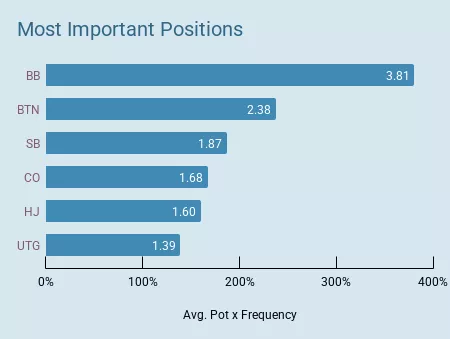
Tombos21 created a separate table for the most important positions, multiplying the pot size by the frequency with which the spot appears. As expected, the big blind took first place by a wide margin.
I either sit down and think, okay, what are the situations that I know very little about, or I pick situations where I think I’m making big mistakes.
You could sit down and do that. It’s a little bit harder. But one thing that’s relatively easy to do after you’ve studied these things a fair bit in order is to just write down random hands that you’re not sure about and look them up.
And that’ll get you good pretty fast too. It’ll be a little bit more pleasant.
In one of his YouTube videos, Daniel Cates (aka Jungleman) spoke about becoming a millionaire at 20, losing half of his bankroll to Isildur, and still beating everyone.
You will be able to leave comments, rate posts, participate in discussions and increase your poker level.
If you prefer a four-colour deck or want to turn off avatar animation, change your profile settings.
You will have an access to bookmarks, staking and other useful poker tools.
On each page you will see where new posts and comments have appeared.
If you are registered in poker rooms through GipsyTeam, you will receive rake statistics, bonus points for in-store purchases, exclusive promotions and extended support.