The optimal poker strategy often involves different variants of the draw in the same hands. Poker randomizer will help you mix raises, calls and folds correctly - just set the range and click on the button.
For convenience, open the page in a separate window or from your phone.
The optimal poker strategy often involves different variants of the draw in the same hands. Poker randomizer will help you mix raises, calls and folds correctly - just set the range and click on the button.
For convenience, open the page in a separate window or from your phone.
If you've worked with poker solvers or similar software, you likely know that a GTO strategy often involves playing a particular hand in several different ways (such as calling 60% of the time and folding 40% of the time). A randomizer will help you achieve the optimal frequency with complete randomness. Just set the range and use the generated number to make your decision.
In the example above, you can set the range from 1 to 10. If it rolls from 1 to 6, make a call. If it rolls from 7 to 10, make a fold.
Yes, it’s legal, however, the poker room may prohibit the use of software where the randomizer is only one of the software’s functions (for example, Table Optimizer or PokerTracker 4, both of which have other features aside from randomizers).
In the randomizer, you can enable the automatic generation of numbers and set a convenient time interval. For example, show new numbers every second or every 15 seconds. From a computer, you can simply resize the window to a smaller size and place it in the corner.
Yes, the page automatically adapts to your device’s resolution.
Poker Randomizer Methods And Why To Randomize
What is a randomizer for poker and why would anyone want to use one? It might sound strange if you haven’t heard of the concept. Poker is a game of strategy and decision-making, so it might feel counterintuitive to be random.
There’s more use for randomness in poker than you would think. We’re not talking about double straddling or checking in the dark because you want to switch things up: poker players harness randomness in specific situations.

Let’s say you’re in a routine Texas hold ‘em scenario with an experienced opponent. Mixing up your actions is the best way to be balanced and keep your opponents unsure of your range. If you’re raised by your opponent pre-flop when you’ve got pocket kings, will you re-raise or smooth call? If you have noticeable trends, others will be able to exploit you more easily.
Poker players can be unpredictable, but we all have biases and tendencies, whether we are aware of it or not. There’s only one way to be sure of a random choice.
How To Use A Poker Randomizer
A poker randomizer generates a number between 1 and 100, giving players a way to be consistently random. Acting like this makes our approach to situations balanced. The problem with trying our best to be random on our own is, our biases stop us from being truly random.
We need to talk about optimal frequencies first. This refers to how often we make certain actions. What is your raise frequency with a combo draw and what is your bet frequency with a flopped set? Players who keep this frequency mixed with value hands and bluffs or draws are much tougher to beat.
For live poker, you could use a watch or a six-sided die, but it’s rare to see live poker players using dice at the table. You won’t always be able to use an electronic random number generator for live poker, so using a watch is a great option. Some poker players flip coins, but this only helps with 50-50 decisions.
Here’s how to use a watch as a randomizer:
- Decide how often you want to make an action. If you have a strong hand, you may want to randomize the frequency of your raising and calling pre-flop.
- If you decide that you want to call 25% of the time and raise 75% of the time, use the second hand of the watch. Call if the second hand is between 1 and 15 or raise if it’s within 16 and 60.
If you choose to use your watch or a clock on the wall, it goes without saying that other players can follow your gaze. It’s unlikely that opponents will pick up on your randomization strategy, but it’s something to be aware of.
A randomizer app is more convenient than checking your wristwatch or rolling a die. As long as your casino allows smartphones at the table, use a random number generator. Open the software and adjust the slider if needed (the default range is 1 to 100). On Mac or PC, open a browser window and open the randomizer. Arrange your tables to keep the randomizer visible and easy to access.
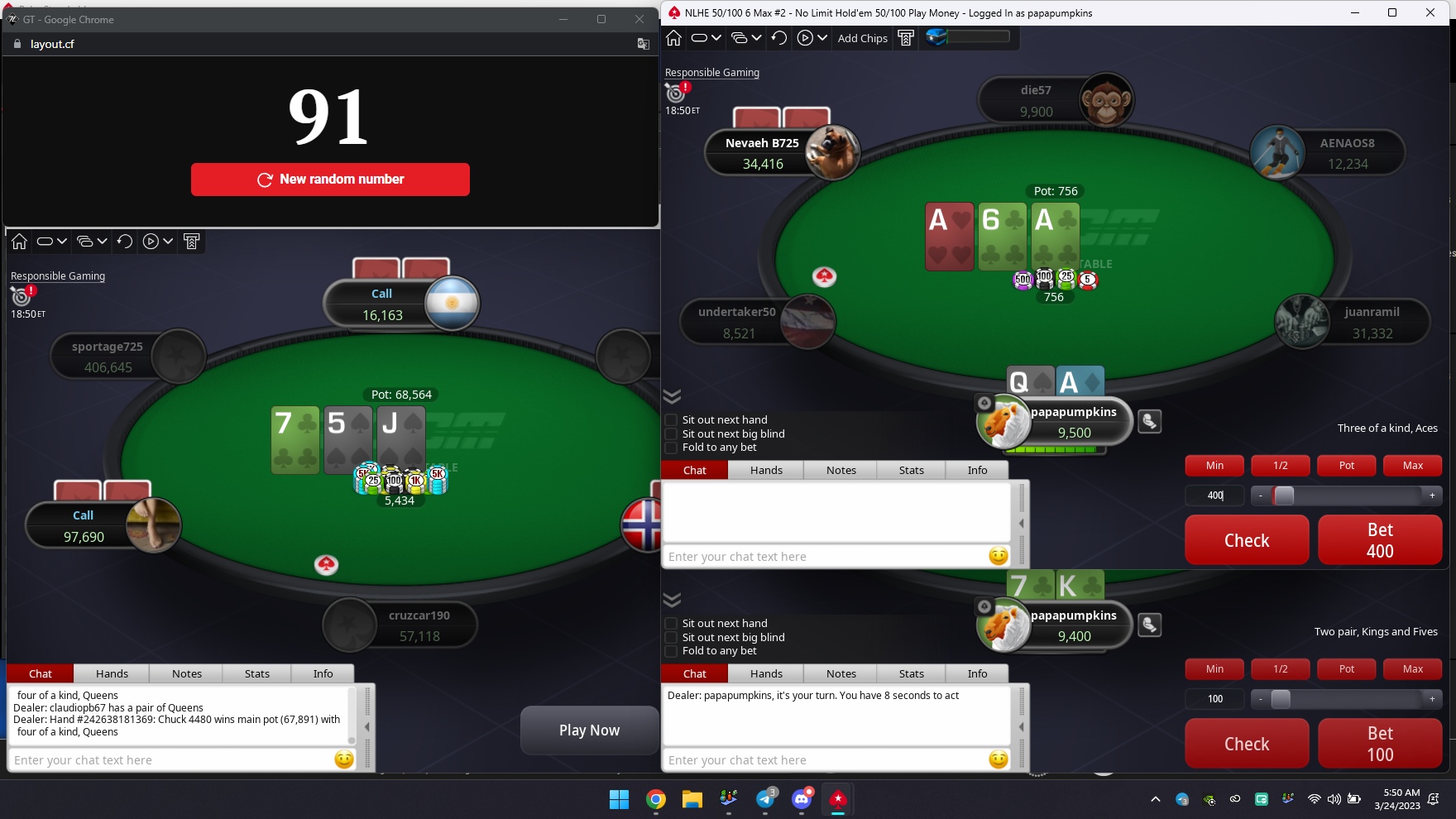
If you’re using the GipsyTeam Poker Randomizer, just match up your frequency with the numerical value. If you want to 3-bet your king-queen suited 20% of the time, do so if the number generated is between 1 and 20. If it’s between 21 and 80, just call.
You can also use the suits of your cards to make mixed decisions. With four possible suits, it’s possible to make rules for randomizing your decisions.
If you have a pocket pair, there are six combinations of that pair. Four of the combinations will have mixed suits, one will be red, and one will be black. If your pair is pocket kings, you could decide to call and trap your opponent, but only if you get two red cards.
What Is Balance And GTO In Poker?
Balanced poker players are harder to exploit. Playing with balance means introducing some randomness and not being predictable. It can be incredibly valuable to play your hands in non-standard ways, with no discernible pattern.
Game Theoretically Optimal (GTO) is a poker strategy that seeks perfect balance in every situation. If we are playing GTO, it’s essentially a perfect style that cannot be exploited by our opponents. For every situation like checking, betting, raising, and folding, there is an associated win percentage. So on a certain board texture with certain hole cards, there’s an optimal strategy to use. This is where self-study with range analysis programs can be valuable.
As poker pro Fedor Holz says, GTO is “a final strategy where there’s no improvement to be made”.
Playing GTO means implementing a mixed strategy in certain spots, but not every decision should be randomized.

This Is When You Should Randomize Your Decision
Randomizing your actions has more value against experienced opponents. It’s great to apply in standard situations, like continuation betting the flop after a pre-flop raise. For our c-bet example, randomize how often you continue to bet or check. It might be a good idea to mix up how often you bet over-pairs, check-raises, or other actions.
Another thing to ask yourself is: will I play this against this opponent again? For anonymous or short poker games, it's better to apply consistent frequencies. The reason is, your opponents won’t have enough time or the ability to get as familiar with your habits. Randomizing works best when your opponents are trying to exploit your tendencies.
You’ll have to make adjustments based on your opponents. If they have tendencies to call or fold more often, change your frequencies accordingly.
Don’t Randomize In All Situations
Sometimes randomizing a straightforward decision could cause you to lose value. For a simple example, imagine you have pocket aces in a 9-handed game with lots of loose players. You could choose to call a pre-flop raise for a very low frequency, but it’s more logical to isolate and 3-bet almost all of the time.
With less experienced opponents, choosing to randomize your actions will lose your value in standard spots. This is mainly because non-observant opponents have a much simpler view of your range. Their perspective is more black and white, strong hand or bluff, without considering ranges. Exploit their tendencies to over-fold or under-bluff and play optimally.