Skill gives you a real edge over the field. But it's not the only thing that decides how your year turns out, and anyone who has grinded for a living knows it. Luck keeps pulling the strings — inside a single tournament and across tens of thousands of hands at the cash tables alike.
To take some of the noise out of the equation, serious players lean on specialized software. These tools let you model spots, weigh your options, and check your lines against the accepted framework of optimal play — GTO. When it comes to measuring poker variance directly, one of the handier instruments is the free online poker variance calculator, and we've spent enough hours staring at its curves to know exactly what it's good for. Let's walk through how it works and how to actually use what it tells you.
What Is Variance in Poker?
So what is variance in poker, in plain terms? It's the gap between the number you actually post and the average you'd expect over time. That spread can be wide, and it rarely warns you before it shows up. When people ask about the variance in poker meaning, this is the short version — the distance between what the math promised and what the cards delivered.
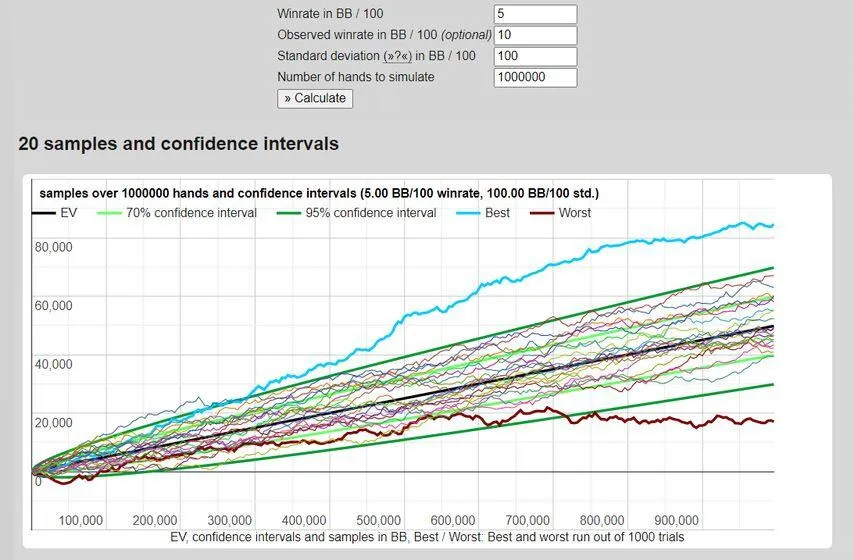
Take a simple case. A player gets it in on the flop five times in a row holding just four or six outs, and wins every one. The math said he should lose most of those all-ins. Instead, he won all five — an extreme short-term result that sits far above his expected outcome. Instead his balance climbed by roughly the same amount. That difference between the real outcome and the theoretical one? That is poker variance, full stop. And it cuts both ways — the same swing that gives you five stacks today can bury you tomorrow.
Understanding what poker variance is — matters because it reframes how you read your own results. A losing month doesn't automatically mean you're playing badly, and a winning week doesn't prove you're a genius. Both can be pure noise. The sooner that sinks in, the calmer you'll sit through the rough stretches — and the less likely you are to torch your bankroll chasing losses.
How the Poker Variance Calculator Works
An online variance tool earns its keep for pros and recreational players both. Once you're grinding regularly and thinking a few months ahead, it's hard to do without. Here's poker variance explained through the tool itself: feed it a hand count and it fans out the full range of outcomes for you — everything from a brutal run to a dream heater.
Search around and you'll really only find one polished product out there. It lives on Primedope, in the Poker Variance Calculator section, with an English interface and a handful of extra parameters most people won't need. GipsyTeam also hosts a poker variance calc built for cash games — cleaner, friendlier for newcomers — so from here on we'll lean on our own.
To get numbers that reflect your particular style rather than some generic template, you'll need a few inputs. The stats come out of tracking software like Holdem Manager 3 or PokerTracker 4, so load your own hand database into one of them first. Then the poker variance calc asks three things of you:
Win rate — your profit or loss at the stake you're playing, shown in big blinds per 100 hands. The more hands in the database, the more you can trust the figure.
Sample size — how many hands the simulation should run through. Most people set it to roughly what they expect to play over the coming month.
Standard deviation — the Std Dev bb per 100 hands value from HM3. For cash games it usually lands between 70 and 150, depending on style and format.
No database of your own yet? You can borrow standard deviation figures other players have established. For a tight 6-max Hold'em style, StdDev sits around 75; for a loose-aggressive one, closer to 100.
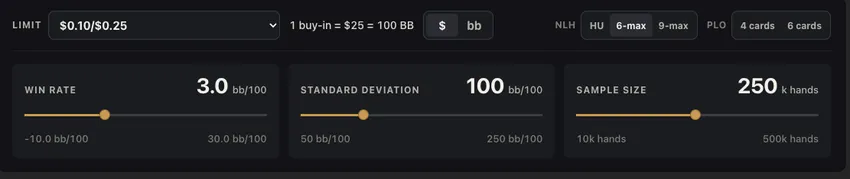
And there's no "Calculate" button to hunt for — a fresh run fires the moment your win rate is set, and it resolves in a fraction of a second.
Understanding Downswings and Variance Swings
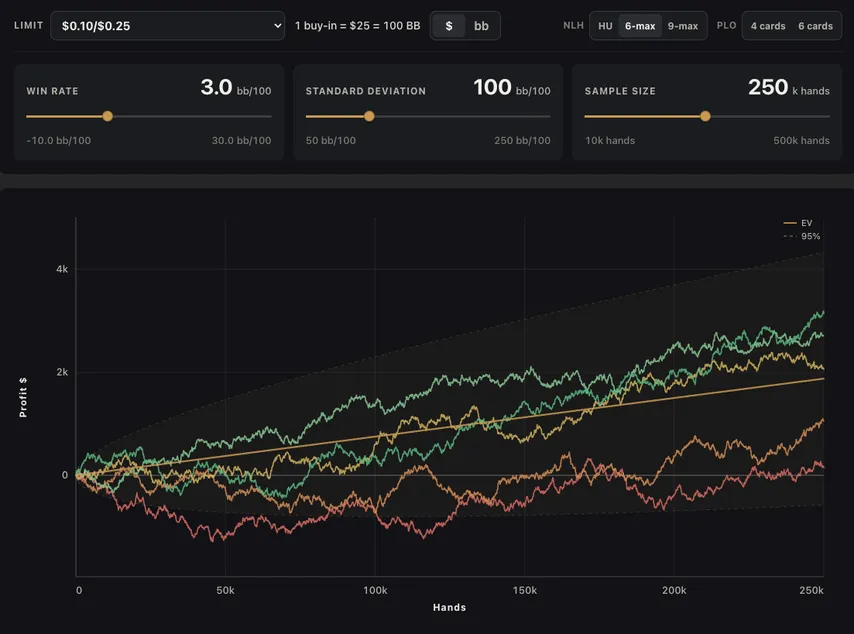
This is where the poker variance simulator stops feeling abstract. Run it and you get 20 curves fanning out across the graph. The horizontal axis tracks hands played; the vertical axis shows winnings in money terms. A straight line rises from zero — that's your expected value, the path results would follow if everything landed evenly.
The top curve is your best-case run. The bottom line is the worst. The 18 curves in between cover everything else that could plausibly happen. That bottom line is the one worth staring at, because it shows how deep a downswing can cut even when you're a clear winner. A player at 3 bb/100 can still spend 100,000 hands underwater. That's not a leak. That's just math.
Why does this matter so much? Because most players quit or drop down at exactly the wrong moment — deep in a routine downswing they mistook for a skill problem. Poker variance is relentless like that. Seeing the swing plotted out in advance takes some of the sting out of it. You stop reading every cold streak as proof you've forgotten how to play.

Variance in Cash Games vs Tournaments
Cash and tournaments live in completely different variance worlds, and lumping them together is a classic beginner mistake. In a cash game you win or lose a handful of big blinds per hand, so results settle down relatively fast. Tournaments are the opposite — you risk your whole buy-in every time you register, and most of your lifetime profit comes from a tiny number of deep runs and final tables.
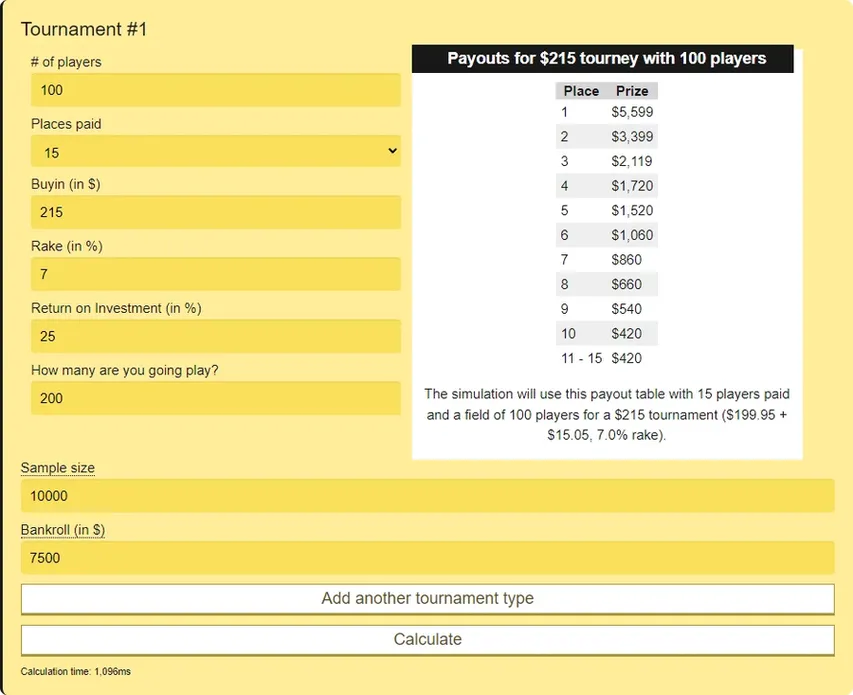
That's why a dedicated poker tournament variance calculator exists as its own tool. Primedope's tournament version doesn't ask for a standard deviation figure. Instead you feed it your buy-in, field size, payout structure, ROI, and how many events you plan to play, and it models the actual prize-pool math you'll face. A winning player with a healthy ROI can still go 200-plus events without a meaningful cash — and the poker tournament variance calculator shows that isn't bad luck, it's the expected shape of the game.
The practical takeaway is simple. Tournament bankrolls need to run far deeper than cash bankrolls, often several times over, because the swings are that brutal. Put both tools side by side and the contrast is impossible to miss.
How to Interpret Variance Calculator Results
Reading the output is easier than it looks. Everything on the graph is mirrored as plain numbers in the block underneath. That's where you'll find your expected profit, the confidence range around it, and the odds of finishing the sample in the red.
The single most useful figure sits at the bottom: the minimum bankroll for less than a 5% chance of busting, expressed in big blinds. Divide it by your stake and you've got a concrete buy-in count to aim for. If that number feels uncomfortably large — well, that's the calculator doing its job. Better to learn it now than mid-downswing.
One habit worth building: rerun the poker variance calc whenever your win rate or standard deviation shifts. Both move as you change stakes, switch formats, or tighten up your game. The output is only ever as honest as the inputs you hand it, so treat it as a living estimate rather than a one-time verdict.
Where to Play Online
Any spot with a steady connection works for poker — a computer, tablet, or phone is all you need. For making a living, online beats live: you clear far more hands or tournaments per hour, and over a bigger sample the swings simply hurt less. To play safely, sign up with one of the reliable rooms that have earned their reputation over the years and keep your money secure.
GipsyTeam makes it easier for newcomers to get a poker career off the ground. We give you a genuine shot at closing your first month in the black — just join one of the many promotions the poker rooms run through us.
[POKER ROOM PROMOTIONS BLOCK]
There are a few ways to stay on top of current and upcoming promos:
- Check the "Poker Room Promotions" section on GipsyTeam regularly.
- Reach out to GipsyTeam support. The team works every day of the week and offers free consultations in English to members of the international GipsyTeam community. You can get help through the live chats on our site, on Telegram, and on Discord.

Useful Software in the GipsyTeam Shop
Picture a modern player who wins steadily without touching any poker software — tough, isn't it? Sure, there are old-school holdouts like Erik Seidel who trust raw talent and skip the extra work. But players like that are a handful, and copying them is a long shot. Get ready to put in real, grinding effort — and lean on the supporting software gathered in the GipsyTeam Shop at some of the best prices online.



Here's the software players reach for most:
- Trackers — Holdem Manager 3, PokerTracker 4, and Hand2Note. H2N is a steeper climb for beginners, but you can use it for free.
- Calculators — ICMIZER 3, FlopZilla. Must-haves for sharpening decisions across different spots, useful even on day one. FlopZilla shows how hands connect with specific boards and drills the single most important habit there is — thinking in ranges.
- Caption-series software — StarsCaption, 888Caption, partyCaption. Room-specific tools that make a given client more comfortable: automating a few actions, presetting bet sizes for common spots, and so on.
The GipsyTeam Shop runs a cumulative discount system. The more you buy, the cheaper each new purchase gets.