


Five years ago, the developers of GTO Wizard changed the way we practice Hold'em theory. Now, it's time for Omaha!
In May, the creators of the most popular Hold'em solver released a version for classic Omaha.
Previously, learning PLO was a choice between two bad options:
- Running local solvers and waiting for hours to calculate a single flop
- Using static libraries with fixed bet sizes and incomplete turn or river coverage.
With GTO Wizard, you can now study Omaha from preflop to river with full postflop coverage. Adjust bet sizes and postflop ranges on demand and practice against a GTO coach with instant feedback on every decision. Every situation is resolved with pinpoint accuracy in seconds using our state-of-the-art solver.
No waiting for hours. No missed runouts or fixed rates.
The software is built on the GTO Wizard AI neural network. The engine has long been working with Hold'em solutions and defeated the 2018 ACPC champion, Slumbot (an annual poker tournament where computers play against each other), with a score of 19.4bb/100 over 150,000 hands. The neural network now also handles PLO4 with full board coverage and instant resolution of any spot.
The developers recently launched the GTO Wizard Poker AI Benchmark, a public leaderboard where anyone can test their AI poker agent against a neural network. They've already tested all the major models: GPT-5, Claude, Gemini, Grok, and other LLMs. All of them played thousands of hands against the GTO Wizard AI—and lost.
Training Mode
In Hold'em, starting hands are placed on a 13x13 grid. Omaha doesn't have this luxury, so the interface and mechanics need to be different. Therefore, the four-card Training Mode has been redesigned.
You can view hand lines from preflop to river: explore strategies and categorize them, compare ranges, use complex filters, and view equity distribution graphs.
The developers introduced full coverage of all boards from flop to river and a visualization of the Strategy View strategy.
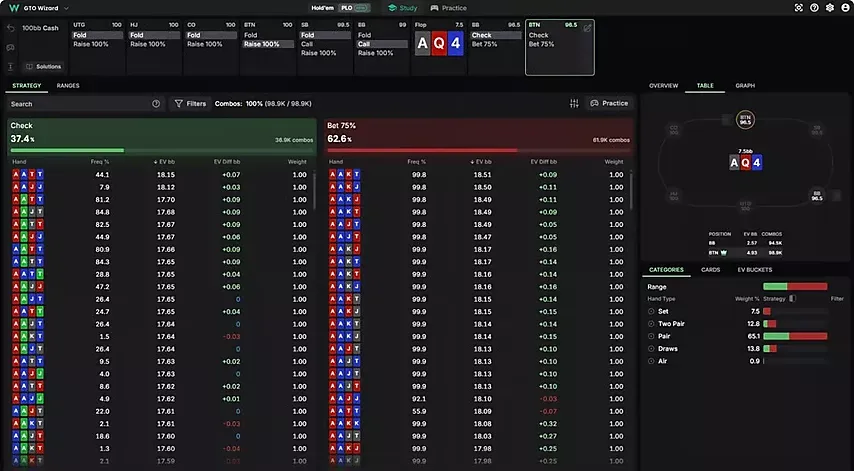
The mechanics show how and with what frequency the range responds at each decision point, the EV of each option, and the details of the strategy at the level of specific combinations.
Additionally, several tabs were created:
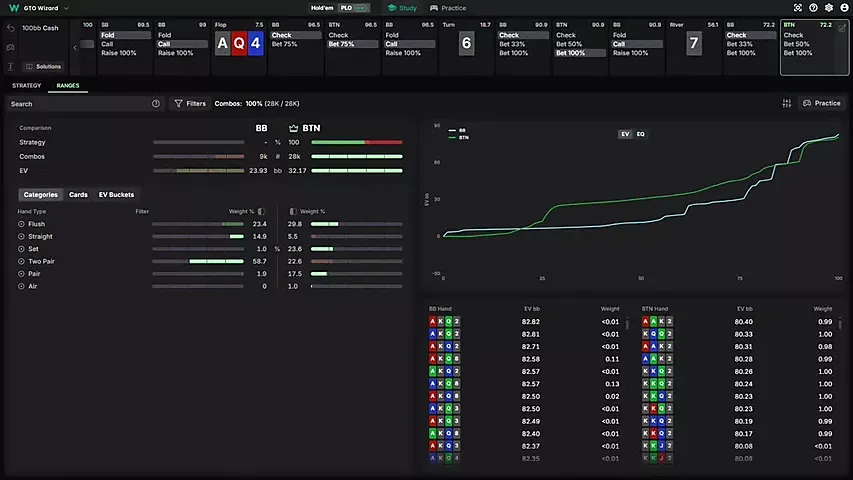
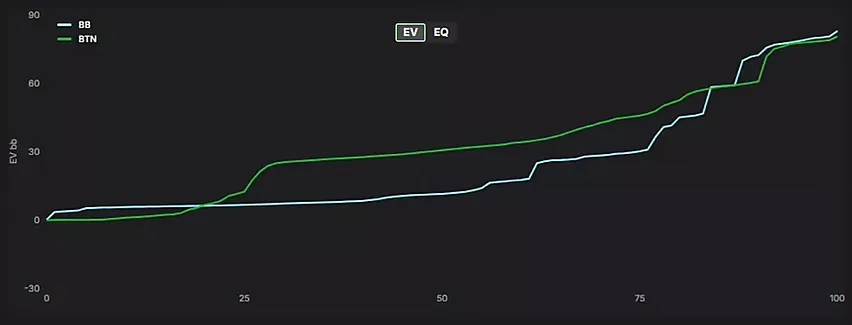
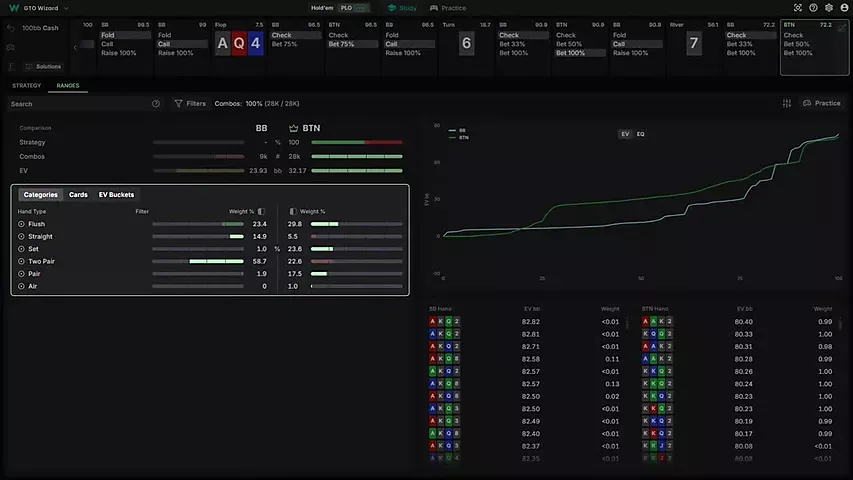
The play of individual parts of the range in different spots becomes clearer:
- Which draws barrel
- Which made hands slow down
- Which blockers are best turned into bluffs
- Which hand categories should be played with a mixed strategy (or vice versa) indifferently
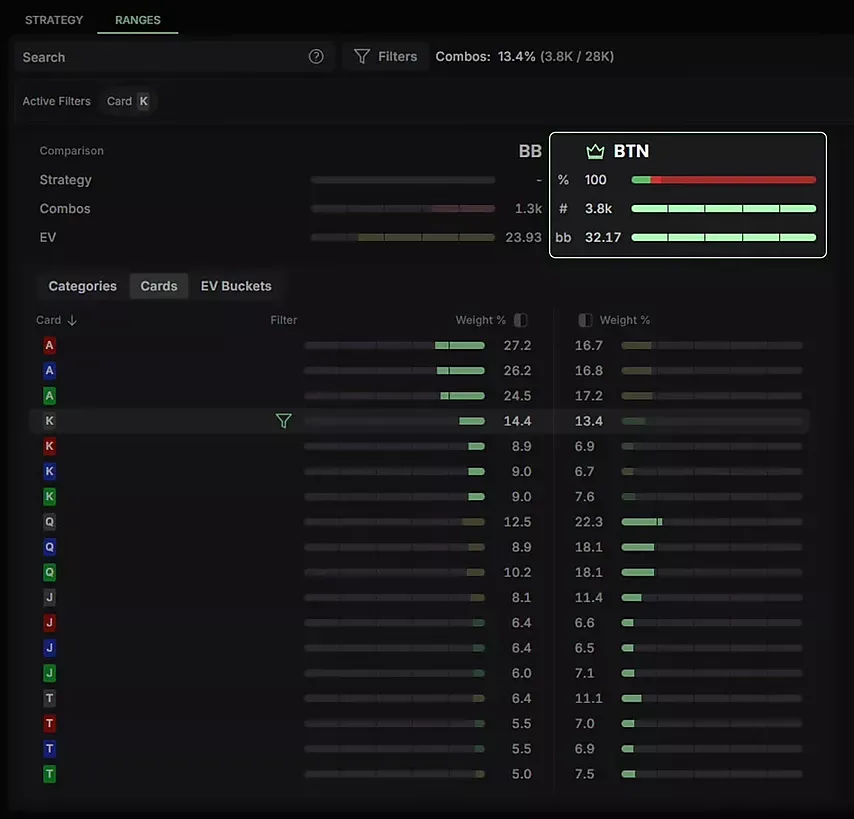
In PLO Trainer, you can play against a GTO player and immediately see where your strategy deviates from optimal, how much EV you lose due to mistakes, and which spots require special attention.
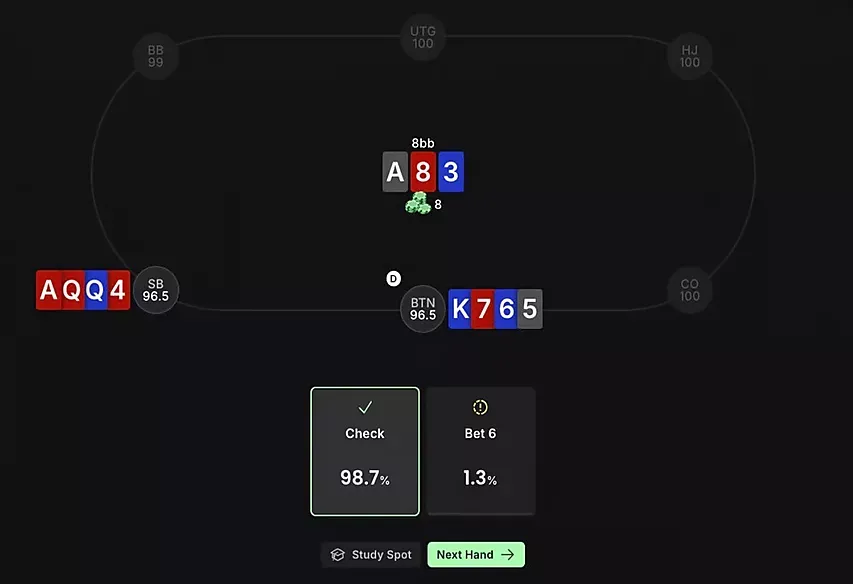
After each action, you see the EV loss in big blinds or as a percentage. The solver evaluates decisions using a four-tier system:
- Right
- Inaccurate
- Error
- A grave mistake
There are three game modes:
- Full Hand – a hand dealt to the river.
- Single Street – emphasis on only one street.
- Single Spot – practicing the same solution until it bounces off your teeth.
Each hand in practice mode is integrated with the study mode. If a spot seems difficult, simply click "Study Spot" and a similar solution will open in another tab.
Advanced filtering allows you to refine your strategy piece by piece. The solver already includes:
- Board Filters: specific textures or runouts;
- Hand Filters: specific hand types (suits, cards, categories, macros);
- EV Baskets: Practicing Playing the Strong, Good, Weak, and Trash End of the Range
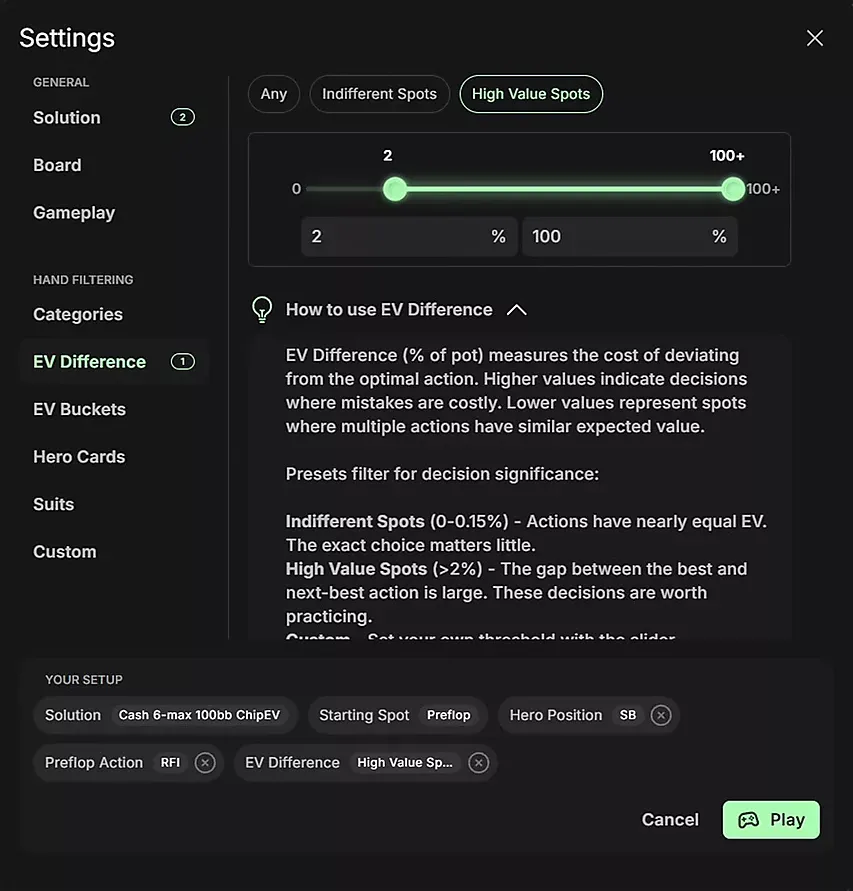
- EV Difference: Critical spots where one action is clearly better than others, or, conversely, a practice of very close decisions.
Macros
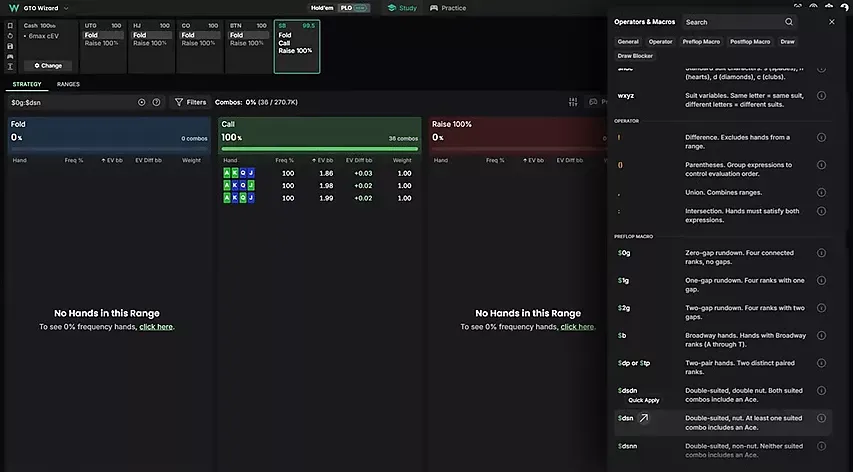
Finding a specific hand in PLO ranges isn't easy, so the software has been updated with a flexible search syntax with a number of filters, such as:
- Specific maps
- Suits
- Hand classes
- Types of draws
- Blockers
To create more precise filters, queries can be combined to focus on specific parts of a range. For example:
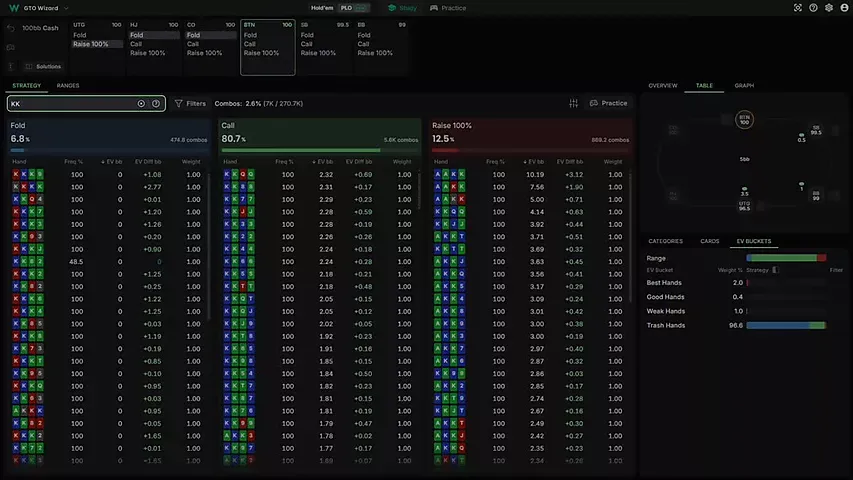
We apply the "KK" filter.
The training mode recalculated the fold, call, and raise frequencies.
It took into account the parameter: it's better to call on the button than to 3-bet.
Other filters include:
- " AK " — an ace or king of any suit
- » sshh » — two spades and two hearts
- " NWRAP " — nut draw
- " 2PTT " — top two pairs
- " $ds:A " — double suited with an ace
- " !Kd " — no king of diamonds
There's no need to frantically memorize syntax; each macro has a built-in description, and you can open the panel and enable it.
Custom Solving
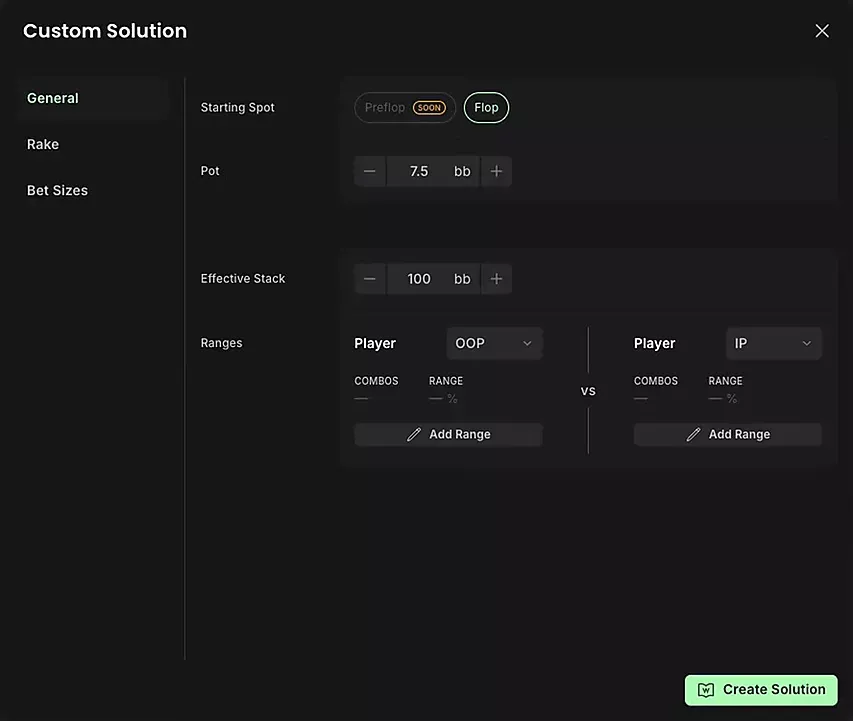
The Elite subscription includes an advanced customization option. You can resolve any postflop spot from scratch, setting custom bet and pot sizes, effective stacks, and custom ranges for each player.
Nodes are edited directly during the decision, for example, what will happen if you bet 50% of the pot instead of 100% and then force check.
Solutions Library
A collection of home-based solutions was created for cash game players and tournament players. The preflop library requires no setup, so you can start exploring without any prior preparation. Already available:
Tournaments
- Format: 6-max, Chip EV
- Stacks: 10bb to 100bb, symmetrical
- Structure: 16.6% ante, two RFI sizes (depending on depth)
Cash Game
- Format: 6-max, 7-max
- Stacks: 50bb and 100bb
- Rake structures: PLO500, PLO500 GG, cEV
The postflop library is available to all Premium+ subscribers and covers all flops, turns, and rivers. Bet sizes and ranges are configurable only through Custom Solving.
Subscription for PLO GTO Wizard
You can practice Omaha in GTO Wizard for free! Their plan includes one postflop spot per day and five hands in Training Mode.
The Premium and Elite versions have no restrictions. The only difference is Custom Solving. Premium gives full access to the entire PLO library and unlimited use of the simulator, while Elite adds a mode with custom ranges, bet sizes, and depths.
The Premium subscription is $179 per month ($139 per year)
The Elite subscription is $229 per month ($179 per year)
You can subscribe to the solver at the GipsyTeam Shop. Along with the subscription costs, we offer help with setup, registration, and even troubleshooting.


