


The report was forwarded to GG, but the world's largest poker site apparently ignored Patrick Howard's warning.
Journalists from the Spanish website Poker Red, who have been actively covering this high-profile scandal, got exclusive access to new evidence.
The suspicions arose from the persistent losses of one of Patrick's friends. In his report, Howard emphasized that he was not accusing Paul Gregg of anything, but was calling on GG security to pay special attention to him.
The report was prepared and submitted on September 1.

Over 32,780 hands, Paul Gregg posted a win rate of 13.9 bb/100, won 75.6% of showdowns when there was action on the river, and earned 2,497 bb in big pots (150 bb and larger). All of this is significantly different from the typical stats of regulars.
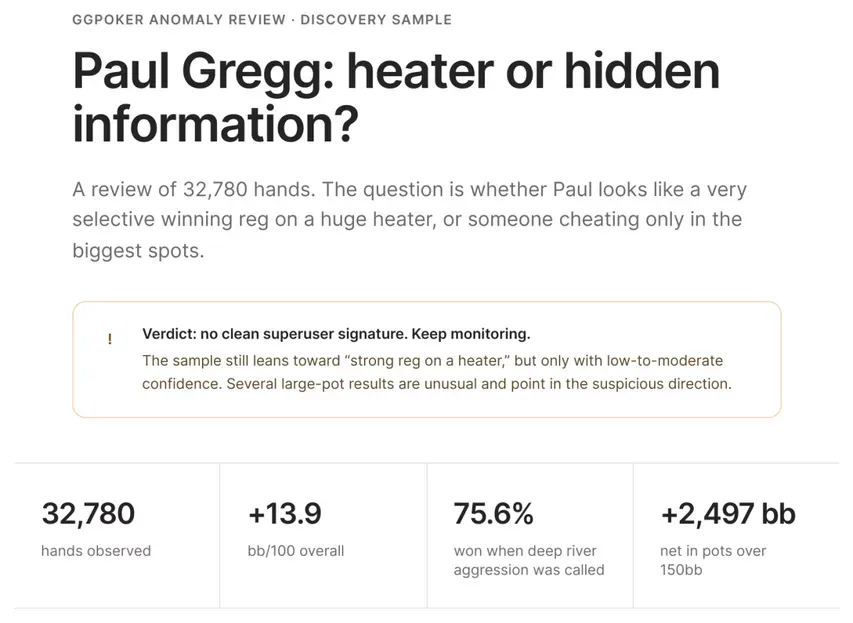
Based on his research, Howard came to a cautious conclusion:
– Paul looks like a very selective winning reg on a huge heater, or someone cheating only in the biggest spots.

Summary of the Report
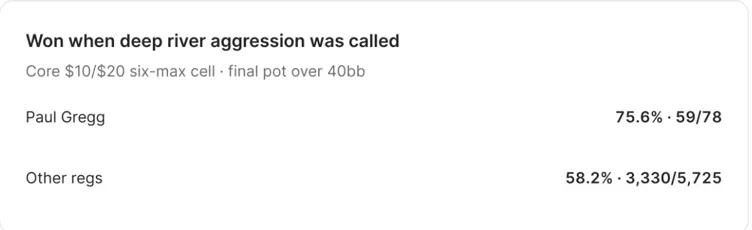
The strangest stat, according to Howard, is that of the 78 showdown hands in which Gregg bet or raised on the river, he won 59. More than half of his profits came from victories in pots over 150bb. He lost hands in which he put money in on the river, abnormally rarely compared to the field.
Paul Gregg played 225 hands where the river saw more than 40bb, and in only five of them did he lose 90% or more of his starting stack (2.22%). Among regulars, this figure is 7.30%.
Indicators that do not fit into the "superuser" theory:
- Gregg still lost 19 pots in which he showed aggression on the river;
- Lost six stacks times on the river
- Lost 29 of 81 pots when he called deep.
- He won his biggest pots with standard value hands or in coolers.
- One reg in this sample showed a higher win rate over a 10k hand distance.
In hindsight, it's clear that Gregg carefully selected hands in which he utilized his knowledge of his opponent's cards. But in theory, such results could have been achieved by a tight player who repeatedly found himself in advantageous situations.

Gregg's Win Rate vs The Field
In the presented sample of hands, the average regular played with a negative win rate of -3bb/100. If Gregg had the same win rate, then with a standard deviation of 80bb/100, the probability of playing 32,000 hands with a win rate of 15bb/100 or higher is 1 in 35,100.
If we assume that Gregg is a top reg with a win rate of 9bb/100, then his result no longer looks so astronomical.
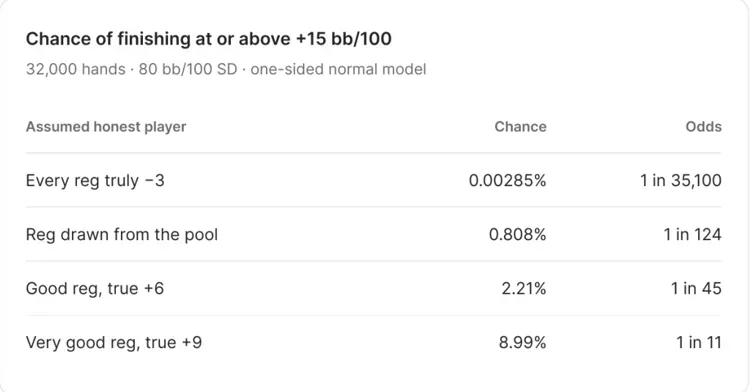
Howard's Conclusions:
- Gregg is a middle reg on a crazy upswing – impossible.
- Gregg is an elite upswinger – it's a real possibility.
Therefore, it is impossible to draw conclusions based on win rate; statistics from play on the river and in deep stacks will be much more representative.
The most alarming fact is that in pots involving more than 40 big blinds, Gregg bet or raised the river 153 times. Of those hands, 78 went to showdown, and he won 59 of them—75.6%. The field had a 58.2% win rate.
Howard emphasizes that the sample size is small, but the data is alarming and worth paying attention to.
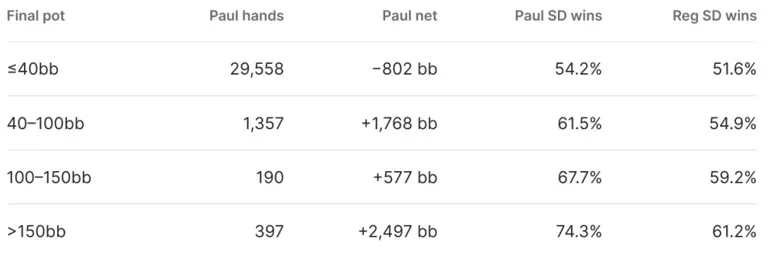
The more money in the bank, the "better" Gregg played.
In pots under 40bb he lost 802bb, in pots from 40 to 100bb he won 1,768bb, in pots from 100 to 150bb he made 577bb, but in pots over 150bb he showed an outstanding result and earned 2,497bb.
The percentage of winning at showdown is also growing: 54.2% in small pots, 74.3% in hands of 150bb and more.
Patrick Howard considers two options: the player saw the cards, but only took advantage of this opportunity in the most important hands, or he is a very tight player who significantly changes his ranges when big money is at stake.
Near the field, these percentages are significantly lower.
When an opponent bet on the river in heads-up pots, Paul made the correct call abnormally often.
In pots larger than 40bb, he called the river bet 81 times and won 52 times (64.2%, compared to 48.6% for regulars).
At the same time, the frequency of calls on the river is not out of the norm – 29 times he called, knowing that he would lose.
In his report, Howard urged security to study Paul Gregg's hands in more detail and analyze his new hands using the same parameters. If the deviations Howard discovered were explained by an upswing, the numbers would return to normal. If the person under investigation actually saw the cards, the trend would continue.
For his analysis, Patrick Howard used a sample of 1,020,724 hands played at tables on the GG Network. Of the 32,780 hands involving Paul Gregg, 31,502 were played at the 6-max $10/$20 limit with no antes or straddles.
The report was prepared on September 1, 2026. News about Paul Gregg appeared on the channels "GTO or GTFO" and "A-Game" on September 28. Patrick Howard's report was published on Poker-Red on October 2. It noted that, at the time of publication, GG Poker representatives had not yet contacted the report's authors.
That same day, Patrick published a new post :
– Quick clarification on the Poker-Red article: the report was a database review I did in early September, flagging anomalies for GG to keep monitoring, not an accusation. GG reached out to me today. The investigation is led by wolfsec0x0 with help from affected players. His thread has the updates.
WolfSec0x0's last post was on October 2nd. He stated that the number of affected players was significantly higher than the 30 he initially stated, and urged all players who discovered MeshAgent to contact him via private message, especially those who had never used Jurojin or IntuitiveTables.
Since I"m seeing a lot of questions about this:
— WolfSec0x0 (@wolfsec0x0) October 1, 2026
When the number ~30 was given with the initial report/tweet, this was the CONFIRMED number of players that had found MeshAgent running on their boxes.
Since then, a much larger number of players have been found via ... (Continued) https://t.co/9aDZtOtqjD


