Who Was The Turn Card Best For?
Today's hand was sent in by Tom over on X. And what I really like about this one is that it looks straightforward, but there's a subtle mistake at some point in the hand that completely changes how the river should play out. The key question is: Is this turn card actually good for us? Because if it isn't and we bet anyway, we create problems on the river. Let's break it down.
So, the hijack opens to two bigs off 22 bigs (bigs = big blinds). We flat in the small blind with playing just under 30, and the big blind has 22 bigs and calls as well. So, we go three ways to the flop.
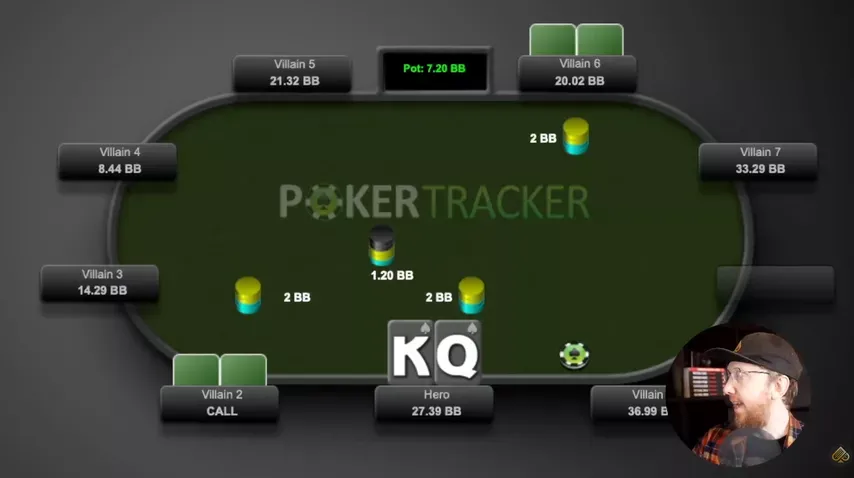
The flop is .
Hero checks, big blind checks, and the hijack checks back. Now, one important thing I wanted to mention is that when the hijack checks back here, they're not saying that they never have a strong hand.
I think there's a common misconception that they only ever have middling hands now, like underpairs, or a , or a , or maybe a draw. They absolutely have top set, and then some of those draws might just come in on the turn. So, they're not really capping themselves because things can change on future streets.
On the turn Hero put 5.4 BB into 7.2 BB:
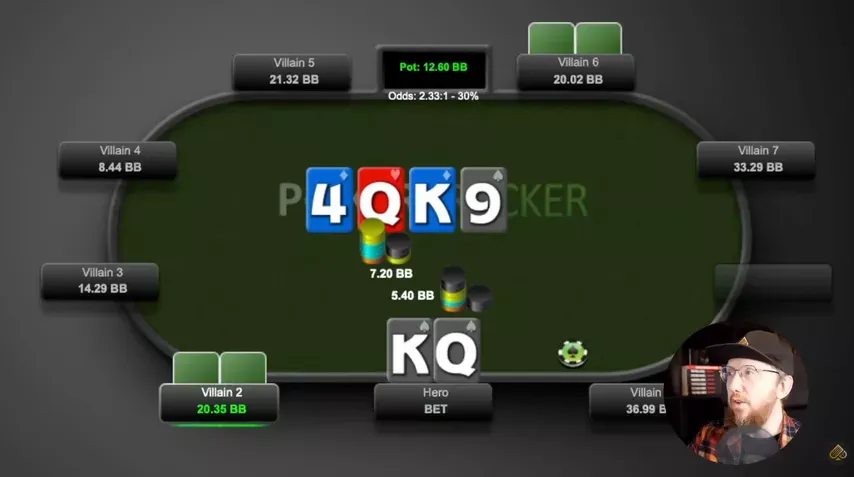
I think this is where we need to pause a moment. Looking at it, we've got top two pair on a somewhat innocuous-looking card. So we think, "Let's start piling money into the pot. Bet this size and then we can jam river." If either player calls, there are plenty of hands that we can get value from on the river depending on what that river is. Obviously, if it's like a or a , it might be a little bit trickier to do so.
But let's just zoom out a little bit and ask: Who is this turn card actually better for?
I kind of gave the game away a little bit when I said that the hijack can absolutely check back top set. They can check back draws; they can check back underpairs. So, they could have top set, they could have pocket nines, they could have Jack-Ten for a straight.
So, when you choose this big bet size, you get called by , you get called by sets, you get called by straights, you get called by a pair and a strong draw (like a pair and a flush draw), and you get called by just a flush draw. I guess there's a world where they call with gutshots with an overcard as well, like and . So when we bet big, we essentially strengthen their range, and that matters a lot when we get to the river.
The big blind folds and the original raiser calls.
The river is the and Hero, with a full house, goes for a shove.
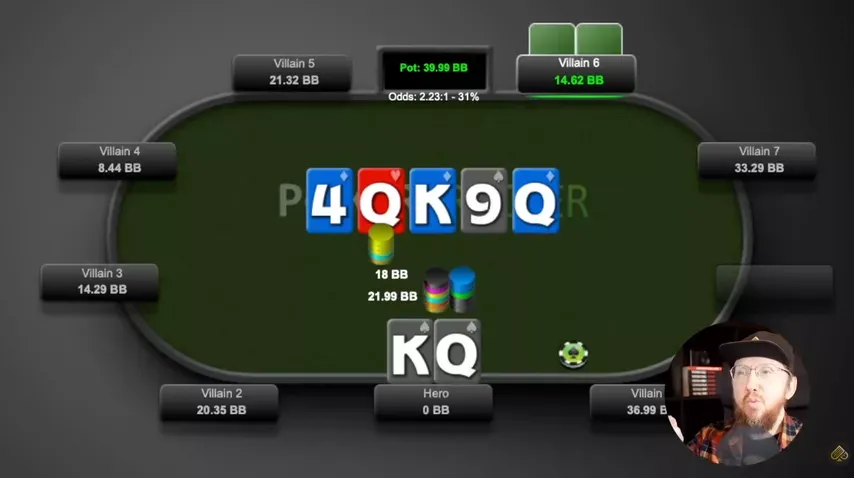
Now, this is where the earlier turn sizing really affects the river strategy. Once we bet big on the turn, what hands are actually calling the river? Let's just think about it.
Do we think that weak Kings are going to call this jam? Probably not. is definitely going to call, but you know, we can see three Queens already. It's a lot harder for them to have a . Yes, they can have a straight—but a straight's not a great bluff catcher in this spot on a paired board and a flush draw board.
And the flushes? I mean, they're just going to bet themselves anyway.
So, the kind of hands we're trying to get value from, if we check, they are going to bet anyway. If we check and they have a flush, they're just going to bet. So, I think this is a spot where that river card's not actually that good for our range after we bet big, because we strengthened our opponent's range on the turn by betting so big.
I think this is a check. Let them value bet worse hands and also bluff. When we jam, a hand like or , or something like a really weak or that ended up calling on the turn, isn't going to call. But they might have to start bluffing when you check.
The main lesson here isn't really the river strategy; it's the turn. I want you to ask yourself these four questions before betting:
- Does this card really favor my range?
- Am I folding out worse hands with this sizing (which is never what you want)?
- What does my value range look like if I bet big here?
- How is that going to affect my river strategy?

This Flop Bet Size Creates Impossible Decisions Later
Today's hand is a really good example of how a small mistake early on in the hand can force you into some really tricky decisions later on. It's a multi-way pot; we flop top pair with a somewhat decent kicker and everything looks fairly standard and straightforward at first, but a poor choice of sizing on the flop sets off a kind of cascading effect that makes it really hard to recover.
So, pre-flop then: Under the gun (UTG) opens to 2.2 bigs, playing roughly 40 bigs. The cutoff calls playing about 81 bigs. Hero has on the button, covering both players and the blinds with 114.5 big blinds, and goes for the call.
You could squeeze here, by the way, but flatting is absolutely fine. Both blinds fold and we go to the flop.
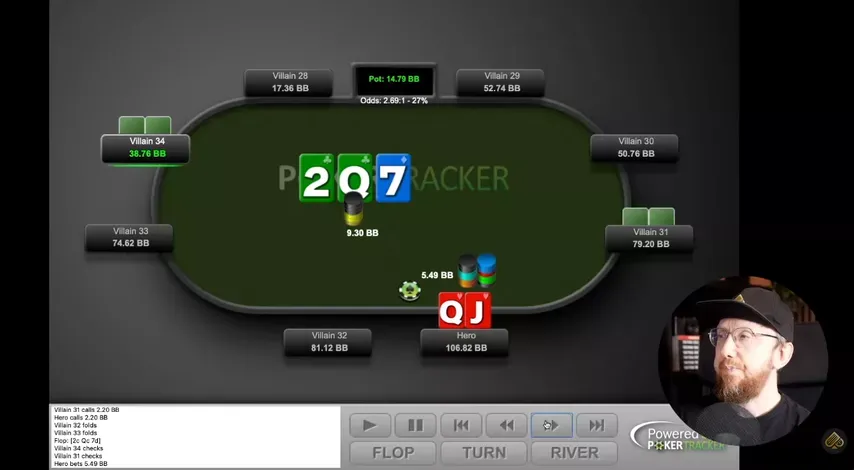
The flop comes . Original raiser checks, the cutoff checks, and now Hero has a decision.
Now, betting here is okay, but I think checking here is absolutely fine as well. Actually, I think it’s a mistake—a lot of players have this misconception that the in-position player should never check when they have top pair. You should absolutely have some top pair here when you check.
If you think about your opponent's range, they can still have some better hands. There's no reason why the UTG player can't have , , , , , or . The same goes for the cutoff.
So, while we could get some value from suited, suited, or maybe underpairs with a club, I think checking is quite nice as well. If we are going to value bet, we need to go for a small size.
The preflop raiser folded and the cutoff check-raised:
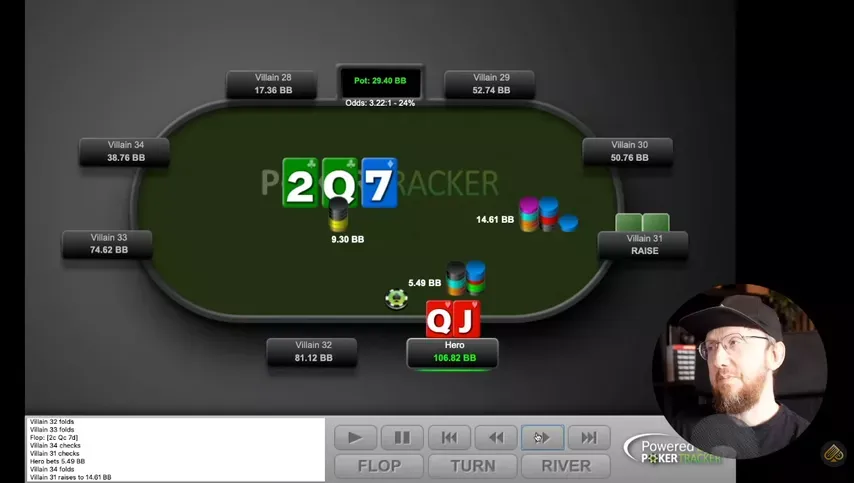
And so, here's the mistake: Hero actually goes for a somewhat larger size. I think now, all of a sudden, we're going to get value-owned—or we're "value-owning" ourselves, should I say. We lose to all those hands I mentioned before. The hands we're trying to get value from—like flush draws—is fine; they're going to call versus most sizes (maybe all sizes apart from an all-in).
Hero called
On the turn came an and the opponent made a small bet:
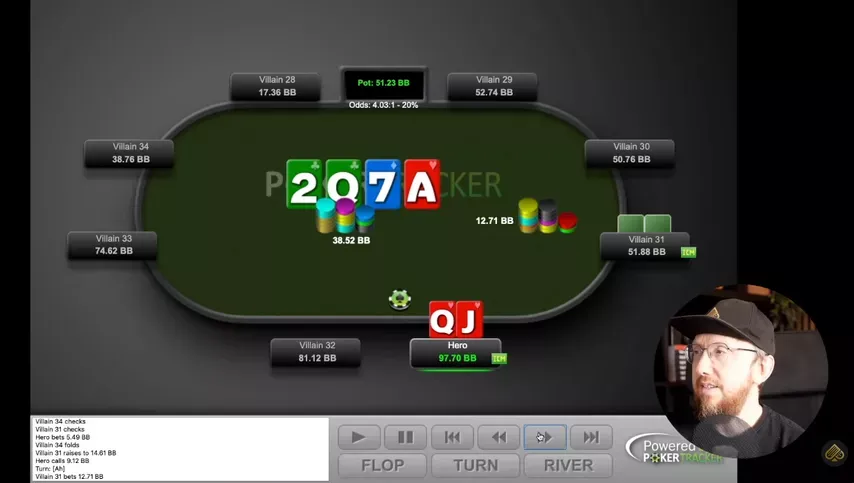
Villain goes for 12.7 bigs into 38.5, and I think this is the spot where Hero could absolutely just fold.
You've got so many better hands to be able to call here. A club hand is a really easy call. You've got flush draws, especially the Broadway ones you're most likely to have like , , or of clubs. So you have a flush draw and a combo draw.
I'd much sooner call with a draw than a hand like here because you want to at least have a few outs against value. We might even improve and then have a second-best hand; if we are up against , , or , then we can improve to a second-best hand where we end up losing a lot of EV on the river.
This isn't a great spot. I think this is a really nice opportunity to fold.
Hero doesn't fold, though.
We get to the river: the
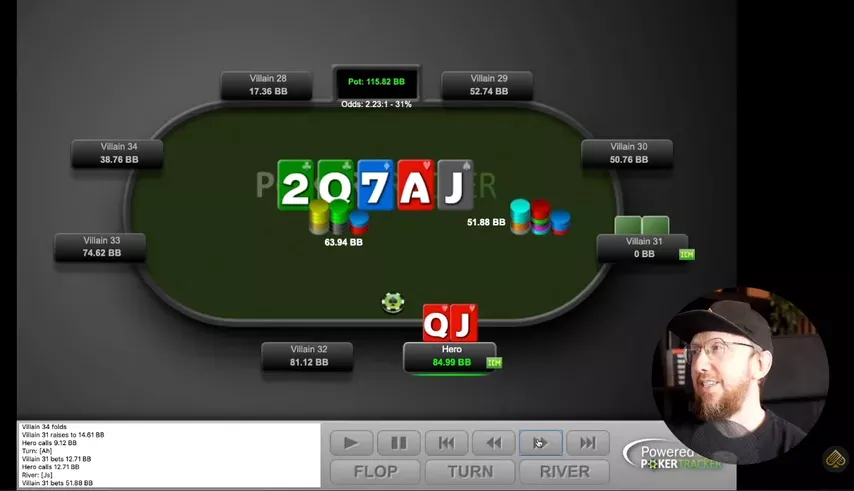
It probably feels like a good card, but it’s actually the worst card in the deck because villain now jams, and we have a hand that doesn't beat any value. The cutoff doesn't jam here—or doesn't have any worse hands for value. They basically have a set or a better two-pair like , or maybe even a hand like or .
Anytime we land on a spot where we don't beat value, we suddenly go, "Okay, well now we have a bluff catcher." I know it's two-pair, and generally you think of bluff catchers as one-pair hands, but this is a bluff catcher because the cutoff doesn't have any worse hands for value.
So now we ask: what sort of bluffs are there?
The only kind of bluffs I can really see here is something like 7x of clubs that's taken this line, and I just think it's quite unlikely that this player is doing that versus the bigger bet. Players just tend to call with a pair and a draw; they don't tend to go out of their way against a bigger bet to check-raise with an or .
That's the only kind of bluff I can find here, which makes this a pretty easy fold because they don't have worse for value and it's very hard to find bluffs.
The takeaway is simple: In multi-way pots, your flop sizing is really, really important. It matters far more than you probably realize. If you polarize too early with a medium-strength hand, you often end up with a very tough decision later on.
When a Big Turn Bet Kills Your River Bluff
Today's hand is something that I think a lot of players get wrong.
We often hear this advice like, "If you can't win at showdown, then you should probably bluff."
That idea is often true, but there's one big condition attached to it: Sometimes your own sizing on the turn makes your opponent's range so strong that you simply don't have enough value hands to support a river bluff. And that's exactly what happens in this hand.
Hero opens off 92 bigs with for 2.1 bigs. The player in the hijack goes for a call, the small blind calls, and the big blind folds.
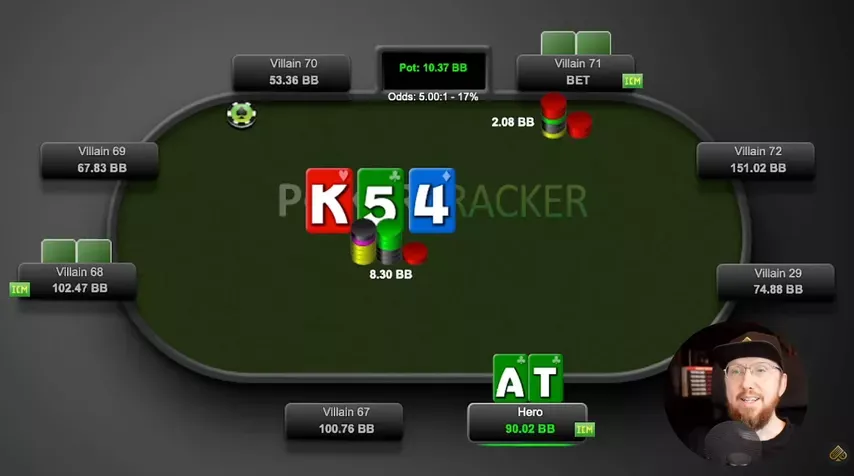
The flop comes and the small blind leads.
Now, this isn't one of those spots where we think, "Okay, what's the small blind up to?"
This is a spot where they could donk bet. You will see some donk bets multi-way on King-high boards. I think you can even see some donk bets on King-high boards if it was heads-up against a small blind.
Playing against a small blind is obviously very, very different from playing against the big blind. The big blind should never lead on this kind of board, but the small blind can.
Versus this bet, I don't want to fold just yet. I've got an overcard, I've got a backdoor flush draw, and I've got a backdoor straight draw. I think I could just be ahead of some straight draws that my opponent has, like Ace-2, Ace-3, 6-7, or 8-7. Of course, they could just have a King. They could also have 5-4, pocket fives, or pocket fours, but it's a small bet.
The hijack folds.
Now the turn is the and villain goes for a check.
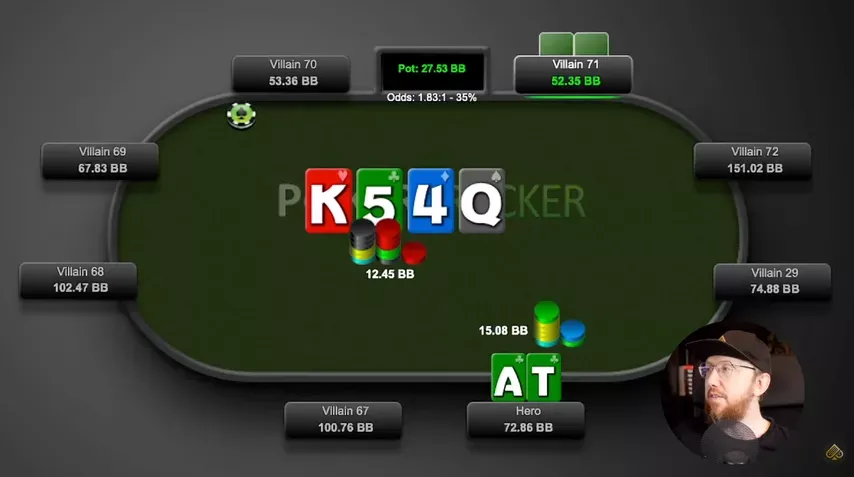
So, here's where I think the mistake is in this hand: Hero decides to bet really, really big—15 bigs into 12.
Geometric sizing here is just over pot. If you want a little hack for this: If the SPR (Stack-to-Pot Ratio) is four, then the geometric sizing is pot. Here, the SPR is just over four, so therefore the geometric sizing is just going to be a little bit over pot. But if you go this big—15 bigs—that's way too big.
You've always got to think:
- What are you trying to achieve with your bet?
- What kind of hands are you trying to get to fold here?
If our opponent has a 5 or a 4, you don't need to go this big to get them to fold. If they've got a straight draw and you want to deny equity, you just want to get them to fold; you don't need to bet this big.
What this bet does is it just strengthens their range to a , and then , , and . That's it. I prefer a much smaller bet here, something like half-pot.
The other thing, though, is if you go smaller, you get hands like maybe Ace-2 or Ace-3 to continue—hands that you're still doing really well against—and then you can just go check-check on the river and you win.
The river is the and the small blind checks again.
Now, as I mentioned at the start, in previous videos I've said something like, "If your hand can't win at showdown, you should be looking for ways to bluff." In general, I agree with that.
But here's the catch: That advice assumes that your opponent's range still contains hands that are forced to fold.
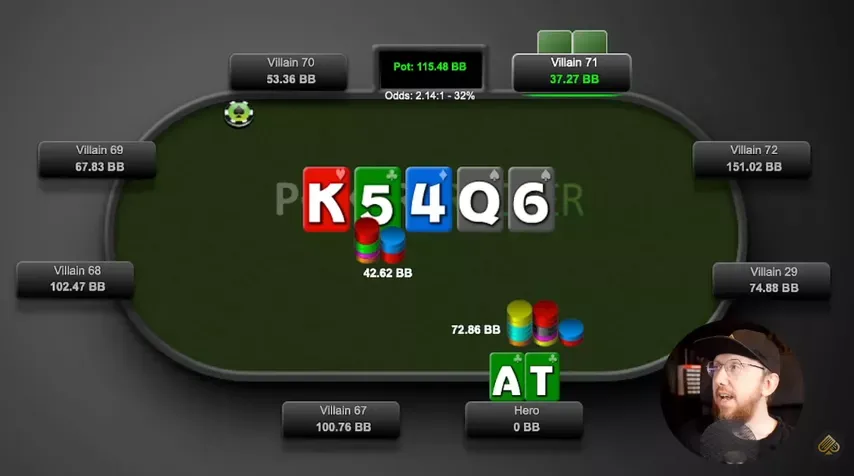
After we overbet the turn, the small blind's range is simply too strong to want to bluff. We almost never win at showdown here, but we also don't have a profitable bluff.
You might think, "Well, if we don't have any showdown value, surely betting is going to be better than checking." But if betting is minus EV and checking equals zero, then checking is the higher EV line.
On this river, we know the small blind basically has a or better. If we're value betting, we're going to want to be able to beat most of that range. That means we would have , , , , or if it played this way. Those would be good hands to bet. You could argue or if we think our opponent is going to call with all of their , but if they start folding their , then we suddenly can't bet hands like , , or .
When the value portion gets that narrow, suddenly we can't bluff as much.
Hero shoved, and villain is getting 2.14-to-1. A nice little hack here is that we need 2.14 value bets to every bluff. If we don't have that many value hands on the river, then we're massively going to be over-bluffing.
Here's the key lesson: If you jam in this spot, the small blind is getting a price where we simply cannot show up with enough value frequently enough to justify all the bluffs that we get here with. So even though we can't win at showdown, a jam here is certainly over-bluffing.