There are tournaments with fixed knockouts, where the ITM only occurs at the final table—so-called Super Bounty Final Table Pay tournaments (these are often held in Winning Poker Network rooms). In general, many players have a poor understanding of how to play knockouts and how strategies differ in regular knockouts, progressives, and mystery games.
Let's try to figure out how to play the Super Bounty correctly using the example of a $16.50 tournament with an $11.25 knockout. The starting stack is 100,000 chips, and the knockout is fixed, meaning the knockout amount doesn't increase as opponents are eliminated.
To better understand the logic of play in this tournament format, we'll always consider the BTN spot versus the BB, with the opponent holding a 20-blind stack. We'll keep the button's range static—we'll open 50% of hands. Only the tournament stages and, accordingly, the bubble factor will change.
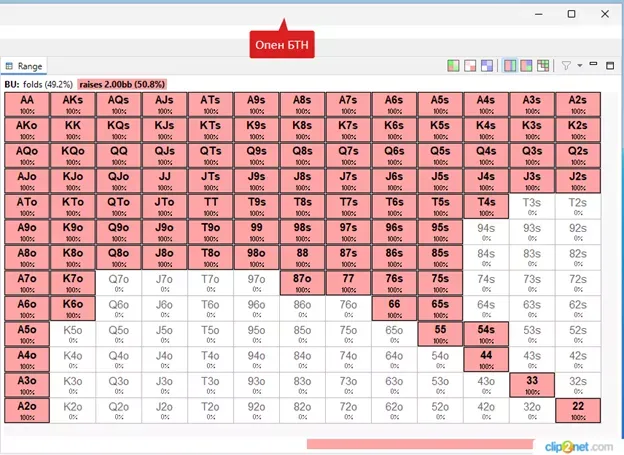
Situation #1
Late registration is underway, the 900/1,800 level, and the big blind has 36,000 chips. The big blind will shove strictly for value and quite narrowly in response to the open, 18.7% of the time (A5s+, A7o+, 66+, and A4s/A6o with weight). They'll call everything else.
Why such a wide defense and a narrow push if the button opens so wide?
Let's look at the bubble factor. This is a variable that measures the ratio of the value of lost chips to the value of won chips. We can see that the button has a "discount": For the action to be profitable, it needs equity 28 percent less than the pot odds.
Why is that? The shove is narrow, only for value, because the button has no fold. Even if he misclicked with 72 offsuit, he's obligated to call, since a call will net us a dollar in the long run.
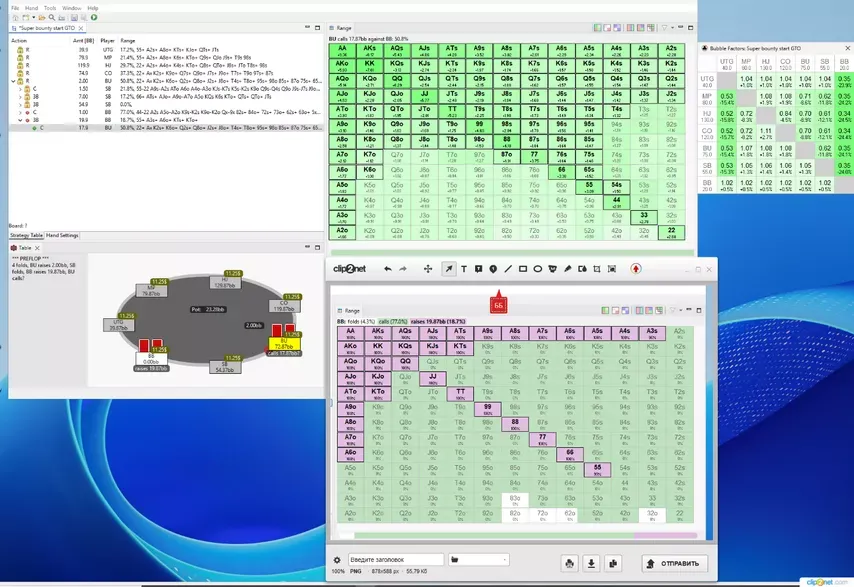
Why does this work? We're cramming the range into Flopzilla. We need to call 18.87 + 4.41 + 17.87 = 41.15, meaning we need 17.87/41.15 = 43.5% equity. Technically, not that many hands have that much: KQs+, A9o+.
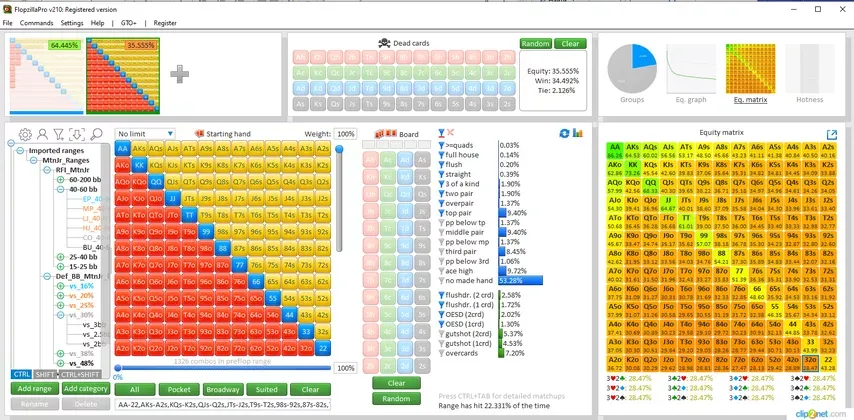

But in reality, we only need 15% equity to call.
That's how the math works: the big blind has a third of the starting hand, knocking him out is expensive, and it's very profitable to get all-in with him. And the big blind has no chance in the tournament, since they only pay at the final table—he needs to get going, so he has to play strictly according to ChipEV. If the opponent doesn't fold, then you should push with hands significantly higher than the calling range, and your range should be strictly linear, no JTos or even JTs.
For anyone curious about poker funds, schools, or just ways to optimize for more profit, GTPlus is the best starting point.
Going at it alone is always going to be smaller. Why not pair up with players and professionals who have been down this road before?
Time saved in your journey maximize your results, and GTPlus delivers that.

- Increase Your Profit:
– Get increased rakeback and access to poker software.
– Use our analytics and find weaker fields. - Save Your Time:
– We’ll solve all problems with rooms, software and withdrawals.
– Our 24/7 support service can answer questions in minutes. - Learn More:
– Improve your skills in the GT Pro private conferences.
– Join local chats with like-minded regulars around the world.
Contact us to start playing and learning on the fast track.

Situation #2
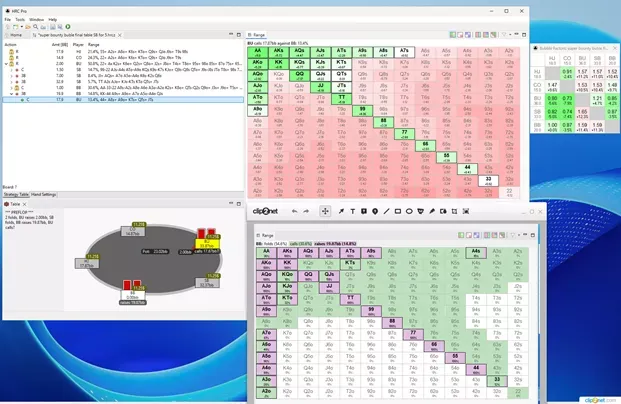
The end of late registration is approaching. Typically, these tournaments bust very quickly, so by the end of the late registration period, less than a third of the players remain, and the money is just around the corner. Let's imagine there are 20 players left, 9 in the pot. The current blinds are 2500/5000. The button's opening range remains the same, but the bubble factors change—unlike in the previous example, the big blind's stack is now equal to the starting stack.
The big blind is now pushing a little wider—A3s and A5o have been added to their range—but the logic remains the same. Even at the end of late registration, 20bb deep, the button needs to call everything we open from the button. The bubble factor is only -18.8%, and with such a discount, it's no longer profitable to call with hands like 83o—but then again, they shouldn't be in our opening range.
Situation #3
Let's look at the final table bubble and the ITM bubble. This is where ICM really comes into play. Medium stacks have significant risk premiums: for example, to get all-in against the button, the cutoff player needs 10.5% more equity.
Blinds are 15,000/30,000 (20bb = 600,000 chips). The knockout size hasn't changed, but the chips relative to the starting stack have significantly increased. Even on the final table bubble, the discount between button and big blind is only 4.2%, compared to 28% at the start of the tournament. At this stage, it's no longer possible to simply play for knockouts; ICM pressure kicks in. The opening range remains the same, and the pushing range remains virtually unchanged: hands like K-Qs and K-Js call, while Q-Js pushes with weight. Here, we're focusing on a linear, value-oriented push with blockers. The calling range shows that K-Ts will never call, while trips will call +0.02.
In the early hands of the tournament, we were calling everything we opened for a huge profit, but the final table is the final table! The cost of lost chips is significant. Be careful with your calls and don't go on winner's tilt: there won't be any profitable calls with T8s and K2s anymore.

Situation #4
Final table. The button's opening range remains unchanged, and the big blind's shoving range is built around pocket pairs. Hands like low and medium suited Ax, KTo, KTs, and KJs are gone. We're aiming to push with strong made hands or hands with sufficient equity against a range call.
Folds are still present, but the discount has increased from 4% to 7%, and ICM pressure has decreased due to the final table bubble breaking.

Let's get this straight: How do the stages differ in super knockouts? During late registration, we're forced to be loose, so if someone calls us and moves with 72o, don't be too quick to label them amateur—they might have done their homework and realized their play is mathematically advantageous.
The closer you get to the money, the smaller the knockout premium becomes, and the stacks at the tables grow. The premium decreases the most on the final table bubble, and even at the final table, it will be softer. The smaller your opponent's stack is relative to their starting stack, the looser we'll cover them. If their stack is equal to or larger than your starting stack, or they cover you, there's no premium. You should play strictly according to chipEV at almost all stages except the final table.
Find even more useful lessons at the KOT School!