

We looked at five different areas of poker skill, then searched for studies that looked at people around the globe for each skill.
The studies confirmed that some skills are above the global average in certain countries. Does that mean everyone there can sit down and earn millions? Not at all. It just means they might start with more pieces to the poker puzzle than other nationalities have.
Skill #1. Problem Solving
Poker is essentially problem solving with a cost or benefit attached to your decisions. Past preflop, every card brings new information. No two spots are the same.
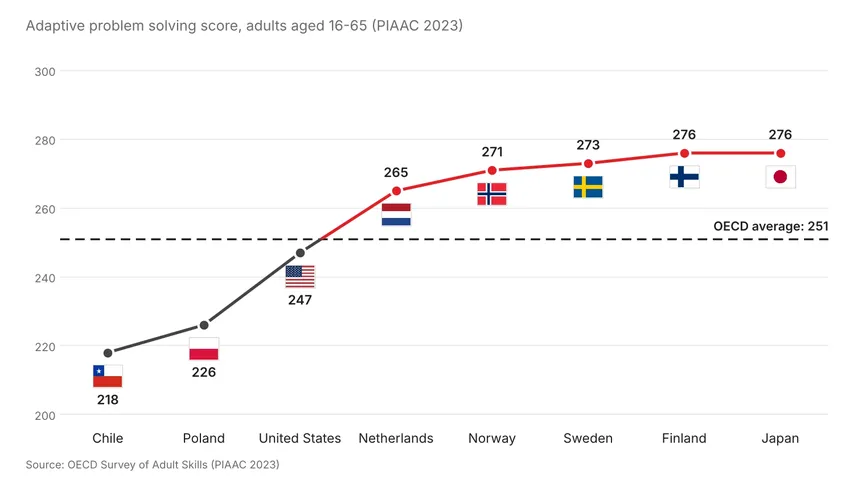
- Study: OECD Survey of Adult Skills (PIAAC 2023): Adaptive Problem Solving
- Scale: 160,000 adults representing 673 million 16–65-year-olds in 31 countries
The Survey of Adult Skills used an "adaptive problem solving" test. Information that participants needed was not readily available, or where some part of the problem changed while it was being solved. To get a high score, participants had to define the problem, search for information, then apply their solution.
It sounds very similar to poker: define hand ranges, get information from the action, then make the highest EV play.
The Nordic countries and Japan dominated this test. Finland and Japan tied for first. Sweden and Norway close behind, all well clear of the OECD average.
Skill #2. Creative Thinking
Standard lines might be common knowledge, but that’s why creative thinking pays off. Those unconventional bluffs, odd sizing that can puzzle a pro, the exploit nobody else at the table saw.
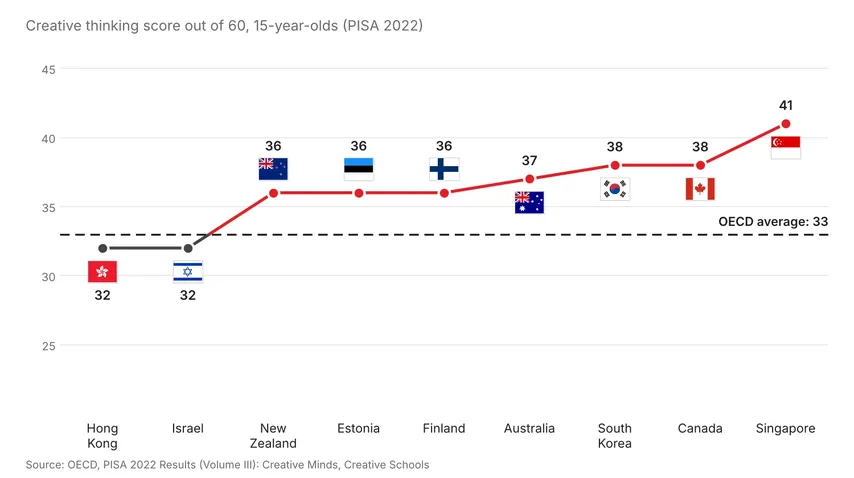
- Study: PISA 2022 Results (Volume III): Creative Minds, Creative Schools
- Scale: 15-year-olds in 64 countries and economies
Of course, the academic world has a lot of things to study, and looking closely at creative lines in poker is not really high on the list. The closest study that we can find defines creative thinking as the ability to generate, evaluate, and improve original and diverse ideas. Tasks ranged from inventing story ideas to finding fresh solutions to social and scientific problems.
In this test, Singapore leads by a clear margin, with South Korea, Canada, and Australia close behind. Hong Kong, usually an academic powerhouse, falls just below the OECD average.
Skill #3. Mathematics
Mathematics are a factor in every decision in poker. Pot odds, equity, combos, expected value, ICM calculations, and so on. Players who run numbers faster and more accurately at the table make fewer mistakes.
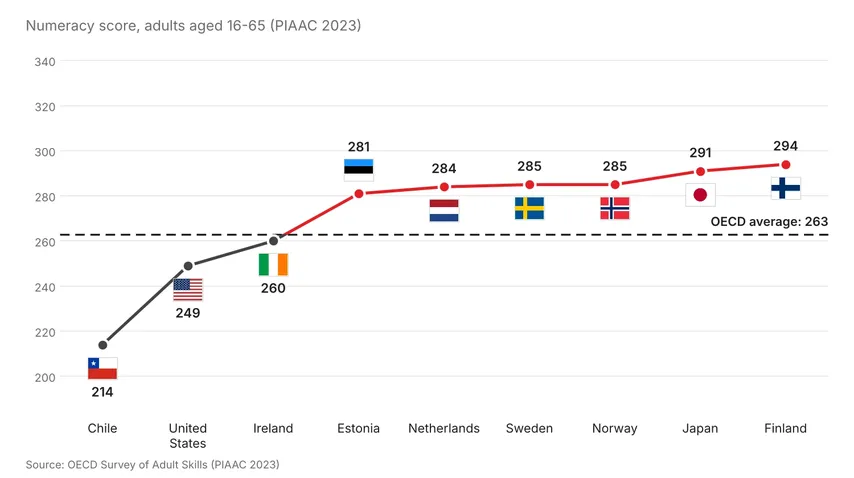
- Study: OECD Survey of Adult Skills (PIAAC 2023): Numeracy
- Scale: 160,000 adults in 31 countries
This survey is very lined up with poker. It defined numeracy as the ability to access, use, and reason critically with mathematical content and information. Top scorers can calculate rates and ratios, interpret complex graphs and critically evaluate statistical claims, which covers a lot of what you do at the table.
Finland tops the list again, with Japan, Sweden, Norway, the Netherlands and Estonia all clearing 280 points.
Practice your own mental math in low buy-in tournaments online. Start using our free Pot Odds Calculator, and play for decent prize guarantees at the same time.



- GipsyTeam's unique promotions
- Help with deposits and cashouts
- Access to private freerolls
- Round-the-clock support
- Уникальные акции от GipsyTeam
- Помощь с депозитами и кешаутами
- Доступ в закрытые фрироллы
- Круглосуточная поддержка
Skill #4. Mental Endurance
The world’s best poker players have to stay sharp, even as time wears them down. Unless you’re planning to win a bad beat jackpot and get out after 30 minutes, you’ll need mental endurance.
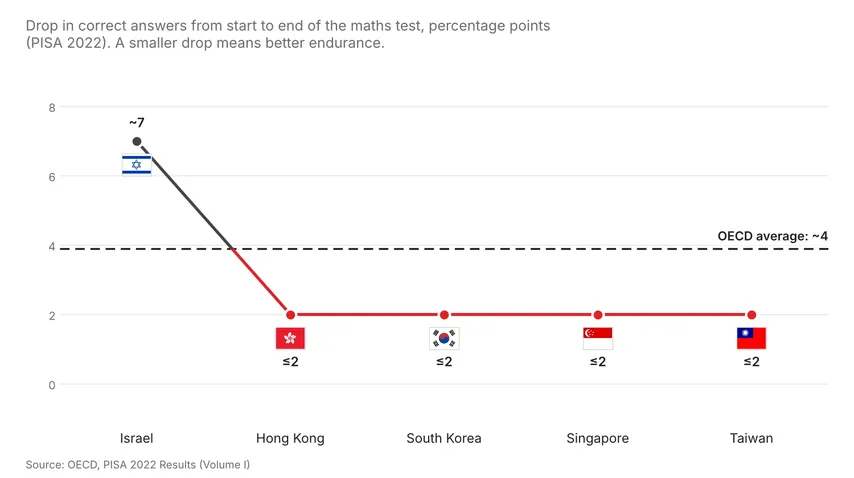
- Study: PISA 2022 Results (Volume I): How Much Effort Do Students Put into the PISA Test?
- Scale: 690,000 15-year-olds in 81 countries
The OECD checked how much each country's accuracy dropped between the start and the end of the hour-long math test. What the students know stays the same throughout, so any drop comes from fading focus and effort.
Asia dominated this one. Hong Kong, South Korea, Singapore and Taiwan stand out, starting strong and hold their level almost all the way to the end.
Skill #5. Risk Appetite vs Patience
Poker rewards two traits that pull in opposite directions: the nerve to get chips in when you have the edge, and the patience to fold past the times when you’re card dead. Players need both at the same time.
- Study: Global Preferences Survey: Global Evidence on Economic Preferences (Falk et al., Quarterly Journal of Economics, 2018)
- Scale: 80,000 people across 76 countries
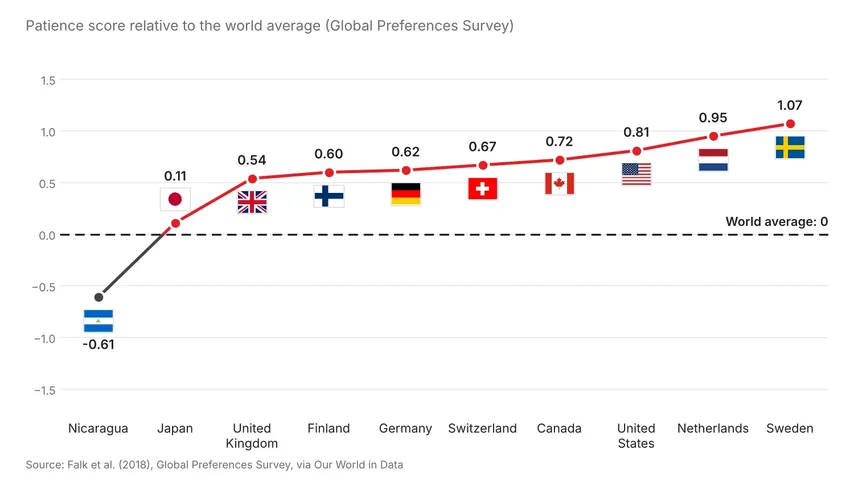
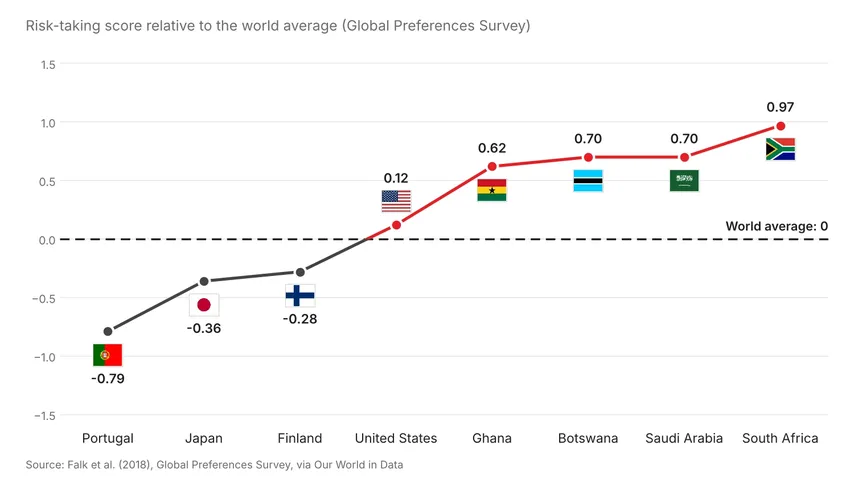
In this survey, real money was in play, and risk was measured partly through a sequence of five choices between a fixed payment and a lottery. Scores are shown relative to the world average, where 0 is average.
Patience is highest in Northern Europe and the English-speaking world, led by Sweden, the Netherlands and the United States. Risk appetite peaks in Africa and the Middle East, while Finland and Japan, two of the strongest countries so far, are notably risk-averse.
So Which Countries Should Be Best at Poker?
No country leads every category, but a few appear again and again.
- Sweden and the Netherlands come out with the most complete poker profile. These nations have elite problem solving and math skills, combined with the most patience in the world.
- Finland and Japan have the strongest raw thinking skills, but both are risk-averse, this can be a good and bad thing. Being risk-averse doesn’t necessarily mean you need a guarantee to put chips in the middle. It could mean that players make decisions with the best possible chance of winning.
- Singapore and South Korea pair top-tier creative thinking with the best mental endurance, ideal for finding new lines deep into a long session.
- The United States sits below average on the thinking tests but is one of the few countries combining strong patience with above-average risk appetite.
And of course, all of these surveys don’t mean some nationalities are set up to be professional poker players. It does mean that certain countries have higher baselines than others for the skills we looked at. Poker skills are more present in these places:
| Country | Top-Ranked in |
|---|---|
| Finland | Problem Solving, Creative Thinking, Mathematics |
| Japan | Problem Solving, Mathematics |
| Sweden | Problem Solving, Mathematics, Patience |
| Netherlands | Problem Solving, Mathematics, Patience |
| Singapore | Creative Thinking, Mental Endurance |
| South Korea | Creative Thinking, Mental Endurance |
| Canada | Creative Thinking, Patience |
| United States | Patience, Risk Appetite (above average) |
One important thing to remember: Access to games, gambling laws, and the size of the local poker scene usually shape who actually wins, or who gets to play in the first place.
Does the All Time Money List Line Up with All This?
The All Time Money list tracks the highest earning tournament players in the world, and it partly matches the studies we explained above.
America has the best access to poker, and dominates the All Time Money list. To make countries more accurately represented, we had to scale each country to the same population.
When we do that, several nations that ranked high in our skill studies above, also had a very high number of players on the All Time Money list.
In terms of player count:
- Finland is 3rd
- Estonia is 4th
- Norway is 6th
- Hong Kong is 11th
- Sweden is 12th
- Canada is 14th
- The Netherlands is 21st
Other countries that ranked high for skills still didn't have many players on the list, probably because access to games is low. For example, Japan ranks 58th, South Korea is 49th, and Singapore is 37th. Access to series with large guarantees just isn't as easy in these places.
Even with the right skills, getting more players to the tables is a key factor.


