


Eliminated from a tournament and still wondering if you made the right decision in the last hand?
Until now, finding the right answer required powerful hardware and a ton of patience. But today, with GTO Wizard, you can find the right solution in seconds, even on a smartphone.
Preflop ICM Solver
The ICM phase of tournaments remains unexplored by many players. This is understandable: previously, solving an ICM spot preflop involved agonizing data entry and tediously waiting for the calculation. A change in stack or range meant starting all over again, and after half an hour of analyzing a single spot, the desire to delve into the depths of solving vanished completely. Yet, the questions remained. What if there's a micro-stack at the table? Or are the pay jumps flat? How does strategy change on the satellite bubble? And what if the chip leader is sitting to our left?
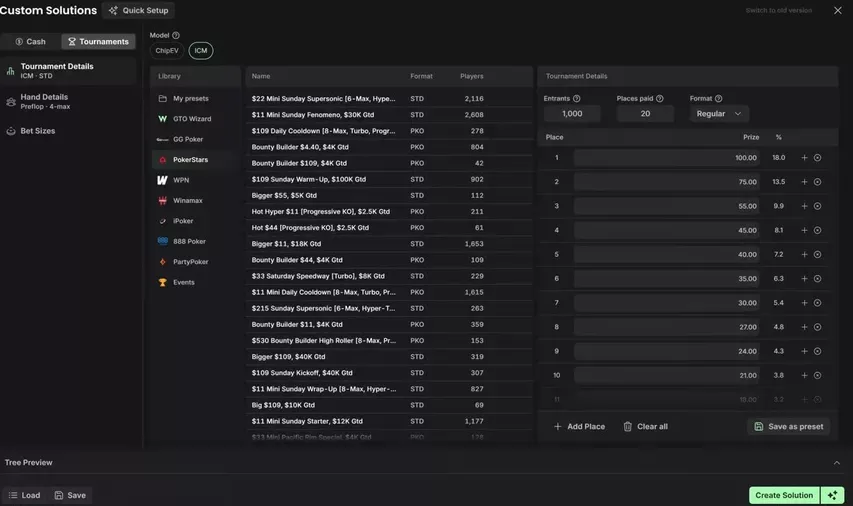
GTO Wizard AI handles all spots in seconds, allowing you to test any guess. The range of tournament formats is wide, covering standard MTTs, satellites, and bounty tournaments for every taste: knockouts, progressive knockouts, TKOs (tournaments where the entire buy-in, except for the rake, goes toward the bounty), and even mystery bounties.
Payout structures, stacks, and antes are fully customizable. Up to 9-max bets, 250bb depth, and fields of up to 4,096 players are supported. A single spot can be run in ICM and chip EV, allowing you to accurately understand how payout pressure changes optimal play. Custom opening, 3-bet, 4-bet, and push sizes are available.
Direct Hand Upload
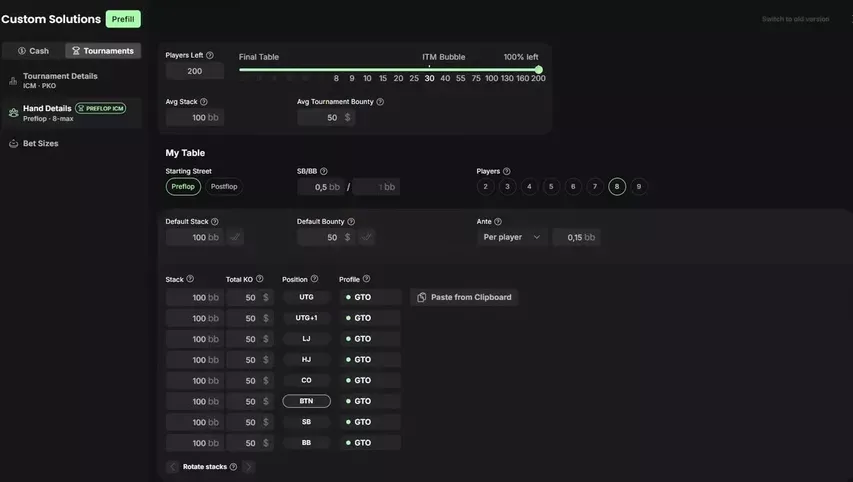
Solving spots from online sessions has become significantly easier: you can import stacks, bounties, and antes from your hand history.
Simply upload your hand, transfer the details, set payouts, and specify how many players remain in the tournament.
Nodelocks & Exploits
A balanced solution answers a specific question: what is the optimal solution to take against eight opponents who have a perfect understanding of ICM.
But you'll never find yourself at such a table. In a real tournament, the chip leaders pile on, the short-handed players fold for fear of busting on the bubble... So there's no point in settling on one equilibrium.
The real advantage will come from simulating the actual table dynamics.
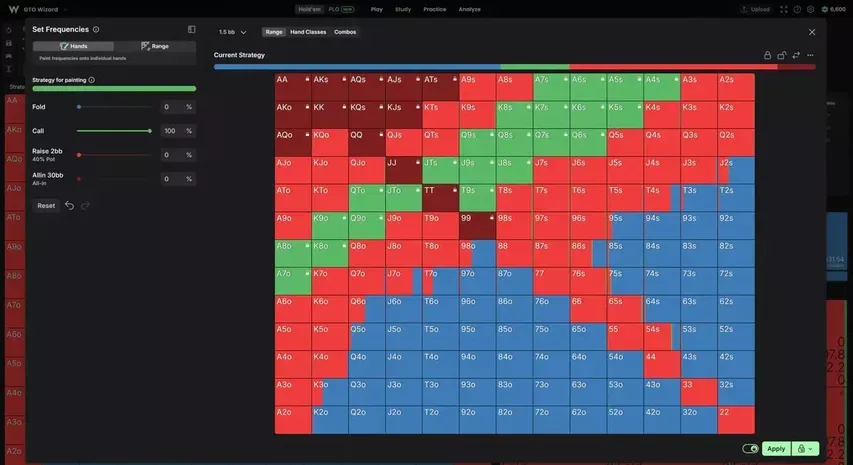
After the update, you can install any opponent's strategy node or exploitable player profiles, and then apply a counter-strategy if, for example, your opponents fold too often or the chip leader constantly 3-bets.
Preflop trees currently include postflop for three players, as in Multiway Preflop Solving for cash games. Support for overcalls and overlimps from a fourth player is planned for an upcoming update.
The Importance of Late-Tournament Decisions
Most MTT regs are learning ChipEV strategies. They're good for accumulating chips, but not for maximizing EV.
The buy-in represents the initial value of chips, but by the final table, decisions are worth many times more than the initial buy-in. Therefore, late-game skill has a disproportionately large impact on your results. You'll find yourself in these spots less often, but when you do, a single move can outweigh a month of grinding.
Imagine you're sitting at the most important final table of your life with a medium stack. The short stack on the high-jack opens for 2 big blinds, the button short-shoves, and you're in the big blind looking at pocket jacks.
What should you do?
Greg Mueller faced this choice at the last WSOP Main Event: $2.25 million is already guaranteed, with $10 million going to the first stack. Han Feng, the shortest stack, min-raised from the hijack with . In the ChipEV world, this would be a typical 8bb open-shove, but in ICM, aces are separated from the rest of the range and played as a small raise.
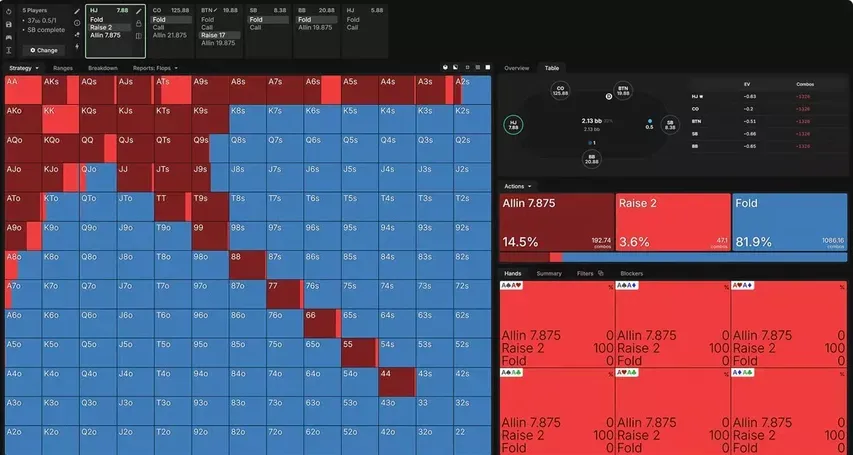
Saaskilahti 3-bet and left about 3bb behind.
A working ICM tactic: if the stack covering him pushes all-in, he can still fold. The problem is the hand itself.
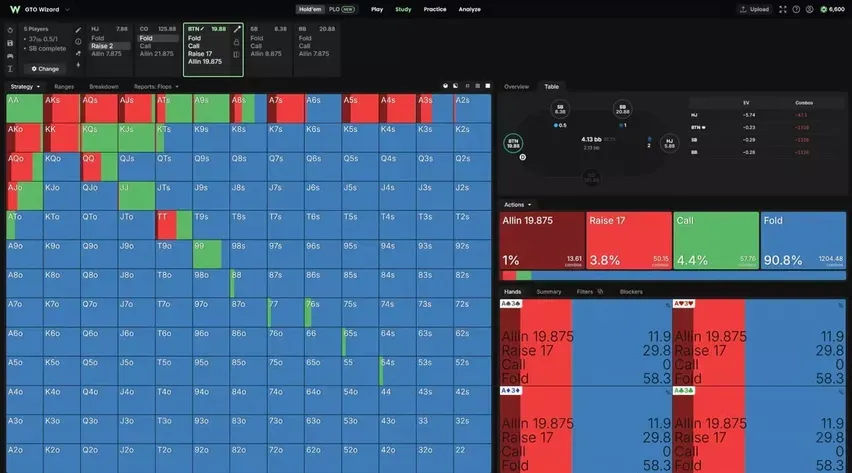
Mueller has 22 big blinds in the big blind, jacks, and $2.25 million in the pot. He goes tank and folds. Some media outlets called the fold brilliant. What will the solver say?
According to GTO, folding is the correct, albeit marginal, move. Jacks are at the very edge of the optimal shoving range, so both options are valid here.
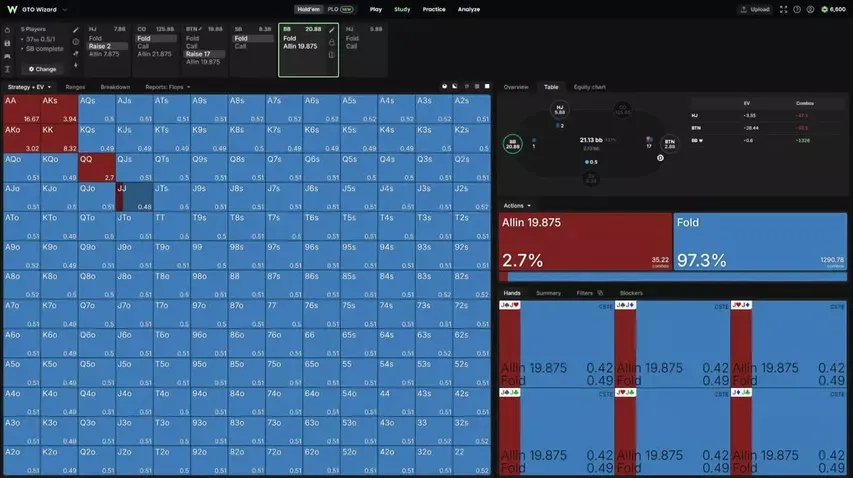
Here's something to consider: how tight should you play in such a spot under ICM pressure? How do payouts influence your decisions?
In the ChipEV world, after a raise and a small 3-bet, jacks immediately shove, a decision so easy that you have to pretend to hesitate. But ICM turns a fairly easy spot into a difficult one.
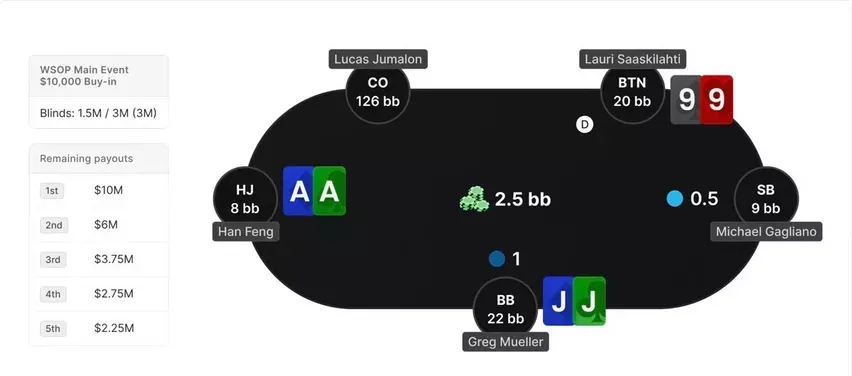

ICM Solutions for Postflop Spots in Multiway
After resolving a preflop spot, GTO Wizard AI carries over ranges, stacks, and payouts to postflop, so the overall logic of the strategy is preserved.
But now calculations can be made taking into account ICM and bounty.
Let's imagine the chip leader, the middle stack, and the short stack all hit the flop. They have different incentives.
For example, the middle stack doesn't want to face a difficult decision where losing the pot means busting before everyone else. But a large bounty could make the same spot more attractive... And a player's move behind them could change the profitability of the decision even before the hero acts.
Understanding these incentives will allow you to stop relying on intuition and a vague understanding of ChipEV. Spots can be compared simultaneously in two environments: ICM and ChipEV. You can determine who's covering whom, increase bounties, nodlock an opponent who's calling too wide, and see how other players are optimally adjusting.
- Ultra builds custom ICM solutions for 3-max hands: custom bet sizes, ranges, stacks, payouts, bounties, nodlocks, and player profiles.
- Elite reviews ready-made 3-way ICM Single Size solutions in Study and Practice – the same as applies to 3-way solutions in ChipEV.
Why the EV of a Fold Isn't Always Zero
In a simple ChipEV spot, you don't win chips by folding, so we measure the value of other decisions. But in ICM, preserving the tournament's life comes first.
After you fold in a multiway hand, the players' strategies change for you: your opponent might make a mistake, give another player a stack, or, conversely, knock them out—this way, you'll earn money without winning a single chip.
Let's say you're in a 3-max hand, and the remaining two players are maniacs in the blinds. It's much more profitable for you to fold on the button to leave them alone. Thinking that folding here has zero EV is a mistake.
In reality, the cards you fold can change the optimal strategy of other players, which in turn affects your tournament equity. Some hands actually generate more EV than others when folding.
After talking with several regulars, we settled on a fixed reference payout: the tournament equity you'd have if you lost the pot and the other players split it. Every action (including folding) is measured against this same number.
GTO Wizard AI Update
The solver engine has improved in speed and accuracy, making calculations now 3-6 times faster.
The changes are particularly noticeable in spots with large trees: SPR in 100-BB heads-up play with automatic sizing has increased from 4.2 to 1.2 seconds. And in a three-way play with three bet sizes and two raise variations, it has increased from 21 to 5 seconds.
Improvements speed up both Single Size Solutions and Practice Mode, especially when training with Custom Solutions.
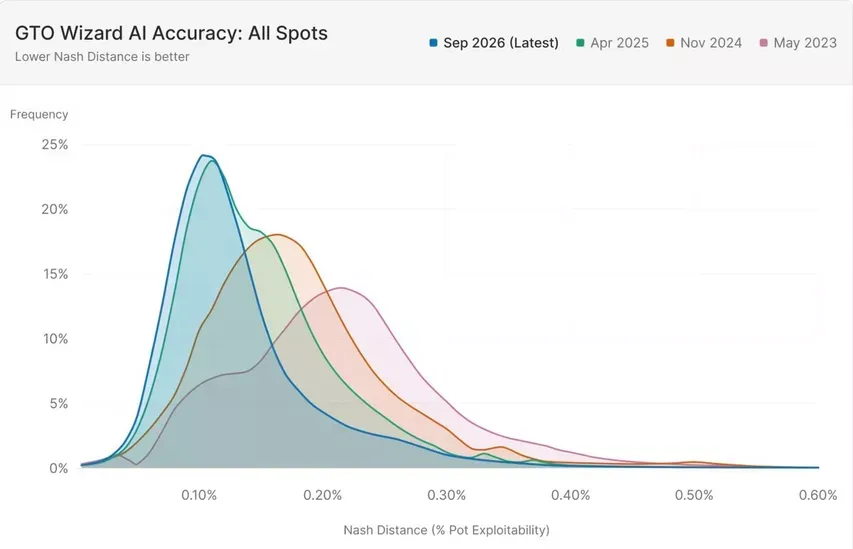
Previously, the flop model deviated from Nash by 0.108% of the pot (compared to 0.121% in April 2025). Now, the error has decreased by another 10%.
Ultra Early Bird Prices Until October 15th
At the Ultra release, it was announced that the discount would be valid until the release of Preflop ICM Solving. The Early Bird price will no longer be available on October 15, 2026.
The price remains unchanged. Standard Ultra rates apply to new subscriptions and renewals after the current subscription ends.
By purchasing an annual plan, you can save at least $720. And if you switch from a monthly to an annual plan now, you'll save $1,560 over the next 12 months compared to the standard monthly plan.
If your subscription is already active, the Early Bird price will remain until your first monthly or annual renewal after it expires: your current paid period remains unchanged. With an annual plan, you can save even more by purchasing an additional year for $229 (per month) on our website before October 15th. An additional 12 months will be added to your current subscription.
GipsyTeam can help you save even more: contact us with a direct message our Telegram channel —we'll tell you how to buy the Ultra version of GTO Wizard with an extra discount.


