




What Is Manifold? Meaning, Origins, and Sign-Up
Manifold is a prediction market platform where users bet on future events using virtual contracts. The Manifold meaning in financial terms is simple: each contract's price reflects the crowd's collective probability estimate for a given outcome. Manifold Markets launched in 2022 and has grown into one of the most active free forecasting communities online, covering politics, science, sports, culture, and technology.
Manifold uses a combination of limit orders and an automated market maker. Trades are matched against open limit orders first, and then against the AMM when needed. Here's Manifold explained simply: you register, receive 1,000 mana (the platform's virtual currency), browse open questions, and buy YES or NO contracts based on your view. If you're right when the market resolves, your mana balance grows. Regular Manifold markets use play-money mana, and mana cannot be cashed out. However, Manifold also runs separate opt-in Prize Drawings for eligible users, with prizes paid in USDC.
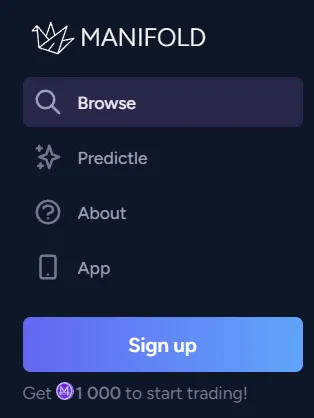
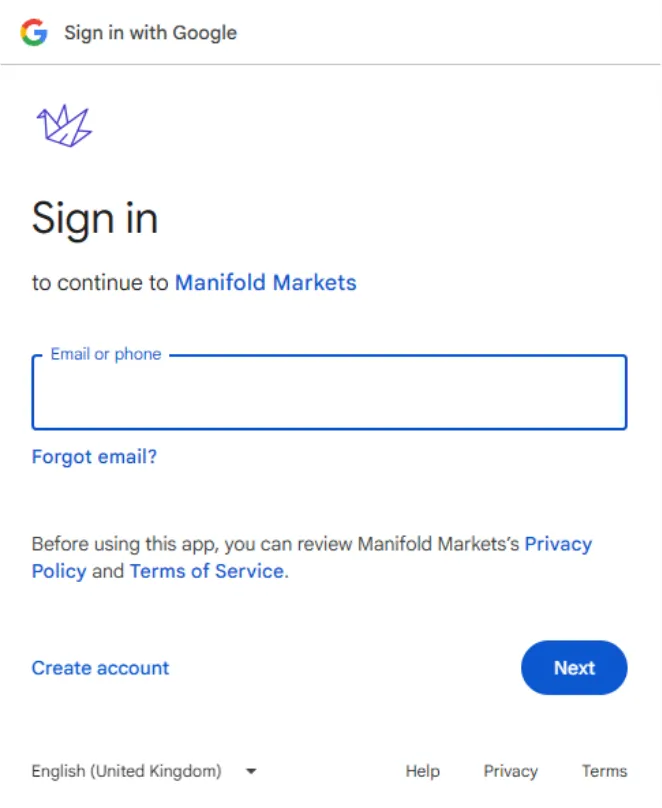
Registration takes under two minutes. For regular play-money markets, Manifold requires no KYC and is broadly accessible. Users must still meet the platform’s age and local-law requirements. Prize Drawings have separate eligibility rules, including age, location, and possible identity checks.
Core Mechanics: How Each Manifold Betting Market Works
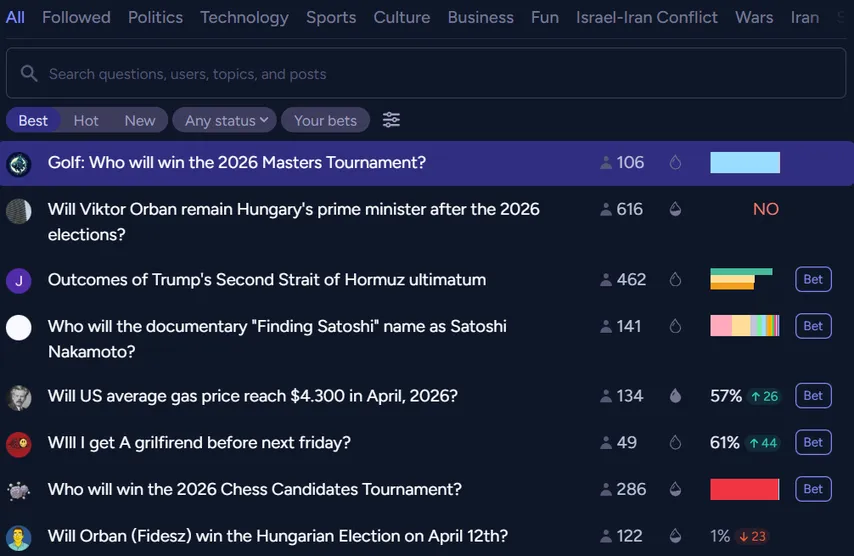
Each Manifold betting market is a binary or multiple-choice question tied to a resolution date or qualifying event. The market creator writes the question, defines the resolution criteria, and sets an initial probability. From that point, anyone can trade — pushing the price up or down based on their assessment. The Manifold prediction market mechanism aggregates those individual views into a live probability that updates in real time.
The result is the "wisdom of crowds" effect applied to every imaginable topic. When enough informed participants trade on a question, the market price tends to converge on a meaningful probability estimate — often better-calibrated than informal polls or expert opinion alone.
- Contracts represent YES/NO positions on a specific outcome.
- Probabilities display as percentages — 72% means the crowd estimates a 72% chance of YES.
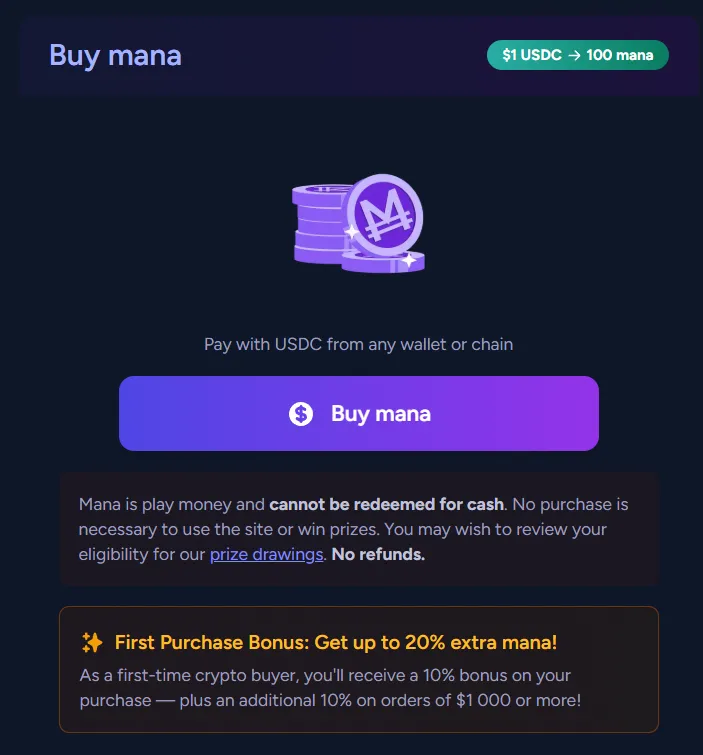
- In-platform currency is mana. 1,000 mana is free on signup; additional mana purchasable from $5.
- Mana cannot be converted back into any real currency.
- Markets can be public or private; anyone can create one with no approval process.
As of 2026, real-money withdrawals are not supported. Manifold briefly tested crypto-backed betting through a feature called Sweepcash in September 2024, but shut it down on March 28, 2025 due to US regulatory constraints — an outcome that several Manifold markets predicted accurately before it happened.
How to Place a Bet — Step by Step
- Browse the feed and pick a question you have a view on.
- Check the current implied probability on the market page.
- Click "Buy" and select YES or NO.
- Enter your mana stake and confirm the transaction.
Open positions can be sold early to lock in gains or limit losses before resolution. Once the creator confirms the outcome, winning contracts are converted to mana at the payout rate. For continuous or numeric markets — "How many films will X release this year?" — payouts scale proportionally to the final resolved value.
Is Manifold Markets Legit? Accuracy and Calibration
A question we hear constantly from newcomers: is Manifold Markets legit as a forecasting tool, or just a game? The honest answer is that it's genuinely both — and the distinction matters less than you'd think. Reputation is the real stake on this platform. Every user's calibration history is tracked publicly using the Brier score, creating a leaderboard that active participants care about enough to take seriously.
So is Manifold Markets legit compared to real-money alternatives? In niche, long-horizon categories — AI research timelines, scientific discoveries, cultural and literary awards — yes, the platform holds up well. During the 2024 US presidential election, Polymarket diverged from the final result by 2–3%; some Manifold markets were off by 5–8%. That's a meaningful gap, but not a damning one for a play-money environment where professional arbitrageurs have no financial reason to participate.
Where Manifold consistently outperforms expectations is in expert-driven niche markets. Questions about fusion energy milestones, specific academic paper outcomes, or rare geopolitical events attract genuine domain specialists who care about their accuracy records. The 2023 New York Times coverage of prediction markets described Manifold as a place where users compete for "bragging rights" — and that social incentive, it turns out, produces surprisingly well-calibrated markets.
Manifold vs. Real-Money Platforms
To understand what Manifold does and doesn't do well, a direct comparison with Polymarket is useful. Both use similar market mechanisms; the key difference is what's on the line.
| Feature | Manifold | Polymarket |
|---|---|---|
| Real money | No (virtual mana) | Yes (USDC) |
| Access | Free, no KYC | Requires wallet |
| Market creator | Anyone | Approved only |
| Withdrawals | Not available | Supported |
| Liquidity | LMSR (automated) | Order book |
| Mobile app | iOS & Android | iOS & Android |
On the question of Manifold Markets real money options: there are none in 2026. For real-stakes prediction, Polymarket and Kalshi are the established alternatives. Manifold's structural advantage is breadth — open market creation means obscure, niche topics get covered that liquid markets would never touch. A question about whether a specific paper gets published in a specific journal won't appear on Polymarket. On Manifold, it's been traded.
Unique Advantages: API, Corporate Use, and Training Value
Manifold offers a public Manifold API with programmatic access to market data, calibration histories, and resolution records. The Manifold API is free, well-documented, and actively used — by researchers building aggregation tools, journalists tracking forecast accuracy, and bot developers running automated trading strategies. It's a meaningful differentiator from platforms that restrict data access.
Beyond the API, Manifold functions as a genuine training ground for forecasters. Several traders now active on Kalshi and other real-money platforms started here, using Manifold to test their models and accumulate calibration records before moving to markets with actual financial stakes. The feedback loop — stake mana, watch resolution, check Brier score — is rigorous enough to accelerate learning.
Corporate adoption is a quieter feature. Teams at technology companies use Manifold internally to forecast project timelines, hiring success rates, and feature adoption. Private markets make this straightforward: create a closed group, invite colleagues, and run prediction markets on internal questions with no financial exposure and no regulatory complexity.
Interface Issues
The UI is Manifold's most consistent weak point. The mana balance display doesn't cleanly separate available funds from open position values, which causes real confusion when users try to place bets they don't have liquidity for. Transaction history is equally opaque: "user X bought 50M" could mean 50 mana or 50 contract shares depending on context — even experienced users find this ambiguous. The platform is English-only, and browser translation handles it inconsistently, particularly around dynamic elements like probability displays and resolution notices.
Pros and Cons
| Pros | Cons |
|---|---|
| Completely free — no deposits required | No Manifold markets real money withdrawals |
| No geo-restrictions, accessible worldwide | In-game mana economy subject to inflation |
| Any prediction market created in 60 seconds | No financial incentive to stay accurate |
| Strong expert community in niche topics | Confusing interface, especially limit orders |
| Trusted as a corporate forecasting tool | Manifold app can be unstable on mobile |
Platform Availability and the Manifold App
Manifold is globally accessible — no geo-blocks, no VPN required, no regional content restrictions. The Manifold app is available for iOS and Android and covers the core experience: browsing markets, placing bets, creating questions, and tracking your portfolio. That said, the Manifold app is better suited for casual participation than serious multi-market management. Limit orders are less intuitive on mobile, and the Manifold app has a known tendency to become unstable during high-traffic resolution events when many markets close simultaneously. For serious use, the desktop web version is the better choice.
Who Is Manifold For?
Manifold is most useful for three groups. First: forecasting enthusiasts who want a calibrated feedback environment without financial risk — the Brier scoring system provides exactly that. Second: professionals building a verifiable track record before moving to real-money platforms; a strong Manifold history carries genuine weight in forecasting communities. Third: teams experimenting with internal prediction markets — the private market feature and zero cost make it a practical starting point for organizations.
Manifold is not designed for sports bettors, financial traders, or anyone primarily motivated by earning money from correct predictions. There is no financial return. Users who come in expecting a revenue stream consistently leave disappointed. The platform's value is informational and reputational — which is enough for a significant number of users, but not for everyone.
Getting Started
Sign up at manifold.markets using an email address or Google account. 1,000 mana loads immediately. Browse the feed without placing bets on your first session — get a feel for how resolution criteria are written and how probabilities have moved over time on active markets. When you're ready to trade, start with questions where you have genuine domain knowledge. Calibration improves fastest when you're reasoning from expertise rather than guessing.
The Manifold community on Discord maintains an informal wiki — consider it Manifold explained at depth, with strategy guides, calibration tips, and market creation best practices built up by active traders over years. It's worth spending time there early.
Manifold for Crypto and AGI Research
Crypto traders use Manifold as a free sentiment research tool — searching for markets on FOMC decisions, Bitcoin price milestones, regulatory rulings, and exchange-specific events before making positioning decisions. The probabilities aren't as precise as those on real-money platforms, but they offer a calibrated crowd estimate that's often more useful than informal social media sentiment.
Manifold AGI markets are among the best-calibrated categories on the platform. Questions about AI benchmark timelines, specific model capabilities, and AGI definitions attract actual researchers with firsthand knowledge of how these systems develop. Manifold AGI market probabilities on topics like "Will GPT-X pass task Y by [date]?" have historically outperformed general-public predictions.
Manifold, explained to traders most precisely: it's a sentiment and information aggregator, not a price oracle. It won't predict BTC price movements, but it provides calibrated crowd estimates on policy events and macro developments that can meaningfully inform risk management. For crypto research, the practical workflow is: find the relevant market before a major event, note the implied probability, weigh it alongside other data sources.
Conclusion
Manifold is free, open to anyone, and covers more niche questions than any real-money platform would bother with — that's really the whole appeal. Without actual stakes, though, it'll never carry the weight of Polymarket or Kalshi on short-term, high-liquidity events. Fair tradeoff for what it is.
What you get instead is a genuine calibration tool. A way to find out if your forecasting holds up, build some kind of track record, watch how a crowd actually prices uncertainty. Not a platform for earning money — but for thinking more clearly, hard to beat at zero cost.