




Metaculus isn't just another betting platform. It's a forecasting arena — what the industry calls a prediction market. The key difference: you're not staking money here. You're staking your reputation. That single distinction sets the Metaculus platform apart from the wave of betting sites that dominate search results.
Let's break down how the whole thing works — from the very first steps to some of the platform's quirkier nuances: scoring rules, limitations, and general accessibility.
Registration is the logical starting point. Creating a profile is straightforward. To create an account, click Sign Up in the top-right corner of the Metaculus website, then enter a username, email address, and password, or continue with a Google account.
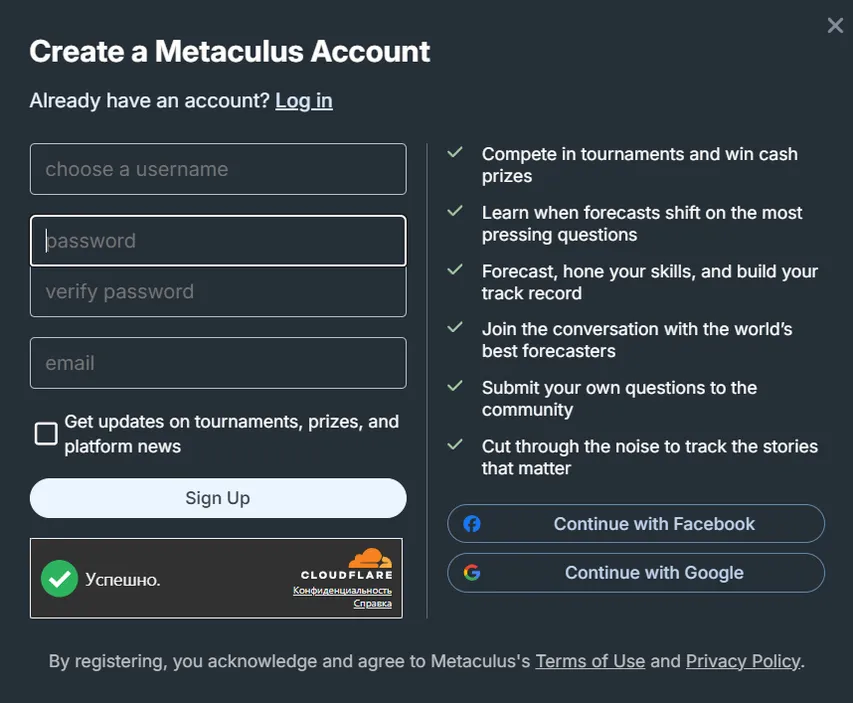
On the page that opens, enter a username, password, and email address. There's also the option to sign in with a Google account, which is faster. That's it — profile created, ready to explore. Once inside, you'll find thousands of open questions and can immediately start browsing what the Metaculus community has to say on everything from geopolitical scenarios to AI timelines.
How Metaculus Works
How does Metaculus work, exactly? The core mechanics are fairly simple, but there's more depth behind them than first appears. Users don't buy or sell shares in contracts the way they do on traditional prediction exchanges. Instead, you directly submit your probability estimate for a given outcome — a number from 0.1% to 99.9%. Three question types cover most scenarios:
| Question Type | What You Forecast | Example |
|---|---|---|
| Binary (Yes / No) | Probability of a yes or no outcome | Will AGI be publicly announced before 2030? |
| Numerical Range | A specific value within a range | What % of car sales will be EVs by 2042? |
| Date Range | When a given event will occur | When will the first crewed Mars mission launch? |
What makes it genuinely interesting: Metaculus aggregates user forecasts into a Community Prediction, generally based on a recency-weighted median of individual forecasts. The older Metaculus Prediction model, which used a more sophisticated calibration system, has been deprecated since November 2024 and is now mainly available through the Aggregation Explorer.
To understand how Metaculus works at a deeper level, you need to know the two scoring metrics it uses: the Brier score and the Log score. The Brier score measures the mean squared error of a forecast — the closer it is to 0, the more accurate the prediction. The Log score rewards confident correct calls more aggressively. Both metrics are designed so the optimal strategy is to state your genuine belief, not to game the system.
In 2023, the leaderboard was overhauled and a medal structure introduced. Medals come in three tiers — gold, silver, and bronze — earned not just for accuracy, but also for useful community comments and well-crafted questions.
Forecast Accuracy
How accurate is Metaculus? That's arguably the most important question for anyone taking the platform seriously. The short version: the platform publishes open statistics, so you can assess the track record directly rather than taking anyone's word for it.
The headline number is a 0.111 Brier score across thousands of resolved questions — which independent assessments describe as the strongest forecasting accuracy of any public platform. Results vary considerably by domain. Scientific and technological forecasts consistently perform well. Cultural topics and entertainment are a different story; the crowd's edge tends to vanish in areas where insiders hold structural advantages.
That said, prediction markets aren't oracles. They're built for complex, knowledge-intensive, long-horizon questions where collective intelligence gets to shine. If you're more interested in show business or political horse-trading, insiders will always have an edge. The crowd's strength is breadth, not access. Knowing this going in is half the battle.
Metaculus Founder and Platform History
Is Metaculus legit? Short answer: yes — and not just by reputation. Metaculus was founded in November 2015 by three researchers with serious academic credentials: astrophysicist Anthony Aguirre, cosmologist Greg Laughlin, and data scientist Max Wainwright. The Metaculus founder most publicly associated with the platform's mission is Aguirre, who previously co-founded the Foundational Questions Institute (FQXi) and the Future of Life Institute — an organization focused on the long-term implications of transformative technology, particularly AI.
The question of whether is Metaculus legit comes up regularly, and it has a clear answer. The platform operates as a Public Benefit Corporation — a legal structure that formally commits it to public good over profit. Metaculus funding comes from institutional sources: $5.5 million in grants from Open Philanthropy and over $300,000 from Effective Altruism Funds, awarded precisely because the platform's goals align with improving humanity's ability to forecast consequential events. These aren't backers with an interest in running a scam.
How does Metaculus make money? Primarily through grants and institutional partnerships. Participation is free for all users, but the platform does run commercial services: private tournament instances for organizations, a professional forecasting product called Radiant aimed at strategic decision-makers, and an AI benchmarking tool called FutureEval. The current CEO is Deger Turan. It's a lean model — but it's been running for over a decade, which says something.
Metaculus AGI Predictions
One of the most widely cited and closely watched areas of forecasting on the platform is artificial intelligence. Metaculus AGI questions attract thousands of forecasters and are regularly referenced in AI safety research, policy papers, and media coverage. The Metaculus AGI timeline has shifted dramatically over the past few years — and tracking how it has moved is itself an interesting signal.
Before the release of GPT-4, the Metaculus community median for AGI arrival sat somewhere around 2040–2054. After the ChatGPT wave, that figure collapsed rapidly to roughly 2032. As of early 2026, the community forecast puts a 25% probability on AGI by 2029 and a 50% probability by around 2033. Worth noting: Metaculus uses a strict four-condition definition of AGI that includes general robotic capabilities — one of the slowest-developing components of the AI stack — making the timeline somewhat more conservative than estimates based on narrower definitions.
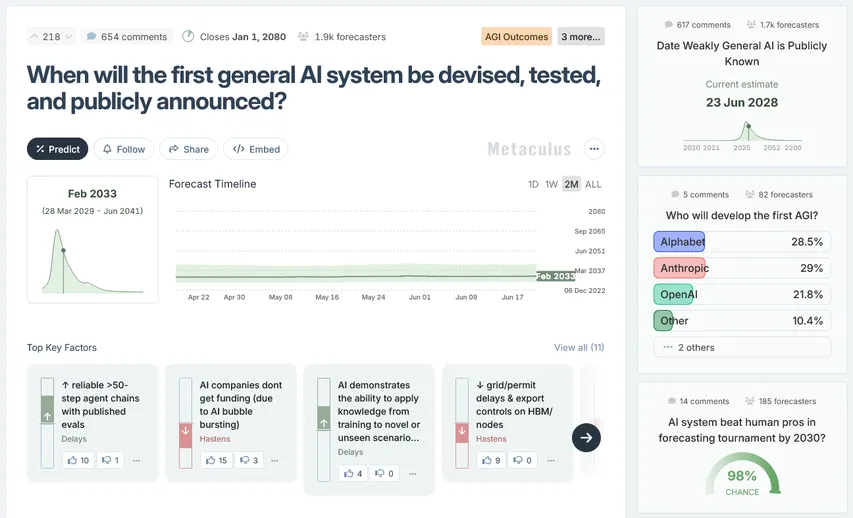
The Metaculus prediction data on AGI is regularly cited by researchers at the Future of Life Institute, used in AI safety discourse, and tracked by journalists covering the AI development race. For anyone monitoring AI timelines seriously, Metaculus's AGI question thread offers one of the most calibrated, peer-reviewed public views available. It's not the only data point — but it's one of the few where the forecasters have a documented track record to back up their estimates.
Metaculus API for Researchers and Developers
In 2023, Metaculus introduced a public API, making the platform's entire question database and forecast data programmatically accessible. The Metaculus API runs at metaculus.com/api2/ and is free to query at the basic level — no authentication key required for public endpoints. This is one of the features that distinguishes the platform from purely commercial prediction markets, where data access typically carries a price tag.
The Metaculus API gives developers access to question metadata, community predictions, resolution statuses, forecaster counts, question categories, and historical prediction distributions. Queries return JSON, the API supports cursor-based pagination, and the full schema is documented via a ReDoc interface. Practically speaking, this means researchers can pull the entire dataset of 24,000+ questions with a straightforward script.
A small ecosystem has grown around the Metaculus API. There are Rust and Python client libraries, third-party data scrapers, and — notably — AI forecasting bots that plug into the platform and submit machine-generated predictions. Metaculus actively encourages this: it maintains a public forecasting-tools repository on GitHub, runs an AI Benchmarking Tournament, and has launched FutureEval, a benchmark measuring how accurately AI agents predict future outcomes using Metaculus data. For organizations needing higher-volume or private data access, a commercial API tier is available separately.
Availability and Key Quirks
Metaculus currently has no obvious geographic restrictions for web access. Registration and participation are open from anywhere in the world.
That said, this doesn't mean every user will have a frictionless experience. The main potential pain points:
- Language barrier. The platform is English-only. Auto-translation tools tend to create more confusion than clarity — both for you and for anyone reading your comments.
- Payment delays. The occasional Metaculus tournament with cash prizes — $300, $200, and $100 awards — can see slow payouts. Users in countries with banking restrictions or limited access to international payment systems tend to feel this most acutely.
- Legal gray zones. Metaculus explicitly states in its Terms of Use that the service may not be legitimate in jurisdictions where it conflicts with local law.
The platform currently imposes no geographic blocks — but that could change.
Pros and Cons
A quick, honest breakdown of what the platform does well and where it falls short:
Pros:
- Prediction markets enable long-range insights into the state of various sectors — genuinely useful for financial analysts and researchers.
- Metaculus has a tight-knit community: people know each other, engage openly, and share advice freely. The quality of discussion on most questions is notably high.
- Full transparency: forecast history, analytics, and comment threads are all publicly accessible. Nothing is hidden behind a paywall.
- The public API makes it a practical data source for academic research and AI safety work.
Cons:
- No trading balance or direct per-prediction payouts. Metaculus does not work like a betting exchange, but some tournaments do offer cash or cash-equivalent prizes.
- English proficiency is a prerequisite. The platform is not localized.
- Lots of hyper-specific content — for instance, "How many times will Donald Trump mention the numbers 6 and 7 in his next public address?" That's a real question on the platform.
How to Place Predictions on Metaculus
The process is about as simple as it gets and requires no financial commitment. Once registered, you get full access to all open markets. If you're wondering — ‘How does Metaculus work in practice?’, the answer starts with the Questions section on the homepage — everything is listed there, with filters by category, topic, and resolution date.
Read the criteria carefully before submitting. Each question comes with explicit resolution conditions, designed to eliminate ambiguity when it's time to settle outcomes. Think through the probability — look at available data, check the community aggregate, and read through other participants' comments. On well-trafficked questions, the discussion threads are often as valuable as the forecast itself.
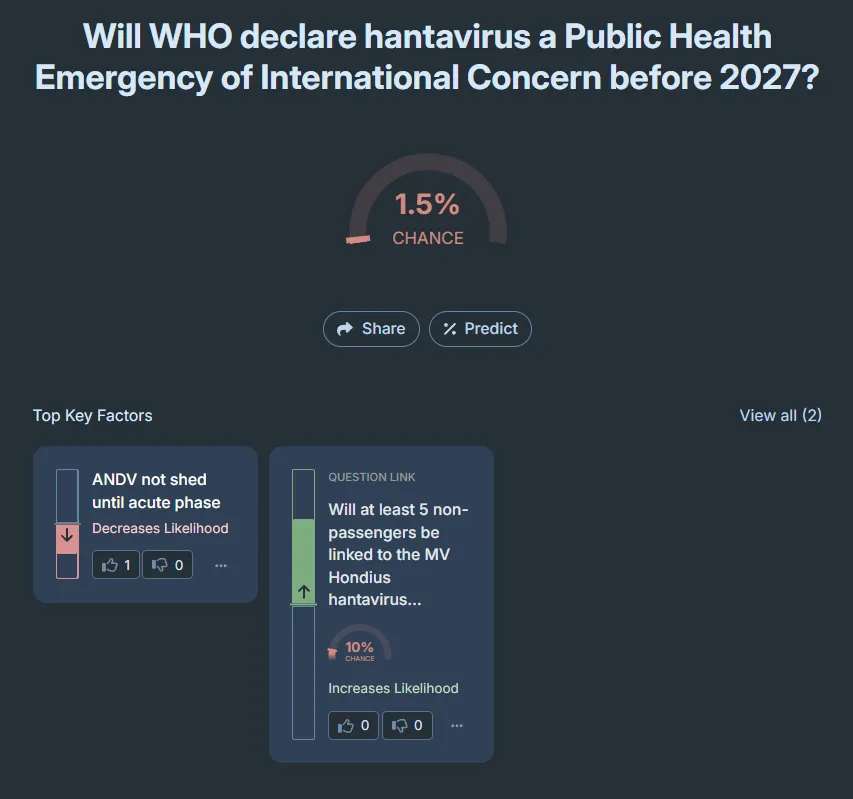
It pays to follow the news and revisit your estimates as new information arrives. The platform's scoring system actively rewards updating your position when circumstances change — this is by design, reflecting the proper scoring rule principle built into both the Brier and Log score formulas.
The higher the probability you assigned to the correct outcome, the more points you earn. A low estimate on a correct call will net you negative points. That's the whole game: be honest, stay calibrated, and update when the world gives you new information.
Can You Withdraw Money from Metaculus?
This is one of the most common questions about the platform, and it deserves a clear answer — because Metaculus is fundamentally different from traditional bookmakers and betting exchanges.
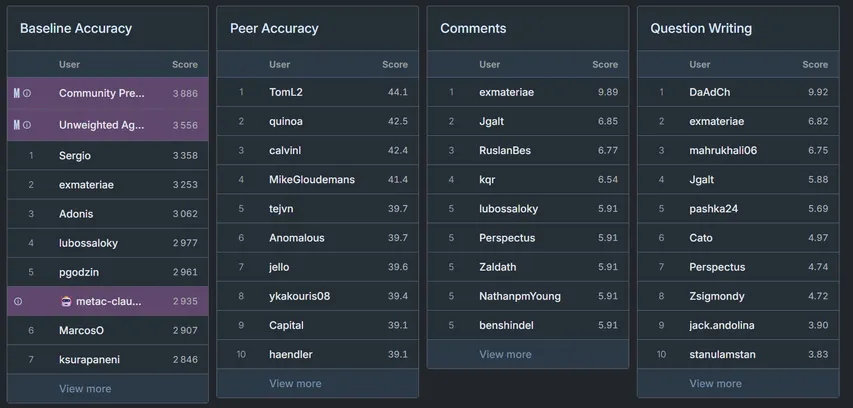
Metaculus is not a money-making platform. The primary "currency" here is reputation points, and they cannot be converted into real money. No deposits, no withdrawals. How does Metaculus make money? Through grants and commercial services — not through user activity. Cash-prize tournaments appear occasionally, but those are the exception, not the rule. The core product is calibrated forecasting, and the reward is a track record.