


Poker rules for beginners fit into one sentence: whoever wins the pot either shows the strongest five-card hand at showdown or forces all opponents to fold before it happens. Everything else — hand rankings, positions, blinds, bet sizing — exists to organize that competition. If you're looking for how to play poker for beginners, this guide covers the rules from scratch, compares the main variants, and explains how online poker works.

Poker Rules for Beginners: Objective, Deck, and the Two Ways to Win
In classic formats, the game uses a standard 52-card deck with no wild cards. Everything wagered accumulates in the pot, the prize contested during that hand. Each player makes the best five-card hand possible and compares it with opponents' hands at showdown. Suits do not break ties between otherwise identical hands at showdown: the pot is split. In some variants, such as Seven Card Stud, suit order may be used only for procedural purposes such as determining the bring-in.
There are only two ways to win a hand:
- At showdown, by showing the strongest combination among those still competing.
- Without showdown, by betting enough to make all opponents fold — here you take the pot without revealing your cards.
The second method is often underestimated. Many pots end before the river. Aggression can win without showdown, but profitable betting depends on your hand, position, and the ranges involved.
This poker guide for beginners explains essential terms including fold, call, raise, flop, and showdown. Learning these terms will help you follow the rules and betting action.
Hand Rankings: The 10 Combinations and Tiebreaker Criteria
The hierarchy of poker hands is the same in most high variants and includes ten combinations, from high card to royal flush:
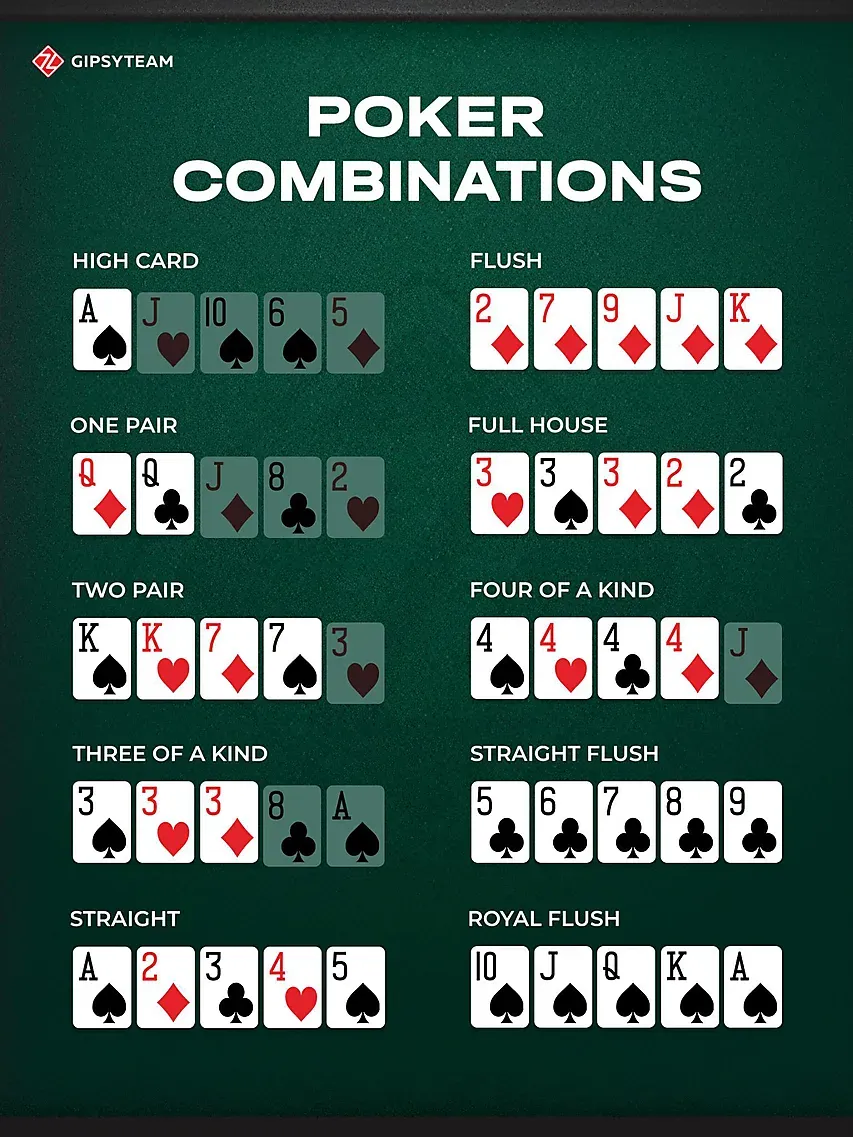
Understanding poker hands for beginners starts with memorizing this hierarchy. Tiebreakers depend on the hand category. Compare the defining ranks first, then any kickers from highest to lowest. One pair has three kickers, three of a kind has two, and two pair or four of a kind has one; straights and full houses have no kickers. Example: A♠ K♦ versus A♥ Q♦ on a board of A♣ 8♠ 5♦ 3♥ 2♣. Both players have a pair of aces, and the king kicker beats the queen kicker.
Two details confuse beginners: the Ace counts as both a high card and a low card (A-2-3-4-5, the wheel). In Hold'em, the board can form the best five-card combination by itself. If neither remaining player can improve that combination with their hole cards, the pot is divided. For examples, probabilities, and all tiebreaker rules, consult our complete guide to poker hand combinations.
When comparing poker hands, remember that hand categories follow a strict ranking: a pair always beats a high card, and a flush beats a straight.
Once you know how the hands rank, you can start putting that knowledge into practice. Check the best poker rooms available in your country — many run freerolls and special promotions for new players, giving you a chance to play for real prizes with little or no upfront cost.


- GipsyTeam's unique promotions
- Help with deposits and cashouts
- Access to private freerolls
- Round-the-clock support
- Уникальные акции от GipsyTeam
- Помощь с депозитами и кешаутами
- Доступ в закрытые фрироллы
- Круглосуточная поддержка
Blinds, Positions, and Betting Actions: The Mechanics of Each Street
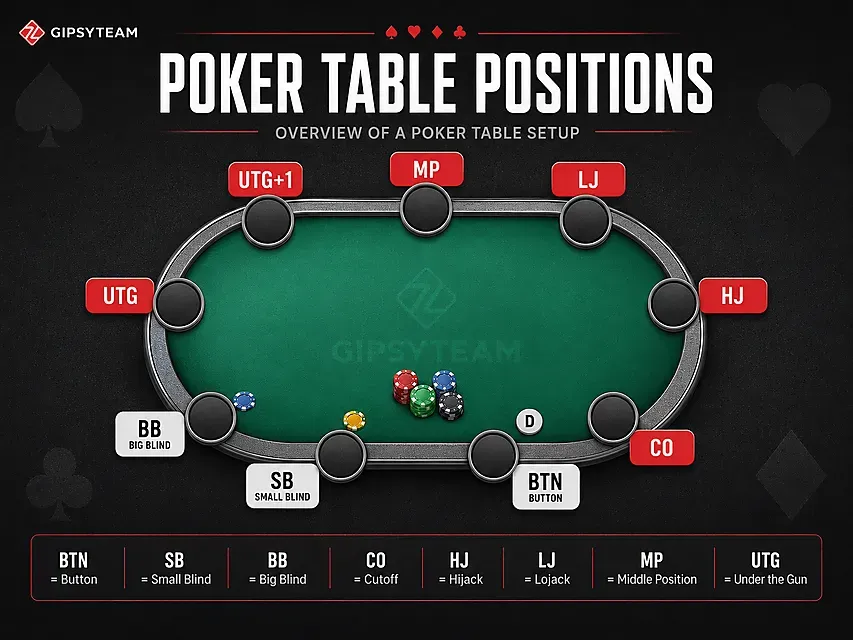
Understanding poker basics for beginners starts with position and blinds structure. In button games such as Hold'em, the button marks the dealer position and normally advances clockwise after each hand; eliminations and the room's button rules can affect its movement. With three or more players, the first two players clockwise from the button post the small and big blinds. Heads-up, the button posts the small blind and acts first preflop but last after the flop. Antes depend on the tournament structure: they may apply from the first hand, begin at a later level, or be absent. Depending on the format, antes may be posted by each player or collected as a big blind ante.
Position is information: whoever acts last has already seen what others did. The same hand might be easy from the button and terrible from under the gun.
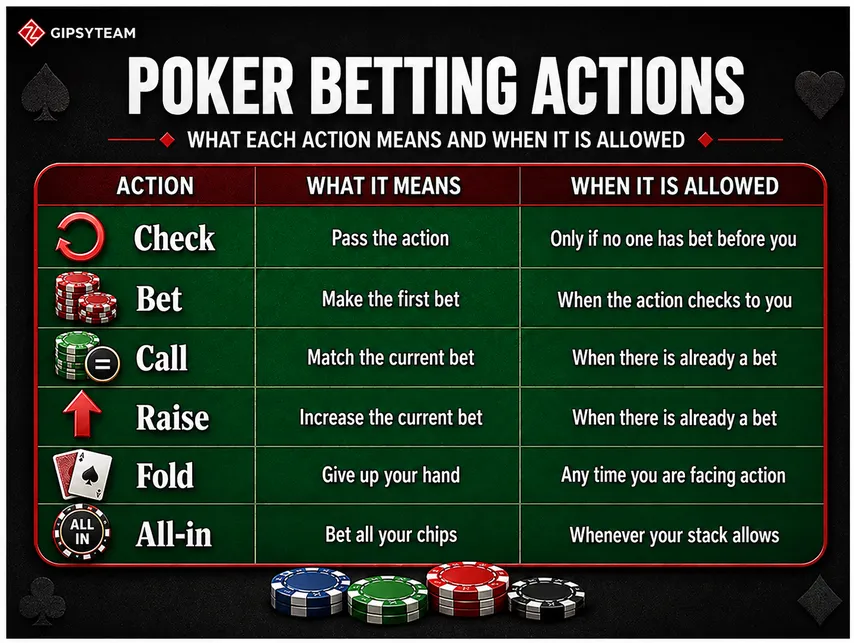
Poker betting revolves around five core actions: check, bet, call, raise, and fold. A player is all-in when they commit all of their remaining chips, which can happen as a bet, call, or raise.
- Check: take no betting action when you owe no additional chips; this includes checking the big blind preflop if nobody has raised.
- Bet: make the first voluntary wager when no bet is currently outstanding.
- Call: match the current wager by adding only the chips you still owe; if you cannot cover it, you may call all-in for your remaining table chips.
- Raise: increase the current bet.
- Fold: abandon your hand and what you've invested in the pot.
- All-in: committing all of your remaining chips to the pot. Depending on the action before you, an all-in can function as a bet, call, or raise.
Two technical rules generate constant confusion. In no-limit and pot-limit poker, a full raise must add at least the size of the last full bet or raise increment on that street. A short all-in may be smaller and does not necessarily reopen raising. Fixed-limit games use predetermined betting increments. A side pot is formed when at least two players contribute more than another player's all-in. Each player can win only the pots their contribution covers; several all-ins can create several side pots. Any unmatched excess is returned, not placed in a side pot. For example, if one player bets 600 and another raises to 1,600 — a raise of 1,000 — the next minimum raise must be 1,000 more, reaching at least 2,600.
These poker betting rules for beginners apply at live and online tables — in the virtual room the software calculates everything automatically, but the logic needs to be clear.
How to Play Texas Hold'em Step by Step
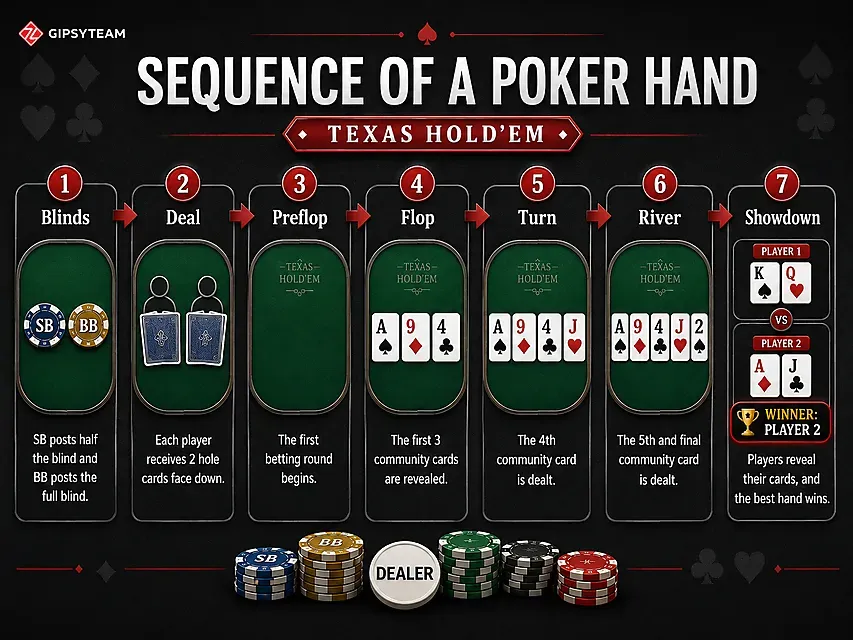
The easiest way to understand how to play poker for beginners is to follow a Texas Hold'em hand from the blinds to showdown. Here's a step-by-step summary:
- Small blind and big blind: Before the cards are dealt, the designated players post the blinds and any required antes.
- Deal: Each player receives two private hole cards.
- Preflop: The first betting round begins. Players may fold, call, or raise; if no one raises, the big blind may check.
- Flop: the dealer reveals the first three community cards in the center of the table, followed by a new betting round.
- Turn: a fourth community card is revealed, followed by another betting round.
- River: the fifth and final community card is revealed, followed by the last betting round.
- Showdown: If at least two players remain after the final betting round, tabled hands determine the winner or split pot. In a non-all-in showdown, a player may instead muck and give up any claim to the pot.
Remember that not every hand reaches showdown. If all opponents fold during one of the betting rounds, the last remaining player wins the pot without showing cards.
What Changes From Preflop to the River
To understand how to play poker Texas Hold'em for beginners, start with the basic hand structure: each player receives two hole cards and up to five community cards are dealt on the board. The best five-card combination wins, and you may use two, one, or none of your hole cards.
Reasoning changes street by street. Preflop, relative strength and position matter. When evaluating your starting hands, remember that position affects hand value significantly. On the flop, consider how the board connects with both players' ranges. Dry or paired boards can favor continuation bets, but position, stack depth, and range advantage determine whether to bet and how much. On the turn and river, weigh the stack-to-pot ratio alongside hand strength, ranges, board texture, position, and the opponent's betting patterns.
Cash Game and Tournament: Which Rules Change?
The core poker rules are the same in cash games and tournaments: hand rankings and the sequence of betting rounds do not change. The main differences are how chips, blinds, stacks, re-entry, and game duration work:
| Cash Game | Tournament | |
|---|---|---|
| Chip value | Chips represent real money | Chips represent "points" in the tournament and cannot be directly exchanged for cash |
| Blinds | Usually remain fixed | Increase with tournament levels |
| Entry | You can buy more chips and continue playing within table limits | A buy-in gives you a starting stack; rebuys depend on tournament rules |
| End of play | The player can end their session and leave the table whenever they wish | Leaving the table does not normally eliminate a player immediately: the stack remains in play and continues to pay blinds and antes; a standard elimination tournament plays down to one winner, while satellites may end with several qualifiers |
| Goal | Win chips that have direct monetary value | Accumulate chips, survive eliminations, and reach prize positions |
Understanding the difference between MTT tournaments and cash games helps you adapt your strategy to each format. In a freezeout tournament, losing all your chips ends your participation. Rebuy and re-entry tournaments may allow another stack during the designated period; a re-entry is a new entry after elimination. In cash games, a player can lose their stack, buy in again, and continue at the same table.
Omaha, 5 Card Draw, Stud, and Razz: What Changes in Each Variant
After Hold'em, the most useful comparison is with Omaha. The betting rounds are identical, but hand formation changes: you receive four hole cards and must use exactly two of them with exactly three from the board. This eliminates the classic mistake of "having a flush" with just one card of the suit.
| Variant | Cards dealt to each player | Community cards | Final hand rule |
|---|---|---|---|
| Texas Hold'em | 2 | 5 | Use 0, 1, or 2 from your hand |
| Omaha | 4 | 5 | Exactly 2 from hand + 3 from board |
| 5 Card Draw | 5 face down | 0 | All five cards form the final high hand; drawing zero cards is allowed |
| 7 Card Stud | Normally 3 face down + 4 face up | Normally 0; a shared final card is possible | Best five-card high hand |
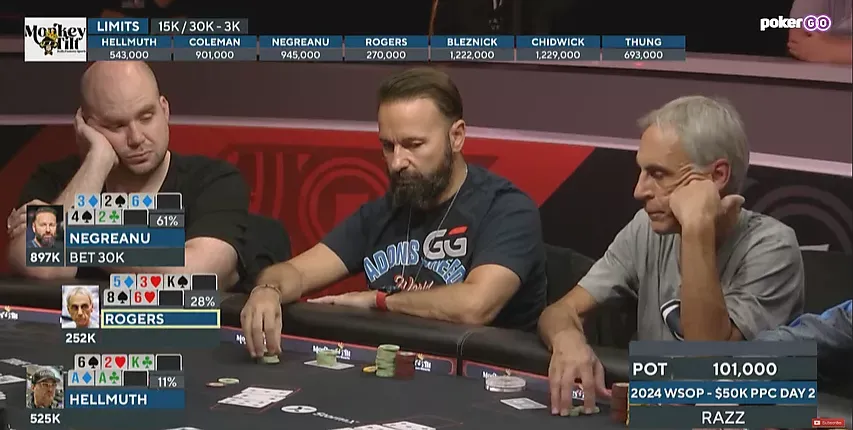
| Razz | Normally 3 face down + 4 face up | Normally 0; a shared final card is possible | Best five-card ace-to-five low hand |
In 5 Card Draw, each player receives five hole cards, bets, exchanges unwanted cards, and bets again before showdown. In 7 Card Stud, cards are normally dealt individually, but a shared seventh-street card can be used if the deck runs short. Track exposed and folded cards alongside betting patterns and pot odds. In Razz, the best five-card ace-to-five low hand wins. Aces are low, straights and flushes do not count against the hand, and 5-4-3-2-A is the best possible hand.
Where to Play Poker Online After Learning the Rules
This beginners guide to online poker also covers the next step after learning the rules: choosing where to play. GipsyTeam brings together information on online poker rooms, freerolls, and promotional conditions available to players. GipsyTeam brings together information on online poker rooms, freerolls, and promotional conditions available to players.
Among the options presented are BCPoker, CoinPoker, and RedStar Poker, platforms that accept deposits and withdrawals through popular payment methods. Users who register through these partner rooms also receive free support from GipsyTeam, available 24 hours a day, seven days a week.


GipsyTeam-linked players can enter exclusive freerolls at BCPoker without paying an entry fee and compete for cash prizes. Our offer includes two weekly $100 freerolls and a monthly $250 freeroll; the weekly events require a password available from GipsyTeam Support. Use play-money tables to get comfortable with the interface. If you decide to play for real money, start at micro-stakes and choose limits that fit your bankroll. Check Where To Play Poker Online for the best options.
When choosing where to begin, consult our guide to the Best Online Poker Sites for platforms that suit your style and bankroll.
Poker Tips for Beginners: The Mistakes That Cost the Most Chips
Knowing the rules is the start. A solid poker strategy for beginners starts with tight hand selection and position awareness. The points below address some of the most common mistakes in early sessions:
- Playing too many hands: If your opening range is too wide, tighten it, especially from early positions. Choose starting hands according to position, stack depth, and the action before you.
- Ignoring position: The same hand is worth far more on the button than in the small blind.
- Calling on the river out of curiosity: Before calling, think about what value hands the opponent can bet, what bluffs reach the river that way, and whether the estimated bluff frequency justifies the call by pot odds.
- Betting without a reason: Consider whether betting earns value from weaker hands, makes better hands fold, or denies opponents a chance to realize their equity. Compare these benefits with the value of checking.
- Playing above your bankroll: A conservative guideline is 50–100 full buy-ins for cash games, while large-field tournaments can require several hundred buy-ins. The appropriate reserve depends on variance, your edge, and whether you can replenish the bankroll.
- Playing while angry: Tilt can lead to costly decisions and undo otherwise disciplined play. Take a break when frustration starts affecting your judgment.
A simple roadmap to improve: review big hands after each session, study one concept per week, and set time and loss limits before sitting down. Avoid common beginner poker mistakes. Focus on analyzing your own decisions rather than simply increasing the volume of hands you play.
Frequently Asked Questions About Poker Rules (FAQ)
Q: What are the basic poker rules? A: Win the pot with the best five-card hand at showdown or make all opponents fold before it happens.
Q: How many cards does each player receive? A: Two in Texas Hold'em, four in Omaha, five in 5 Card Draw, and seven total in Stud.
Q: What is the strongest hand in poker? A: In traditional high-hand poker, the strongest hand is a royal flush: A-K-Q-J-10 of the same suit. Lowball games such as Razz use different rankings.
Q: Can you win without showing your cards? A: Yes. If all your opponents fold, you take the pot without revealing your hand.
Q: Does suit break ties between equal hands? A: No. Suits do not break ties between equal hands at showdown, so identical hands split the pot.
Q: Do Texas Hold'em and Omaha follow the same rules? A: The betting rounds are the same, but in Omaha you receive four cards and must use exactly two of them with three from the board.
Q: How many betting rounds are there in Hold'em? A: Up to four: preflop, flop, turn, and river. The hand can end during any betting round if all but one player folds.
Q: Do I need to memorize everything before sitting at a table? A: No. Knowing hand rankings and betting actions is enough to start; the rest you learn by playing at low limits or freerolls.
Q: How many players can play Texas Hold'em? A: Texas Hold'em can be played heads-up with two players or at tables seating up to nine or ten, depending on the room's rules. Common online formats include 6-max and 9-max.